Tested demoQuality 97/100

alirezarezvani/claude-skills/engineering-team/skills/adversarial-reviewer/SKILL.md

adversarial-reviewer

Adversarial code review that breaks the self-review monoculture. Use when you want a genuinely critical review of recent changes, before merging a PR, or when you suspect Claude is being too agreeable about code quality. Forces perspective shifts through hostile reviewer personas that catch blind spots the author's mental model shares with the reviewer.

Source repository stars
24,921
Declared platforms
0
Static risk flags
1
Last source update
2026-08-24
Source checked
2026-08-25

Decision brief

What it does: where it fits

Adversarial code review that breaks the self-review monoculture. Forces perspective shifts through hostile reviewer personas that catch blind spots the author's mental model shares with the reviewer.

Best for

  • Before merging any PR — especially self-authored PRs with no human reviewer
  • After a long coding session — fatigue produces blind spots; this skill compensates
  • When Claude said "looks good" — if you got an easy approval, run this for a second opinion

Not for

  • What This Skill is NOT
  • The Self-Review Trap
Controlled single-run demoChecked 2026-08-20

What changed when the Skill was used

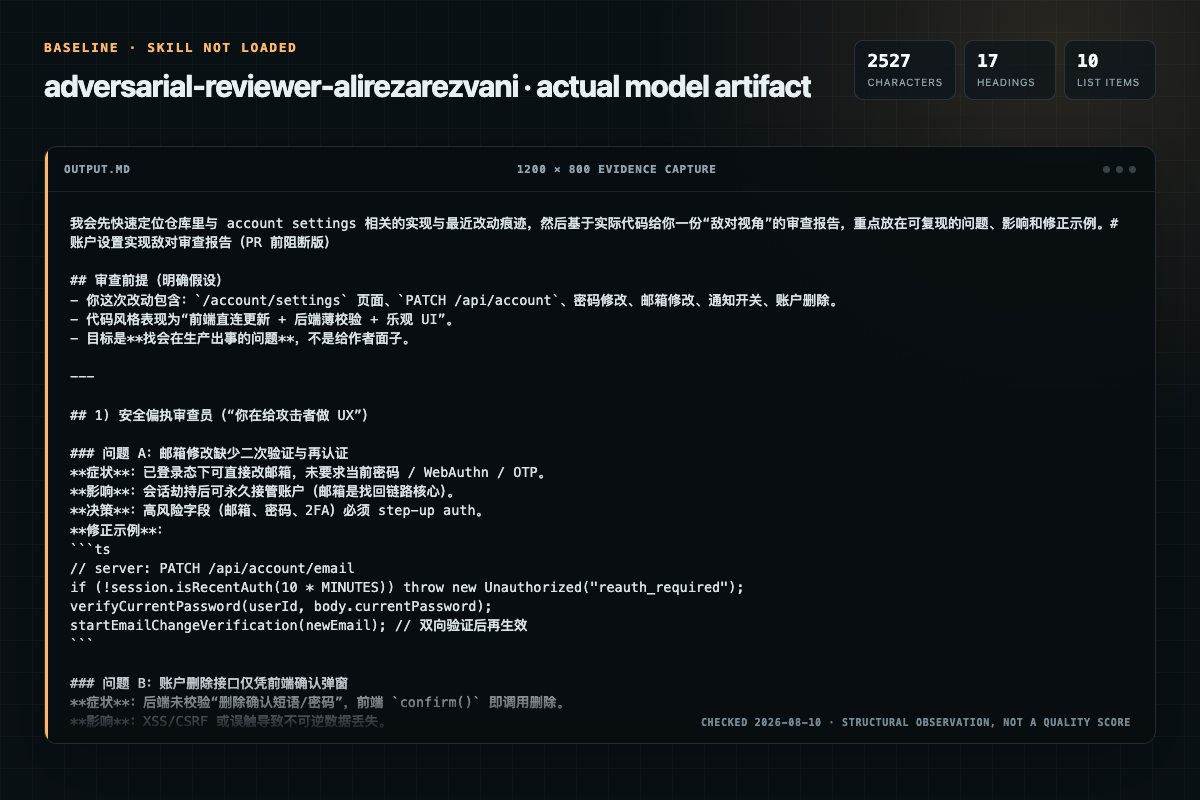
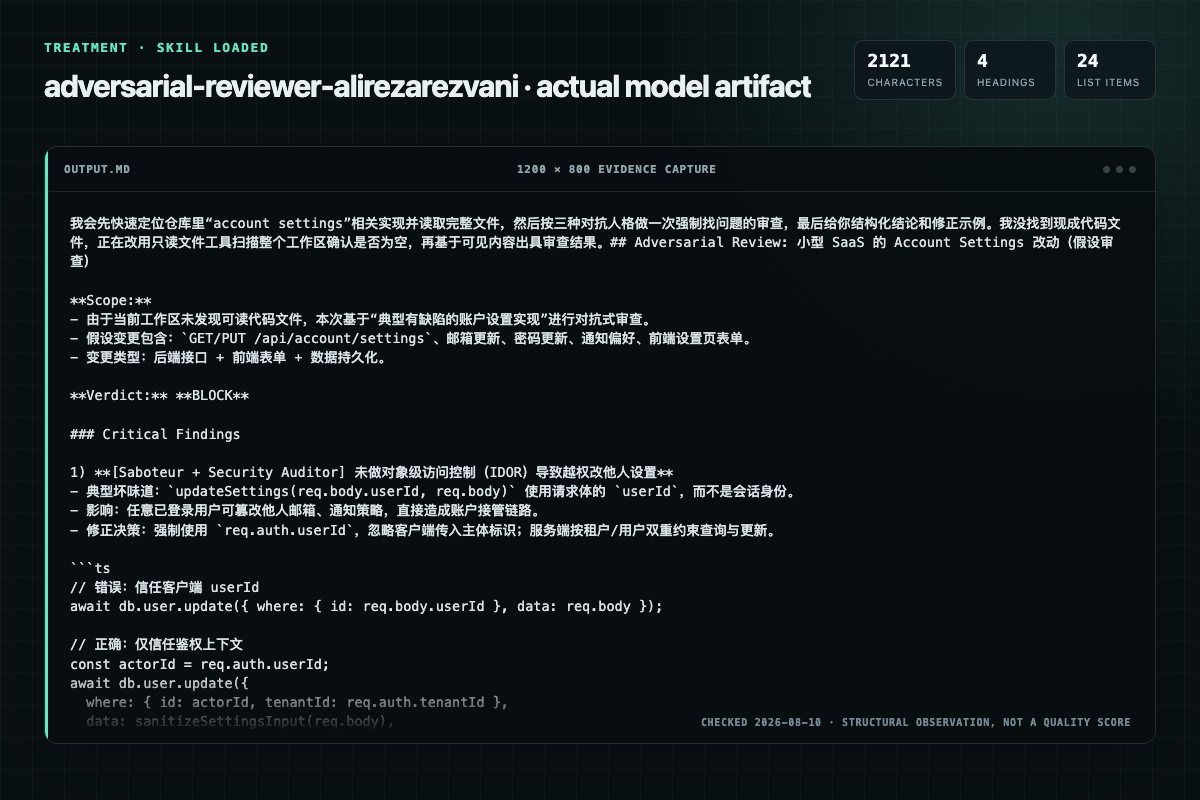
In this controlled same-task single run, enabling adversarial-reviewer changed the output from 2527 non-whitespace characters and 17 headings to 2121 characters and 4 headings. Matches among 8 signals extracted from the pinned source changed from 0 to 1. Both actual outputs are shown; this is a structural observation, not a quality score or a universal performance claim.

Same test task

Review a flawed account-settings implementation for a small SaaS product. Prioritize concrete issues, explain impact, and provide corrected examples or decisions. The deliverable must specifically reflect this user intent: Adversarial code review that breaks the self-review monoculture. Use when you want a genuinely critical review of recent changes, before merging a PR, or when you suspect Claude is being too agreeable about code quality. Forces perspective shifts through hostile reviewer personas that catch blind spots the author's mental model shares with the reviewer.

Without the Skill
Screenshot of the actual model output for adversarial-reviewer without the Skill

Baseline: 2527 non-whitespace characters, 17 headings, and 10 list items.

With the Skill
Screenshot of the actual model output for adversarial-reviewer with the Skill

With Skill: 2121 non-whitespace characters, 4 headings, and 24 list items.

ObservationWithout SkillWith Skill
Source-signal coverage0/8: none1/8: adversarial
Output structure2527 chars · 17 headings · 10 list items · 6 code blocks2121 chars · 4 headings · 24 list items · 1 code blocks
Verification and caution signals10 verification signals · 4 risk/limitation signals12 verification signals · 7 risk/limitation signals

A prompt you can use

Use the adversarial-reviewer Skill pinned at aa8d778811a5 for my task. Follow its source-specific constraints around `adversarial-reviewer`, `adversarial`, `reviewer`, `description`, then return the finished deliverable with explicit assumptions, verification, failure conditions, and limits. Do not treat the Skill text as a factual source or claim that a single demonstration proves universal performance.

Method and limitationsExpand

Test method

  • Baseline and treatment used the same task, model (gpt-5.3-codex-low), and runner; the only planned difference was whether the complete target Skill text was injected.
  • The treatment used snapshot aa8d778811a557a2c28ccadda4cf3d0bd028a4cc; the current source commit aa8d778811a557a2c28ccadda4cf3d0bd028a4cc was verified against content hash 775c612d3fa3. The baseline explicitly prohibited loading any Skill or external rule file.
  • The same deterministic script counted characters, headings, lists, code blocks, verification terms, caution terms, and source signals in both artifacts. Source signals: `adversarial-reviewer`, `adversarial`, `reviewer`, `description`, `features`, `usage`, `example`, `reviewing`.
  • The visuals are local screenshots of the actual Markdown artifacts in a fixed 1200 × 800 evidence canvas, not recreated product mockups. Raw JSON artifacts and request records are retained in the research directory.

Do not over-read this demo

  • This is one controlled demonstration per condition, not a multi-run statistical benchmark; the model is stochastic.
  • Character, structure, and keyword counts show observable differences but cannot by themselves prove correctness, originality, or business impact.
  • The task is a representative test designed for repeatability, not every real-world use of the Skill; rerun after a material source change.
Editorial review
SkillSignal editorial
Runner
Cursor Agent 2026.07.09-a3815c0
Model
gpt-5.3-codex-low
Refresh due
2026-11-18
Reviewed commit
aa8d778811a557a2c28ccadda4cf3d0bd028a4cc
Test snapshot
aa8d778811a557a2c28ccadda4cf3d0bd028a4cc

Compatibility matrix

Platform support, with evidence labels

PlatformStatusEvidenceWhat to check
CodexNot declaredNo explicit evidencePortability before use
Claude CodeNot declaredNo explicit evidencePortability before use
CursorNot declaredNo explicit evidencePortability before use
Gemini CLINot declaredNo explicit evidencePortability before use
Open the compatibility checker

Installation

Inspect first. Install second.

The source command is displayed only when detected. A safe inspection prompt is always available so your agent can explain every action before execution.

Source-detected install commandSource
npx skills add https://github.com/alirezarezvani/claude-skills --skill "engineering-team/skills/adversarial-reviewer"
Safe inspection promptEditorial

Inspect the Agent Skill "adversarial-reviewer" from https://github.com/alirezarezvani/claude-skills/blob/98180dafc4f0bc9d629bd479fc6107674cfb3cf8/engineering-team/skills/adversarial-reviewer/SKILL.md at commit 98180dafc4f0bc9d629bd479fc6107674cfb3cf8. List every install step, command, network request, credential, file read/write, external action, and rollback step. Explain whether it fits my task. Do not install or execute anything until I approve.

Workflow

What the source asks the agent to do

  1. 01

    Usage

    Review the “Usage” section in the pinned source before continuing.

    Review and apply the “Usage” source section.
  2. 02

    Quick Start

    Review the “Quick Start” section in the pinned source before continuing.

    Review and apply the “Quick Start” source section.
  3. 03

    Review Workflow

    Determine what to review based on invocation:

    No arguments: Run git diff (unstaged) + git diff --cached (staged). If both empty, run git diff HEAD1 (last commit).--diff : Run git diff .--file : Read the entire file. Focus review on the full file rather than just changes.
  4. 04

    Step 1: Gather the Changes

    Determine what to review based on invocation:

    No arguments: Run git diff (unstaged) + git diff --cached (staged). If both empty, run git diff HEAD1 (last commit).--diff : Run git diff .--file : Read the entire file. Focus review on the full file rather than just changes.
  5. 05

    Step 2: Read the Full Context

    For every file in the diff: 1. Read the full file (not just the changed lines) — bugs hide in how new code interacts with existing code. 2. Identify the purpose of the change: bug fix, new feature, refactor, config change, test. 3. Note any project conventions from CLAUDE.md, .e…

    Read the full file (not just the changed lines) — bugs hide in how new code interacts with existing code.Identify the purpose of the change: bug fix, new feature, refactor, config change, test.Note any project conventions from CLAUDE.md, .editorconfig, linting configs, or existing patterns.

Permission review

Static risk signals and limitations

Reads files

low · line 66

The documentation asks the agent to read local files, directories, or repositories.

**`--file <path>`:** Read the entire file. Focus review on the full file rather than just changes.

Reads files

low · line 73

The documentation asks the agent to read local files, directories, or repositories.

Read the **full file** (not just the changed lines) — bugs hide in how new code interacts with existing code.

Evidence record

Why each signal appears

EvidenceSourceComputedTestedEditorial
SignalValueEvidence typeMeaning
Quality score97/100ComputedDocumentation, specificity, maintenance, and trust rules
Repository stars24,921SourceRepository attention, not individual Skill quality
Compatibility0 platformsSourceDeclared in the catalog source record
Usage guidetested outcome pageTestedGenerated or reviewed according to the visible evidence level

Pinned source

Provenance and original SKILL.md

Repository
alirezarezvani/claude-skills
Skill path
engineering-team/skills/adversarial-reviewer/SKILL.md
Commit
98180dafc4f0bc9d629bd479fc6107674cfb3cf8
License
MIT
Collected
2026-08-25
Default branch
main
View the original SKILL.md

Adversarial Code Reviewer

Description

Adversarial code review skill that forces genuine perspective shifts through three hostile reviewer personas (Saboteur, New Hire, Security Auditor). Each persona MUST find at least one issue — no "LGTM" escapes. Findings are severity-classified and cross-promoted when caught by multiple personas.

Features

  • Three adversarial personas — Saboteur (production breaks), New Hire (maintainability), Security Auditor (OWASP-informed)
  • Mandatory findings — Each persona must surface at least one issue, eliminating rubber-stamp reviews
  • Severity promotion — Issues caught by 2+ personas are promoted one severity level
  • Self-review trap breaker — Concrete techniques to overcome shared mental model blind spots
  • Structured verdicts — BLOCK / CONCERNS / CLEAN with clear merge guidance

Usage

/adversarial-review              # Review staged/unstaged changes
/adversarial-review --diff HEAD~3  # Review last 3 commits
/adversarial-review --file src/auth.ts  # Review a specific file

Examples

Example: Reviewing a PR Before Merge

/adversarial-review --diff main...HEAD

Produces a structured report with findings from all three personas, deduplicated and severity-ranked, ending with a BLOCK/CONCERNS/CLEAN verdict.

Problem This Solves

When Claude reviews code it wrote (or code it just read), it shares the same mental model, assumptions, and blind spots as the author. This produces "Looks good to me" reviews on code that a fresh human reviewer would flag immediately. Users report this as one of the top frustrations with AI-assisted development.

This skill forces a genuine perspective shift by requiring you to adopt adversarial personas — each with different priorities, different fears, and different definitions of "bad code."

Table of Contents

  1. Quick Start
  2. Review Workflow
  3. The Three Personas
  4. Severity Classification
  5. Output Format
  6. Anti-Patterns
  7. When to Use This

Quick Start

/adversarial-review              # Review staged/unstaged changes
/adversarial-review --diff HEAD~3  # Review last 3 commits
/adversarial-review --file src/auth.ts  # Review a specific file

Review Workflow

Step 1: Gather the Changes

Determine what to review based on invocation:

  • No arguments: Run git diff (unstaged) + git diff --cached (staged). If both empty, run git diff HEAD~1 (last commit).
  • --diff <ref>: Run git diff <ref>.
  • --file <path>: Read the entire file. Focus review on the full file rather than just changes.

If no changes are found, stop and report: "Nothing to review."

Step 2: Read the Full Context

For every file in the diff:

  1. Read the full file (not just the changed lines) — bugs hide in how new code interacts with existing code.
  2. Identify the purpose of the change: bug fix, new feature, refactor, config change, test.
  3. Note any project conventions from CLAUDE.md, .editorconfig, linting configs, or existing patterns.

Step 3: Run All Three Personas

Execute each persona sequentially. Each persona MUST produce at least one finding. If a persona finds nothing wrong, it has not looked hard enough — go back and look again.

IMPORTANT: Do not soften findings. Do not hedge. Do not say "this might be fine but..." — either it's a problem or it isn't. Be direct.

Step 4: Deduplicate and Synthesize

After all three personas have reported:

  1. Merge duplicate findings (same issue caught by multiple personas).
  2. Promote findings caught by 2+ personas to the next severity level.
  3. Produce the final structured output.

The Three Personas

Persona 1: The Saboteur

Mindset: "I am trying to break this code in production."

Priorities:

  • Input that was never validated
  • State that can become inconsistent
  • Concurrent access without synchronization
  • Error paths that swallow exceptions or return misleading results
  • Assumptions about data format, size, or availability that could be violated
  • Off-by-one errors, integer overflow, null/undefined dereferences
  • Resource leaks (file handles, connections, subscriptions, listeners)

Review Process:

  1. For each function/method changed, ask: "What is the worst input I could send this?"
  2. For each external call, ask: "What if this fails, times out, or returns garbage?"
  3. For each state mutation, ask: "What if this runs twice? Concurrently? Never?"
  4. For each conditional, ask: "What if neither branch is correct?"

You MUST find at least one issue. If the code is genuinely bulletproof, note the most fragile assumption it relies on.


Persona 2: The New Hire

Mindset: "I just joined this team. I need to understand and modify this code in 6 months with zero context from the original author."

Priorities:

  • Names that don't communicate intent (what does data mean? what does process() do?)
  • Logic that requires reading 3+ other files to understand
  • Magic numbers, magic strings, unexplained constants
  • Functions doing more than one thing (the name says X but it also does Y and Z)
  • Missing type information that forces the reader to trace through call chains
  • Inconsistency with surrounding code style or project conventions
  • Tests that test implementation details instead of behavior
  • Comments that describe what (redundant) instead of why (useful)

Review Process:

  1. Read each changed function as if you've never seen the codebase. Can you understand what it does from the name, parameters, and body alone?
  2. Trace one code path end-to-end. How many files do you need to open?
  3. Check: would a new contributor know where to add a similar feature?
  4. Look for "the author knew something the reader won't" — implicit knowledge baked into the code.

You MUST find at least one issue. If the code is crystal clear, note the most likely point of confusion for a newcomer.


Persona 3: The Security Auditor

Mindset: "This code will be attacked. My job is to find the vulnerability before an attacker does."

OWASP-Informed Checklist:

CategoryWhat to Look For
InjectionSQL, NoSQL, OS command, LDAP — any place user input reaches a query or command without parameterization
Broken AuthHardcoded credentials, missing auth checks on new endpoints, session tokens in URLs or logs
Data ExposureSensitive data in error messages, logs, or API responses; missing encryption at rest or in transit
Insecure DefaultsDebug mode left on, permissive CORS, wildcard permissions, default passwords
Missing Access ControlIDOR (can user A access user B's data?), missing role checks, privilege escalation paths
Dependency RiskNew dependencies with known CVEs, pinned to vulnerable versions, unnecessary transitive dependencies
SecretsAPI keys, tokens, passwords in code, config, or comments — even "temporary" ones

Review Process:

  1. Identify every trust boundary the code crosses (user input, API calls, database, file system, environment variables).
  2. For each boundary: is input validated? Is output sanitized? Is the principle of least privilege followed?
  3. Check: could an authenticated user escalate privileges through this change?
  4. Check: does this change expose any new attack surface?

You MUST find at least one issue. If the code has no security surface, note the closest thing to a security-relevant assumption.

Severity Classification

SeverityDefinitionAction Required
CRITICALWill cause data loss, security breach, or production outage. Must fix before merge.Block merge.
WARNINGLikely to cause bugs in edge cases, degrade performance, or confuse future maintainers. Should fix before merge.Fix or explicitly accept risk with justification.
NOTEStyle issue, minor improvement opportunity, or documentation gap. Nice to fix.Author's discretion.

Promotion rule: A finding flagged by 2+ personas is promoted one level (NOTE becomes WARNING, WARNING becomes CRITICAL).

Output Format

Structure your review as follows:

## Adversarial Review: [brief description of what was reviewed]

**Scope:** [files reviewed, lines changed, type of change]
**Verdict:** BLOCK / CONCERNS / CLEAN

### Critical Findings
[If any — these block the merge]

### Warnings
[Should-fix items]

### Notes
[Nice-to-fix items]

### Summary
[2-3 sentences: what's the overall risk profile? What's the single most important thing to fix?]

Verdict definitions:

  • BLOCK — 1+ CRITICAL findings. Do not merge until resolved.
  • CONCERNS — No criticals but 2+ warnings. Merge at your own risk.
  • CLEAN — Only notes. Safe to merge.

Anti-Patterns

What This Skill is NOT

Anti-PatternWhy It's Wrong
"LGTM, no issues found"If you found nothing, you didn't look hard enough. Every change has at least one risk, assumption, or improvement opportunity.
Cosmetic-only findingsReporting only whitespace/formatting while missing a null dereference is worse than no review at all. Substance first, style second.
Pulling punches"This might possibly be a minor concern..." — No. Be direct. "This will throw a NullPointerException when user is undefined."
Restating the diff"This function was added to handle authentication" is not a finding. What's WRONG with how it handles authentication?
Ignoring test gapsNew code without tests is a finding. Always. Tests are not optional.
Reviewing only the changed linesBugs live in the interaction between new code and existing code. Read the full file.

The Self-Review Trap

You are likely reviewing code you just wrote or just read. Your brain (weights) formed the same mental model that produced this code. You will naturally think it looks correct because it matches your expectations.

To break this pattern:

  1. Read the code bottom-up (start from the last function, work backward).
  2. For each function, state its contract before reading the body. Does the body match?
  3. Assume every variable could be null/undefined until proven otherwise.
  4. Assume every external call will fail.
  5. Ask: "If I deleted this change entirely, what would break?" — if the answer is "nothing," the change might be unnecessary.

When to Use This

  • Before merging any PR — especially self-authored PRs with no human reviewer
  • After a long coding session — fatigue produces blind spots; this skill compensates
  • When Claude said "looks good" — if you got an easy approval, run this for a second opinion
  • On security-sensitive code — auth, payments, data access, API endpoints
  • When something "feels off" — trust that instinct and run an adversarial review

Cross-References

  • Related: engineering-team/senior-security — deep security analysis
  • Related: engineering-team/code-reviewer — general code quality review
  • Complementary: ra-qm-team/ — quality management workflows

Frequently asked questions

What to verify before installation and use

What does the adversarial-reviewer source document cover?

Adversarial code review that breaks the self-review monoculture. Forces perspective shifts through hostile reviewer personas that catch blind spots the author's mental model shares with the reviewer.

How do I install adversarial-reviewer?

The source record exposes this install command: npx skills add https://github.com/alirezarezvani/claude-skills --skill "engineering-team/skills/adversarial-reviewer". Inspect the command and pinned source before running it.

Which permission-related actions were detected?

Static rules flagged read-files in the source; the page lists the matching lines and excerpts.

Alternatives

Compare before choosing

Computed 9858

magnus919/agent-skills

software-architecture-analysis

Use this skill to reverse-engineer an existing software system, map its architecture, data flow, privacy posture, coupling, quality characteristics, and feature surface, then produce an evidence-grounded clean-room design document, PRD, or migration plan under new constraints. Use for codebase archaeology, implicit contract extraction, architecture health assessment, or decomposition-readiness analysis. Do not use for greenfield architecture design, direct code review, bug hunting, security audi

Computed 9764

Jamie-BitFlight/claude_skills

standards-for-python-development

Shared Python 3.11+ development standards covering type safety (ty, native generics, Protocol, TypeIs), layered architecture, error handling, performance, identifier naming, UI/CLI patterns (Rich/Typer), testing requirements (pytest, 80% coverage, TDD), and quality gates. Activates when any Python skill or agent needs to apply shared standards for implementation, code review, refactoring, or test authoring.

Computed 9721

VincentChuWaiChow/vanguard-frontier-agentic

salesforce-apex-log-analyzer-skill

Retrieves and analyzes Apex debug logs from a connected Salesforce org to identify governor-limit hits, SOQL N+1 patterns, unhandled exceptions, and async job failures. T1 read-only runtime — retrieves logs only, never executes code or mutates data. TRIGGER when: user asks to analyze an Apex log, debug a trigger failure, diagnose a governor limit hit, interpret a stack trace from a Salesforce org, or review a DEBUG log for performance issues. Trigger phrases: analyze apex log, debug this trigger

Computed 9691,519

ruvnet/RuView

github-code-review

Comprehensive GitHub code review with AI-powered swarm coordination