
Tested demoQuality 97/100
aAAaqwq/AGI-Super-Team/skills/api-design-patterns/SKILL.md
api-design-patterns
Comprehensive API design patterns covering REST, GraphQL, gRPC, versioning, authentication, and modern API best practices
- Source repository stars
- 89
- Declared platforms
- 1
- Static risk flags
- 1
- Last source update
- 2026-08-26
- Source checked
- 2026-08-28
Decision brief
What it does: where it fits
Design robust, scalable APIs using proven patterns for REST, GraphQL, and gRPC with proper versioning, authentication, and error handling.
Not for
- ❌ Over-fetching (REST): Returning entire objects when fields are unused ✅ Solution: Support field selection (?fields=id,name,email)
- ❌ Under-fetching (REST): Requiring multiple requests for related data ✅ Solution: Support expansion (?expand=orders,profile) or use GraphQL
Controlled single-run demoChecked 2026-08-20
What changed when the Skill was used
In this controlled same-task single run, enabling api-design-patterns changed the output from 2422 non-whitespace characters and 28 headings to 2838 characters and 19 headings. Matches among 8 signals extracted from the pinned source changed from 0 to 0. Both actual outputs are shown; this is a structural observation, not a quality score or a universal performance claim.
Same test task
Create a design direction and implementation handoff for a developer tool that compares two API responses. Prioritize the repeated user workflow and responsive behavior. The deliverable must specifically reflect this user intent: Comprehensive API design patterns covering REST, GraphQL, gRPC, versioning, authentication, and modern API best practices
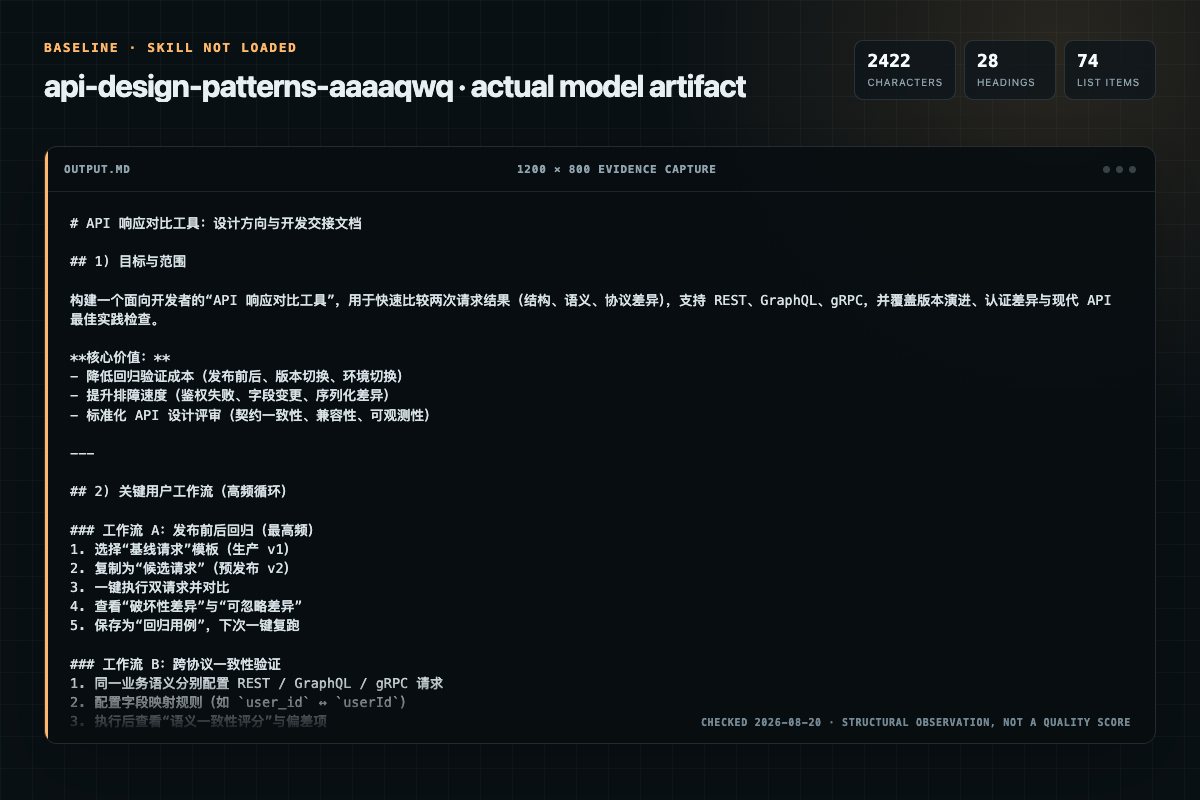
Baseline: 2422 non-whitespace characters, 28 headings, and 74 list items.
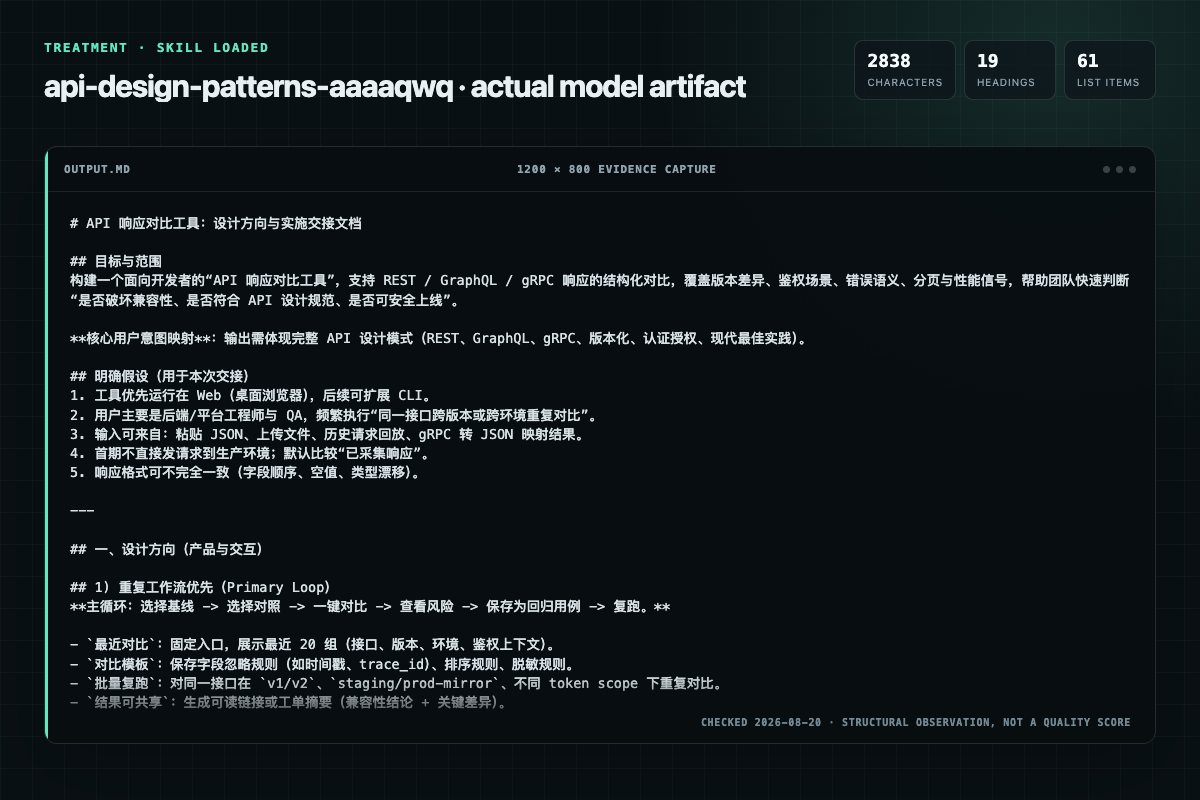
With Skill: 2838 non-whitespace characters, 19 headings, and 61 list items.
| Observation | Without Skill | With Skill |
|---|---|---|
| Source-signal coverage | 0/8: none | 0/8: none |
| Output structure | 2422 chars · 28 headings · 74 list items · 0 code blocks | 2838 chars · 19 headings · 61 list items · 0 code blocks |
| Verification and caution signals | 13 verification signals · 6 risk/limitation signals | 8 verification signals · 13 risk/limitation signals |
A prompt you can use
Use the api-design-patterns Skill pinned at 3a4f3b9309c9 for my task. Follow its source-specific constraints around `api-design-patterns`, `design`, `patterns`, `quick`, then return the finished deliverable with explicit assumptions, verification, failure conditions, and limits. Do not treat the Skill text as a factual source or claim that a single demonstration proves universal performance.
Method and limitationsExpandCollapse
Test method
- Baseline and treatment used the same task, model (gpt-5.3-codex-low), and runner; the only planned difference was whether the complete target Skill text was injected.
- The treatment used snapshot dd50638ed6cb401697840f08199ba577d757969f; the current source commit 3a4f3b9309c9b7e1525088c2d4cca243bc241daf was verified against content hash 174b52ed0381. The baseline explicitly prohibited loading any Skill or external rule file.
- The same deterministic script counted characters, headings, lists, code blocks, verification terms, caution terms, and source signals in both artifacts. Source signals: `api-design-patterns`, `design`, `patterns`, `quick`, `reference`, `principles`, `universal`, `standards`.
- The visuals are local screenshots of the actual Markdown artifacts in a fixed 1200 × 800 evidence canvas, not recreated product mockups. Raw JSON artifacts and request records are retained in the research directory.
Do not over-read this demo
- This is one controlled demonstration per condition, not a multi-run statistical benchmark; the model is stochastic.
- Character, structure, and keyword counts show observable differences but cannot by themselves prove correctness, originality, or business impact.
- The task is a representative test designed for repeatability, not every real-world use of the Skill; rerun after a material source change.
- Editorial review
- SkillSignal editorial
- Runner
- Cursor Agent 2026.08.04-aaa8809
- Model
- gpt-5.3-codex-low
- Refresh due
- 2026-11-18
- Reviewed commit
- 3a4f3b9309c9b7e1525088c2d4cca243bc241daf
- Test snapshot
- dd50638ed6cb401697840f08199ba577d757969f
Compatibility matrix
Platform support, with evidence labels
| Platform | Status | Evidence | What to check |
|---|---|---|---|
| Codex | Not declared | No explicit evidence | Portability before use |
| Claude Code | Declared | Source record | Install path and trigger |
| Cursor | Not declared | No explicit evidence | Portability before use |
| Gemini CLI | Not declared | No explicit evidence | Portability before use |
Installation
Inspect first. Install second.
The source command is displayed only when detected. A safe inspection prompt is always available so your agent can explain every action before execution.
Source-detected install commandSource
npx skills add https://github.com/aAAaqwq/AGI-Super-Team --skill "skills/api-design-patterns"Safe inspection promptEditorial
Inspect the Agent Skill "api-design-patterns" from https://github.com/aAAaqwq/AGI-Super-Team/blob/bfcfb64081f94e5869ff420aaaed63b6da716bc6/skills/api-design-patterns/SKILL.md at commit bfcfb64081f94e5869ff420aaaed63b6da716bc6. List every install step, command, network request, credential, file read/write, external action, and rollback step. Explain whether it fits my task. Do not install or execute anything until I approve.
Workflow
What the source asks the agent to do
- 01
Version Deprecation Process
Include deprecation warnings:
Include deprecation warnings:See references/versioning-strategies.md for detailed migration patterns - 02
Signature Verification
Review the “Signature Verification” section in the pinned source before continuing.
Review and apply the “Signature Verification” source section. - 03
Quick Reference
API Style Selection: - REST: Resource-based CRUD, simple clients, HTTP-native caching - GraphQL: Client-driven queries, complex data graphs, real-time subscriptions - gRPC: High-performance RPC, microservices, strong typing, streaming
REST: Resource-based CRUD, simple clients, HTTP-native cachingGraphQL: Client-driven queries, complex data graphs, real-time subscriptionsgRPC: High-performance RPC, microservices, strong typing, streaming - 04
Core Principles
Apply these principles across all API styles:
Follow established conventions for your API styleUse predictable naming patterns (snakecase or camelCase, pick one)Maintain consistent error response formats - 05
Universal API Design Standards
Apply these principles across all API styles:
Follow established conventions for your API styleUse predictable naming patterns (snakecase or camelCase, pick one)Maintain consistent error response formats
Permission review
Static risk signals and limitations
Network access
The documentation includes network, browsing, or remote request actions.
"documentation_url": "https://api.example.com/docs/errors/validation"Network access
The documentation includes network, browsing, or remote request actions.
"migration_guide": "https://docs.api.com/v1-to-v2",Evidence record
Why each signal appears
EvidenceSourceComputedTestedEditorial
| Signal | Value | Evidence type | Meaning |
|---|---|---|---|
| Quality score | 97/100 | Computed | Documentation, specificity, maintenance, and trust rules |
| Repository stars | 89 | Source | Repository attention, not individual Skill quality |
| Compatibility | 1 platforms | Source | Declared in the catalog source record |
| Usage guide | tested outcome page | Tested | Generated or reviewed according to the visible evidence level |
Pinned source
Provenance and original SKILL.md
- Repository
- aAAaqwq/AGI-Super-Team
- Skill path
- skills/api-design-patterns/SKILL.md
- Commit
- bfcfb64081f94e5869ff420aaaed63b6da716bc6
- License
- MIT
- Collected
- 2026-08-28
- Default branch
- main
View the original SKILL.md
API Design Patterns
Design robust, scalable APIs using proven patterns for REST, GraphQL, and gRPC with proper versioning, authentication, and error handling.
Quick Reference
API Style Selection:
- REST: Resource-based CRUD, simple clients, HTTP-native caching
- GraphQL: Client-driven queries, complex data graphs, real-time subscriptions
- gRPC: High-performance RPC, microservices, strong typing, streaming
Critical Patterns:
- Versioning: URI (
/v1/users), header (Accept: application/vnd.api+json;version=1), content negotiation - Pagination: Offset (simple), cursor (stable), keyset (performant)
- Auth: OAuth2 (delegated), JWT (stateless), API keys (service-to-service)
- Rate limiting: Token bucket, fixed window, sliding window
- Idempotency: Idempotency keys, conditional requests, safe retry
See references/ for deep dives: rest-patterns.md, graphql-patterns.md, grpc-patterns.md, versioning-strategies.md, authentication.md
Core Principles
Universal API Design Standards
Apply these principles across all API styles:
1. Consistency Over Cleverness
- Follow established conventions for your API style
- Use predictable naming patterns (snake_case or camelCase, pick one)
- Maintain consistent error response formats
- Version breaking changes, never surprise clients
2. Design for Evolution
- Plan for versioning from day one
- Use optional fields with sensible defaults
- Deprecate gracefully with sunset dates
- Document breaking vs non-breaking changes
3. Security by Default
- Require authentication unless explicitly public
- Use HTTPS/TLS for all production endpoints
- Implement rate limiting and throttling
- Validate and sanitize all inputs
- Return minimal error details to clients
4. Developer Experience First
- Provide comprehensive documentation (OpenAPI, GraphQL schema)
- Return meaningful error messages with actionable guidance
- Use standard HTTP status codes correctly
- Include request IDs for debugging
- Offer SDKs and code generators
API Style Decision Tree
When to Choose REST
✅ Use REST when:
- Building CRUD-focused resource APIs
- Clients need HTTP caching (ETags, Cache-Control)
- Wide platform compatibility required (browsers, mobile, IoT)
- Simple, stateless client-server model fits
- Team familiar with HTTP/REST conventions
❌ Avoid REST when:
- Complex data fetching with nested relationships (N+1 queries)
- Real-time updates are primary use case
- Need strong typing and code generation
- High-performance RPC between microservices
Example Use Cases: Public APIs, mobile backends, traditional web services
When to Choose GraphQL
✅ Use GraphQL when:
- Clients need flexible, client-driven queries
- Complex data graphs with nested relationships
- Multiple client types with different data needs
- Real-time subscriptions required
- Strong typing and schema validation needed
❌ Avoid GraphQL when:
- Simple CRUD operations dominate
- HTTP caching is critical (GraphQL uses POST)
- File uploads are primary feature (requires extensions)
- Team lacks GraphQL expertise
- Performance optimization is complex (N+1 problem)
Example Use Cases: Client-facing APIs, dashboards, mobile apps with varied UIs
When to Choose gRPC
✅ Use gRPC when:
- Microservice-to-microservice communication
- High performance and low latency critical
- Bidirectional streaming needed
- Strong typing with Protocol Buffers
- Polyglot environments (language interop)
❌ Avoid gRPC when:
- Browser clients (limited support, needs grpc-web)
- HTTP/JSON required for compatibility
- Human-readable payloads preferred
- Simple request/response patterns
Example Use Cases: Internal microservices, streaming data, service mesh
REST API Patterns
Resource Naming
✅ Good: Plural nouns, hierarchical
GET    /users              # List users
GET    /users/123          # Get user
POST   /users              # Create user
PUT    /users/123          # Update user (full)
PATCH  /users/123          # Update user (partial)
DELETE /users/123          # Delete user
GET    /users/123/orders   # User's orders (sub-resource)
❌ Bad: Verbs, mixed conventions
GET    /getUsers           # Don't use verbs
POST   /user/create        # Don't use verbs
GET    /Users/123          # Don't capitalize
GET    /user/123           # Don't mix singular/plural
HTTP Status Codes
Success Codes:
200 OK: Successful GET, PUT, PATCH, DELETE with body201 Created: Successful POST, return Location header202 Accepted: Async operation started204 No Content: Successful DELETE, no body
Client Error Codes:
400 Bad Request: Invalid input, validation error401 Unauthorized: Missing or invalid authentication403 Forbidden: Authenticated but insufficient permissions404 Not Found: Resource doesn't exist409 Conflict: State conflict (duplicate, version mismatch)422 Unprocessable Entity: Semantic validation error429 Too Many Requests: Rate limit exceeded
Server Error Codes:
500 Internal Server Error: Unexpected error502 Bad Gateway: Upstream service error503 Service Unavailable: Temporary outage504 Gateway Timeout: Upstream timeout
Error Response Format
✅ Consistent error structure
{
  "error": {
    "code": "VALIDATION_ERROR",
    "message": "Invalid request parameters",
    "details": [
      {
        "field": "email",
        "message": "Invalid email format",
        "code": "INVALID_FORMAT"
      }
    ],
    "request_id": "req_abc123",
    "documentation_url": "https://api.example.com/docs/errors/validation"
  }
}
Pagination Patterns
Offset Pagination (simple, familiar):
GET /users?limit=20&offset=40
✅ Use for: Small datasets, admin interfaces ❌ Avoid for: Large datasets (skips become expensive), real-time data
Cursor Pagination (stable, efficient):
GET /users?limit=20&cursor=eyJpZCI6MTIzfQ
Response: { "data": [...], "next_cursor": "eyJpZCI6MTQzfQ" }
✅ Use for: Infinite scroll, real-time feeds, large datasets ❌ Avoid for: Random access, page numbers
Keyset Pagination (performant):
GET /users?limit=20&after_id=123
✅ Use for: Ordered data, database index friendly ❌ Avoid for: Complex sorting, multiple sort keys
See references/rest-patterns.md for filtering, sorting, field selection, HATEOAS
GraphQL Patterns
Schema Design
✅ Good: Clear types, nullable by default
type User {
  id: ID!                    # Non-null ID
  email: String!             # Required field
  name: String               # Optional (nullable by default)
  createdAt: DateTime!
  orders: [Order!]!          # Non-null array of non-null orders
}

type Query {
  user(id: ID!): User
  users(first: Int, after: String): UserConnection!
}

type Mutation {
  createUser(input: CreateUserInput!): CreateUserPayload!
}

input CreateUserInput {
  email: String!
  name: String
}

type CreateUserPayload {
  user: User
  userEdge: UserEdge
  errors: [UserError!]
}
Resolver Patterns
Avoid N+1 Queries with DataLoader:
import DataLoader from 'dataloader';

const userLoader = new DataLoader(async (userIds: string[]) => {
  const users = await db.users.findMany({ where: { id: { in: userIds } } });
  return userIds.map(id => users.find(u => u.id === id));
});

// Resolver batches queries automatically
const resolvers = {
  Order: {
    user: (order) => userLoader.load(order.userId)
  }
};
Query Complexity Analysis
Prevent expensive queries:
import { createComplexityLimitRule } from 'graphql-validation-complexity';

const server = new ApolloServer({
  schema,
  validationRules: [
    createComplexityLimitRule(1000, {
      onCost: (cost) => console.log('Query cost:', cost),
    }),
  ],
});
See references/graphql-patterns.md for subscriptions, relay cursor connections, error handling
gRPC Patterns
Service Definition
syntax = "proto3";

package users.v1;

service UserService {
  rpc GetUser (GetUserRequest) returns (User) {}
  rpc ListUsers (ListUsersRequest) returns (ListUsersResponse) {}
  rpc CreateUser (CreateUserRequest) returns (User) {}
  rpc StreamUsers (StreamUsersRequest) returns (stream User) {}
  rpc BidiChat (stream ChatMessage) returns (stream ChatMessage) {}
}

message User {
  string id = 1;
  string email = 2;
  string name = 3;
  google.protobuf.Timestamp created_at = 4;
}

message GetUserRequest {
  string id = 1;
}

message ListUsersRequest {
  int32 page_size = 1;
  string page_token = 2;
}

message ListUsersResponse {
  repeated User users = 1;
  string next_page_token = 2;
}
Error Handling
import (
    "google.golang.org/grpc/codes"
    "google.golang.org/grpc/status"
)

func (s *server) GetUser(ctx context.Context, req *pb.GetUserRequest) (*pb.User, error) {
    if req.Id == "" {
        return nil, status.Error(codes.InvalidArgument, "user ID is required")
    }

    user, err := s.db.GetUser(ctx, req.Id)
    if err != nil {
        if errors.Is(err, sql.ErrNoRows) {
            return nil, status.Error(codes.NotFound, "user not found")
        }
        return nil, status.Error(codes.Internal, "database error")
    }

    return user, nil
}
See references/grpc-patterns.md for streaming, interceptors, metadata, health checks
Versioning Strategies
URI Versioning (Simple, Explicit)
✅ Most common, easy to understand
GET /v1/users/123
GET /v2/users/123
Pros: Clear, easy to route, browser-friendly Cons: Couples version to URL, duplicates routes
Header Versioning (Clean URLs)
GET /users/123
Accept: application/vnd.myapi.v2+json
Pros: Clean URLs, version separate from resource Cons: Less visible, harder to test manually
Content Negotiation (Granular)
GET /users/123
Accept: application/vnd.myapi.user.v2+json
Pros: Resource-level versioning, backward compatible Cons: Complex, harder to implement
Version Deprecation Process
{
  "version": "1.0",
  "deprecated": true,
  "sunset_date": "2025-12-31",
  "migration_guide": "https://docs.api.com/v1-to-v2",
  "replacement_version": "2.0"
}
Include deprecation warnings:
HTTP/1.1 200 OK
Deprecation: true
Sunset: Sat, 31 Dec 2025 23:59:59 GMT
Link: <https://docs.api.com/v1-to-v2>; rel="deprecation"
See references/versioning-strategies.md for detailed migration patterns
Authentication & Authorization
OAuth 2.0 (Delegated Access)
Use for: Third-party access, user consent, token refresh
Authorization Code Flow (most secure for web/mobile):
1. Client redirects to /authorize
2. User authenticates, grants permissions
3. Auth server redirects to callback with code
4. Client exchanges code for access token
5. Client uses access token for API requests
# Request token
POST /oauth/token
Content-Type: application/x-www-form-urlencoded

grant_type=authorization_code
&code=AUTH_CODE
&redirect_uri=https://client.com/callback
&client_id=CLIENT_ID
&client_secret=CLIENT_SECRET

# Response
{
  "access_token": "eyJhbGc...",
  "token_type": "Bearer",
  "expires_in": 3600,
  "refresh_token": "tGzv3JOkF0XG5Qx2TlKWIA",
  "scope": "read write"
}

# Use token
GET /v1/users/me
Authorization: Bearer eyJhbGc...
JWT (Stateless Auth)
Use for: Microservices, stateless API auth, short-lived tokens
✅ Good: Minimal claims, short expiry
{
  "sub": "user_123",
  "iat": 1516239022,
  "exp": 1516242622,
  "scope": "read:users write:orders"
}
Validation:
import jwt from 'jsonwebtoken';

const token = req.headers.authorization?.split(' ')[1];
const payload = jwt.verify(token, process.env.JWT_SECRET);
req.userId = payload.sub;
API Keys (Service-to-Service)
Use for: Server-to-server, CLI tools, webhooks
GET /v1/users
X-API-Key: sk_live_abc123...

# Or query parameter (less secure)
GET /v1/users?api_key=sk_live_abc123
Key Practices:
- Prefix keys with environment (
sk_live_,sk_test_) - Hash keys before storage (bcrypt, scrypt)
- Allow key rotation without downtime
- Support multiple keys per user
- Rate limit per key
See references/authentication.md for API key rotation, scopes, RBAC
Rate Limiting
Token Bucket (Burst-Friendly)
Bucket: 100 tokens, refill 10/second
Request costs 1 token
Allows bursts up to bucket size
Headers:
HTTP/1.1 200 OK
X-RateLimit-Limit: 100
X-RateLimit-Remaining: 73
X-RateLimit-Reset: 1640995200
429 Response:
HTTP/1.1 429 Too Many Requests
Retry-After: 60
X-RateLimit-Limit: 100
X-RateLimit-Remaining: 0
X-RateLimit-Reset: 1640995200

{
  "error": {
    "code": "RATE_LIMIT_EXCEEDED",
    "message": "Rate limit exceeded. Try again in 60 seconds.",
    "limit": 100,
    "reset_at": "2025-01-01T00:00:00Z"
  }
}
Sliding Window (Fair Distribution)
Counts requests in rolling time window. More accurate than fixed window.
Per-User vs Per-IP
- Per-User: Authenticated requests, fair quotas
- Per-IP: Unauthenticated requests, prevent abuse
- Combined: Both limits, take stricter
Idempotency
Idempotent Methods (HTTP Spec)
Naturally Idempotent: GET, PUT, DELETE, HEAD, OPTIONS Not Idempotent: POST, PATCH
Idempotency Keys
Make POST requests idempotent:
POST /v1/payments
Idempotency-Key: uuid-or-client-generated-key
Content-Type: application/json

{
  "amount": 1000,
  "currency": "USD",
  "customer": "cust_123"
}
Server behavior:
- First request: Process and store result with key
- Duplicate request (same key): Return stored result (200 or 201)
- Different request (same key): Return 409 Conflict
Implementation:
const idempotencyKey = req.headers['idempotency-key'];
if (idempotencyKey) {
  const cached = await redis.get(`idempotency:${idempotencyKey}`);
  if (cached) {
    return res.status(cached.status).json(cached.body);
  }
}

const result = await processPayment(req.body);
await redis.setex(`idempotency:${idempotencyKey}`, 86400, {
  status: 201,
  body: result
});
Conditional Requests
Use ETags for safe updates:
# Get resource with ETag
GET /v1/users/123
Response: ETag: "abc123"

# Update only if unchanged
PUT /v1/users/123
If-Match: "abc123"

# 412 Precondition Failed if ETag changed
Caching Strategies
HTTP Caching Headers
# Public, cacheable for 1 hour
Cache-Control: public, max-age=3600

# Private (user-specific), revalidate
Cache-Control: private, must-revalidate, max-age=0

# No caching
Cache-Control: no-store, no-cache, must-revalidate
ETag Validation
# Server returns ETag
GET /v1/users/123
Response:
  ETag: "33a64df551425fcc55e4d42a148795d9f25f89d4"
  Cache-Control: max-age=3600

# Client conditional request
GET /v1/users/123
If-None-Match: "33a64df551425fcc55e4d42a148795d9f25f89d4"

# 304 Not Modified if unchanged (saves bandwidth)
HTTP/1.1 304 Not Modified
Last-Modified
GET /v1/users/123
Response:
  Last-Modified: Wed, 21 Oct 2025 07:28:00 GMT

# Conditional request
GET /v1/users/123
If-Modified-Since: Wed, 21 Oct 2025 07:28:00 GMT

# 304 Not Modified if not modified
Webhooks
Event Delivery
POST https://client.com/webhooks/payments
Content-Type: application/json
X-Webhook-Signature: sha256=abc123...
X-Webhook-Id: evt_abc123
X-Webhook-Timestamp: 1640995200

{
  "id": "evt_abc123",
  "type": "payment.succeeded",
  "created": 1640995200,
  "data": {
    "object": {
      "id": "pay_123",
      "amount": 1000,
      "status": "succeeded"
    }
  }
}
Signature Verification
import crypto from 'crypto';

function verifyWebhookSignature(
  payload: string,
  signature: string,
  secret: string
): boolean {
  const expectedSignature = crypto
    .createHmac('sha256', secret)
    .update(payload)
    .digest('hex');
  return crypto.timingSafeEqual(
    Buffer.from(signature),
    Buffer.from(`sha256=${expectedSignature}`)
  );
}
Retry Strategy
- Exponential backoff: 1s, 2s, 4s, 8s, 16s, 32s, 64s
- Timeout: 5-30 seconds per attempt
- Max attempts: 3-7 attempts
- Dead letter queue: Store failed events
- Manual retry: UI for re-sending failed events
API Documentation
OpenAPI/Swagger (REST)
openapi: 3.0.0
info:
  title: User API
  version: 1.0.0
paths:
  /users/{id}:
    get:
      summary: Get user by ID
      parameters:
        - name: id
          in: path
          required: true
          schema:
            type: string
      responses:
        '200':
          description: Successful response
          content:
            application/json:
              schema:
                $ref: '#/components/schemas/User'
        '404':
          description: User not found
components:
  schemas:
    User:
      type: object
      required: [id, email]
      properties:
        id:
          type: string
        email:
          type: string
          format: email
        name:
          type: string
GraphQL Schema (Self-Documenting)
GraphQL introspection provides automatic documentation. Use descriptions:
"""
Represents a user account in the system.
Created via the createUser mutation.
"""
type User {
  """Unique identifier for the user"""
  id: ID!

  """Email address, must be unique"""
  email: String!

  """Optional display name"""
  name: String
}
API Documentation Best Practices
- Interactive examples: Provide working code samples
- Authentication guide: Step-by-step auth setup
- Error catalog: Document all error codes with examples
- Rate limits: Clearly state limits and headers
- Changelog: Track breaking and non-breaking changes
- Migration guides: Version upgrade instructions
- SDKs: Provide client libraries for popular languages
Anti-Patterns
❌ Over-fetching (REST): Returning entire objects when fields are unused
✅ Solution: Support field selection (?fields=id,name,email)
❌ Under-fetching (REST): Requiring multiple requests for related data
✅ Solution: Support expansion (?expand=orders,profile) or use GraphQL
❌ Chatty APIs: Too many round-trips for common operations ✅ Solution: Batch endpoints, compound documents, or GraphQL
❌ Ignoring HTTP semantics: Using GET for mutations, wrong status codes ✅ Solution: Follow HTTP spec, use correct methods and status codes
❌ Exposing internal structure: URLs/schemas mirror database ✅ Solution: Design resource-oriented APIs independent of storage
❌ Missing versioning: Breaking changes without version increments ✅ Solution: Version from day one, never break existing versions
❌ Poor error messages: Generic "An error occurred" ✅ Solution: Specific, actionable error messages with codes
❌ No rate limiting: APIs vulnerable to abuse ✅ Solution: Implement rate limiting from the start
Testing Strategies
Contract Testing
// Pact contract test
import { PactV3 } from '@pact-foundation/pact';

const provider = new PactV3({
  consumer: 'FrontendApp',
  provider: 'UserAPI'
});

it('gets a user by ID', () => {
  provider
    .given('user 123 exists')
    .uponReceiving('a request for user 123')
    .withRequest({
      method: 'GET',
      path: '/users/123'
    })
    .willRespondWith({
      status: 200,
      body: { id: '123', email: '[email protected]' }
    });
});
Load Testing
// k6 load test
import http from 'k6/http';
import { check } from 'k6';

export const options = {
  stages: [
    { duration: '30s', target: 20 },
    { duration: '1m', target: 20 },
    { duration: '10s', target: 0 }
  ],
  thresholds: {
    http_req_duration: ['p(95)<500'], // 95% under 500ms
    http_req_failed: ['rate<0.01']    // <1% errors
  }
};

export default function () {
  const res = http.get('https://api.example.com/users');
  check(res, {
    'status is 200': (r) => r.status === 200,
    'response time < 500ms': (r) => r.timings.duration < 500
  });
}
Related Skills
- graphql: Deep GraphQL schema design, resolvers, Apollo Server
- typescript: Type-safe API clients and servers
- nodejs-backend: Express/Fastify REST API implementation
- django: Django REST Framework patterns
- fastapi: FastAPI Python REST/GraphQL APIs
- flask: Flask-RESTful patterns
References
- rest-patterns.md: Deep REST coverage (HATEOAS, filtering, field selection)
- graphql-patterns.md: GraphQL subscriptions, relay cursor connections, federation
- grpc-patterns.md: Streaming patterns, interceptors, service mesh integration
- versioning-strategies.md: Detailed versioning approaches and migration patterns
- authentication.md: OAuth flows, JWT best practices, API key rotation, RBAC
Additional Resources
- REST API Design Rulebook - O'Reilly REST guide
- GraphQL Best Practices - Official GraphQL guide
- gRPC Best Practices - Official gRPC guide
- RFC 7807: Problem Details for HTTP APIs - Standard error format
- OpenAPI Specification - REST documentation standard
Frequently asked questions
What to verify before installation and use
What does the api-design-patterns source document cover?
Design robust, scalable APIs using proven patterns for REST, GraphQL, and gRPC with proper versioning, authentication, and error handling.
How do I install api-design-patterns?
The source record exposes this install command: npx skills add https://github.com/aAAaqwq/AGI-Super-Team --skill "skills/api-design-patterns". Inspect the command and pinned source before running it.
Which Agent platforms does the source record declare?
The pinned source record declares support for: claude code.
Which permission-related actions were detected?
Static rules flagged network in the source; the page lists the matching lines and excerpts.
Alternatives
Compare before choosing
Computed 100147
oaustegard/claude-skills
featuring
Generate hierarchical _FEATURES.md files that describe what a codebase DOES from a user/consumer perspective, anchored to source symbols via tree-sitting. Supports large complex codebases through feature-driven decomposition into sub-feature files. Uses a multi-pass synthesis: orientation → detail → overview rewrite. Use when someone says "what does this do", "document features", "feature inventory", "_FEATURES.md", or needs to understand a codebase's purpose before modifying it. Complements tre
Computed 1008
narrative-io/narrative-skills-marketplace
design-analysis
Translate a fuzzy analytical question into a rigorous investigation plan. Interrogates the ask, grounds the plan in the available data dictionary, applies analytical best practices, and produces a structured brief of query specifications for a downstream query-writing skill. Plans, does not write SQL. Use when: "why did X drop", "is there a relationship between A and B", "who are our highest-value customers", "what's driving the change in Y", "investigate this trend", "design an analysis for", "
Computed 9982
vasilyu1983/AI-Agents-public
qa-testing-ios
Guides iOS testing with XCTest, XCUITest, Swift Testing, simctl, and xcresult. Use when choosing destinations, controlling flakes, or parsing test artifacts for native apps.
Computed 9967
brucesongs/kali-claw
insecure-design
Insecure Design (OWASP A06:2025) focuses on security flaws in system architecture and design phases, rather than code implementation-level bugs.