
Best for
- Auditing cryptographic implementations (primitives, protocols)
- Code handles secret keys, passwords, or sensitive cryptographic material
- Implementing crypto algorithms from scratch
trailofbits/skills/plugins/testing-handbook-skills/skills/constant-time-testing/SKILL.md
Constant-time testing detects timing side channels in cryptographic code. Use when auditing crypto implementations for timing vulnerabilities.
Decision brief
Timing attacks exploit variations in execution time to extract secret information from cryptographic implementations. Unlike cryptanalysis that targets theoretical weaknesses, timing attacks leverage implementation flaws - and they can affect any cryptographic code.
In this controlled same-task single run, enabling constant-time-testing changed the output from 2067 non-whitespace characters and 11 headings to 2447 characters and 9 headings. Matches among 8 signals extracted from the pinned source changed from 1 to 0. Both actual outputs are shown; this is a structural observation, not a quality score or a universal performance claim.
Create a test strategy and representative test cases for a JSON API schema comparison feature. Include failure cases and a clear verification procedure. The deliverable must specifically reflect this user intent: Constant-time testing detects timing side channels in cryptographic code. Use when auditing crypto implementations for timing vulnerabilities.
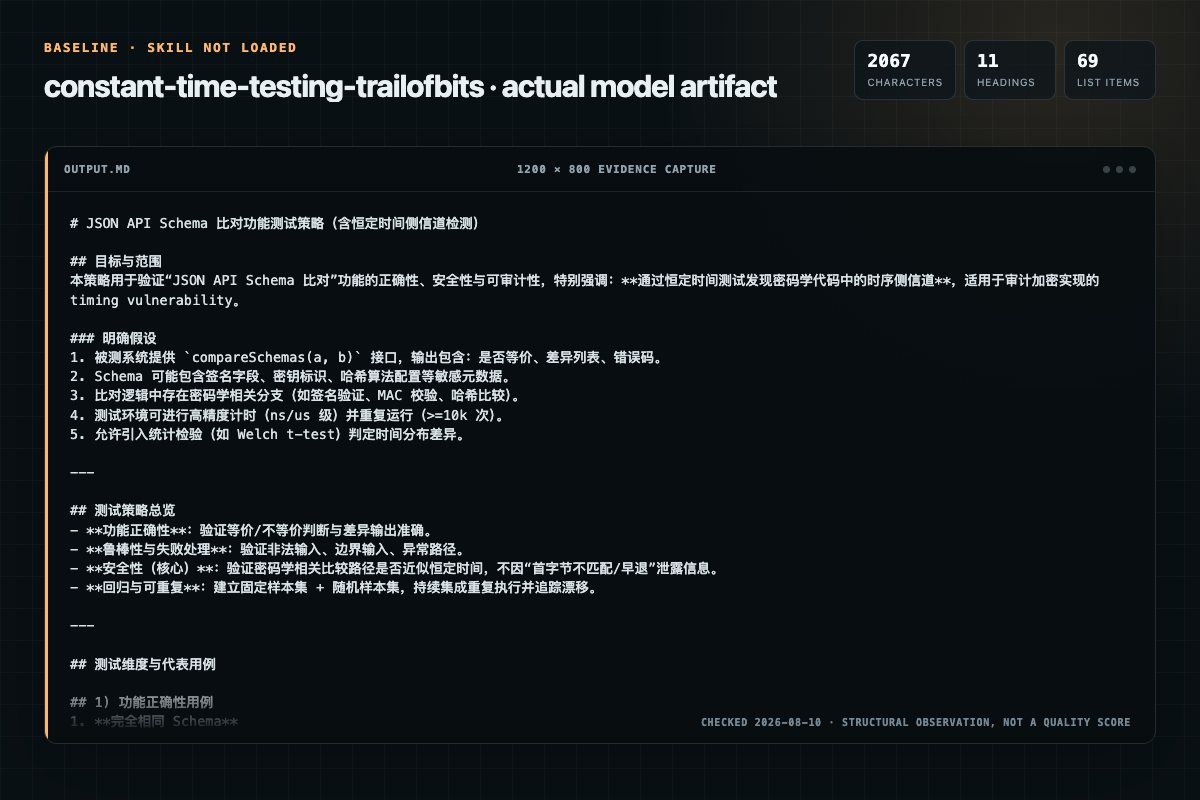
Baseline: 2067 non-whitespace characters, 11 headings, and 69 list items.
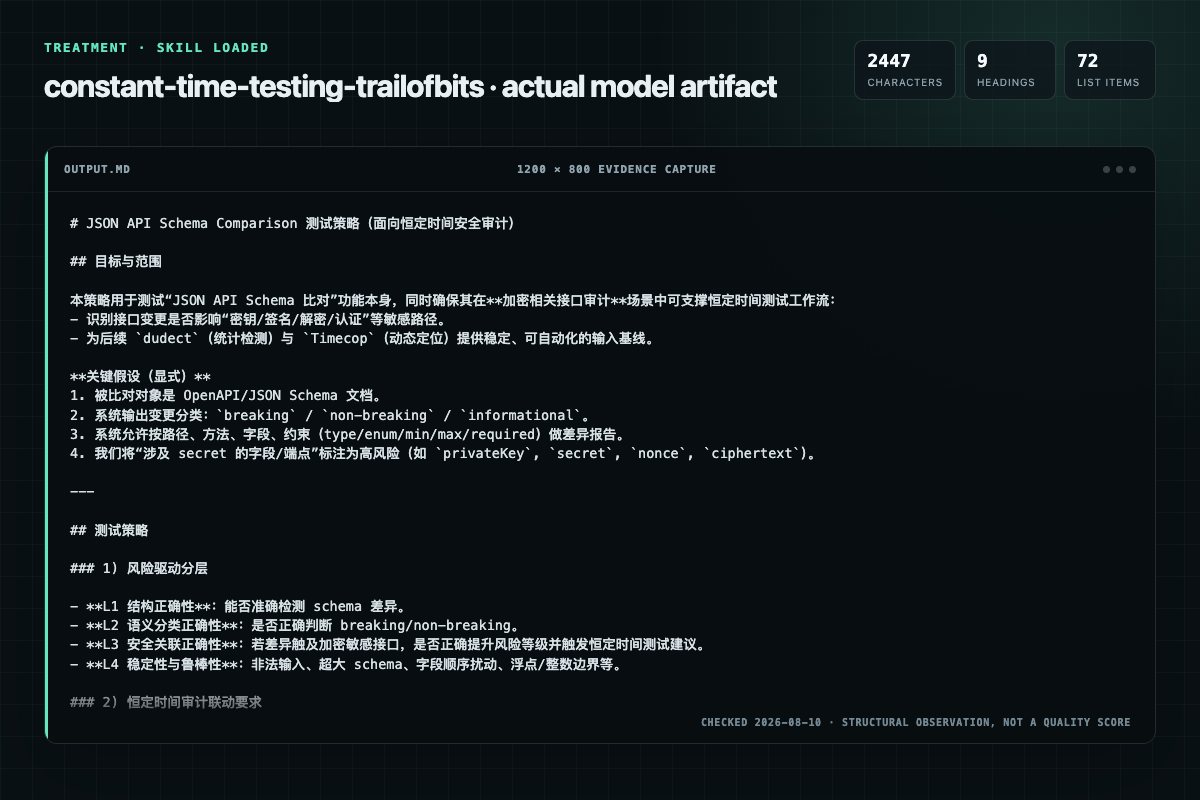
With Skill: 2447 non-whitespace characters, 9 headings, and 72 list items.
| Observation | Without Skill | With Skill |
|---|---|---|
| Source-signal coverage | 1/8: constant-time | 0/8: none |
| Output structure | 2067 chars · 11 headings · 69 list items · 0 code blocks | 2447 chars · 9 headings · 72 list items · 0 code blocks |
| Verification and caution signals | 30 verification signals · 3 risk/limitation signals | 22 verification signals · 13 risk/limitation signals |
Use the constant-time-testing Skill pinned at 9b2813356e9b for my task. Follow its source-specific constraints around `constant-time-testing`, `constant-time`, `testing`, `background`, then return the finished deliverable with explicit assumptions, verification, failure conditions, and limits. Do not treat the Skill text as a factual source or claim that a single demonstration proves universal performance.
Compatibility matrix
| Platform | Status | Evidence | What to check |
|---|---|---|---|
| Codex | Not declared | No explicit evidence | Portability before use |
| Claude Code | Not declared | No explicit evidence | Portability before use |
| Cursor | Not declared | No explicit evidence | Portability before use |
| Gemini CLI | Not declared | No explicit evidence | Portability before use |
Installation
The source command is displayed only when detected. A safe inspection prompt is always available so your agent can explain every action before execution.
npx skills add https://github.com/trailofbits/skills --skill "plugins/testing-handbook-skills/skills/constant-time-testing"Inspect the Agent Skill "constant-time-testing" from https://github.com/trailofbits/skills/blob/1004934abf6b43f614af6f79720373e1d581e6e8/plugins/testing-handbook-skills/skills/constant-time-testing/SKILL.md at commit 1004934abf6b43f614af6f79720373e1d581e6e8. List every install step, command, network request, credential, file read/write, external action, and rollback step. Explain whether it fits my task. Do not install or execute anything until I approve.
Workflow
Recommended approach: 1. Start with dudect - Quick statistical check for timing differences 2. If leaks found - Use Timecop to pinpoint root cause 3. For high-assurance - Apply formal verification (ct-verif, SideTrail) 4. Continuous monitoring - Integrate dudect into CI pipeline
Key advantages: - Simple C header-only integration - Statistical rigor via Welch's t-test - Works with compiled binaries (real-world conditions)
Identify cryptographic code handling secrets: - Private keys, exponents, nonces - Password hashes, authentication tokens - Encryption/decryption operations
Identify cryptographic code handling secrets: - Private keys, exponents, nonces - Password hashes, authentication tokens - Encryption/decryption operations
If dudect detects leakage:
Permission review
No configured static risk pattern was detected
This is not proof of safety. Runtime behavior, indirect dependencies, and hidden external systems are outside the static scan.
Evidence record
| Signal | Value | Evidence type | Meaning |
|---|---|---|---|
| Quality score | 97/100 | Computed | Documentation, specificity, maintenance, and trust rules |
| Repository stars | 6,837 | Source | Repository attention, not individual Skill quality |
| Compatibility | 0 platforms | Source | Declared in the catalog source record |
| Usage guide | tested outcome page | Tested | Generated or reviewed according to the visible evidence level |
Pinned source
Timing attacks exploit variations in execution time to extract secret information from cryptographic implementations. Unlike cryptanalysis that targets theoretical weaknesses, timing attacks leverage implementation flaws - and they can affect any cryptographic code.
Timing attacks were introduced by Kocher in 1996. Since then, researchers have demonstrated practical attacks on RSA (Schindler), OpenSSL (Brumley and Boneh), AES implementations, and even post-quantum algorithms like Kyber.
| Concept | Description |
|---|---|
| Constant-time | Code path and memory accesses independent of secret data |
| Timing leakage | Observable execution time differences correlated with secrets |
| Side channel | Information extracted from implementation rather than algorithm |
| Microarchitecture | CPU-level timing differences (cache, division, shifts) |
Timing vulnerabilities can:
Two prerequisites enable exploitation:
Four patterns account for most timing vulnerabilities:
// 1. Conditional jumps - most severe timing differences
if(secret == 1) { ... }
while(secret > 0) { ... }

// 2. Array access - cache-timing attacks
lookup_table[secret];

// 3. Integer division (processor dependent)
data = secret / m;

// 4. Shift operation (processor dependent)
data = a << secret;
Conditional jumps cause different code paths, leading to vast timing differences.
Array access dependent on secrets enables cache-timing attacks, as shown in AES cache-timing research.
Integer division and shift operations leak secrets on certain CPU architectures and compiler configurations.
When patterns cannot be avoided, employ masking techniques to remove correlation between timing and secrets.
Modular exponentiation (used in RSA and Diffie-Hellman) is susceptible to timing attacks. RSA decryption computes:
$$ct^{d} \mod{N}$$
where $d$ is the secret exponent. The exponentiation by squaring optimization reduces multiplications to $\log{d}$:
$$ \begin{align*} & \textbf{Input: } \text{base }y,\text{exponent } d={d_n,\cdots,d_0}_2,\text{modulus } N \ & r = 1 \ & \textbf{for } i=|n| \text{ downto } 0: \ & \quad\textbf{if } d_i == 1: \ & \quad\quad r = r * y \mod{N} \ & \quad y = y * y \mod{N} \ & \textbf{return }r \end{align*} $$
The code branches on exponent bit $d_i$, violating constant-time principles. When $d_i = 1$, an additional multiplication occurs, increasing execution time and leaking bit information.
Montgomery multiplication (commonly used for modular arithmetic) also leaks timing: when intermediate values exceed modulus $N$, an additional reduction step is required. An attacker constructs inputs $y$ and $y'$ such that:
$$ \begin{align*} y^2 < y^3 < N \ y'^2 < N \leq y'^3 \end{align*} $$
For $y$, both multiplications take time $t_1+t_1$. For $y'$, the second multiplication requires reduction, taking time $t_1+t_2$. This timing difference reveals whether $d_i$ is 0 or 1.
Apply constant-time analysis when:
Consider alternatives when:
| Scenario | Recommended Approach | Skill |
|---|---|---|
| Prove absence of leaks | Formal verification | SideTrail, ct-verif, FaCT |
| Detect statistical timing differences | Statistical testing | dudect |
| Track secret data flow at runtime | Dynamic analysis | timecop |
| Find cache-timing vulnerabilities | Symbolic execution | Binsec, pitchfork |
The cryptographic community has developed four categories of timing analysis tools:
| Category | Approach | Pros | Cons |
|---|---|---|---|
| Formal | Mathematical proof on model | Guarantees absence of leaks | Complexity, modeling assumptions |
| Symbolic | Symbolic execution paths | Concrete counterexamples | Time-intensive path exploration |
| Dynamic | Runtime tracing with marked secrets | Granular, flexible | Limited coverage to executed paths |
| Statistical | Measure real execution timing | Practical, simple setup | No root cause, noise sensitivity |
Formal verification mathematically proves timing properties on an abstraction (model) of code. Tools create a model from source/binary and verify it satisfies specified properties (e.g., variables annotated as secret).
Popular tools:
Strengths: Proof of absence, language-agnostic (LLVM bytecode) Weaknesses: Requires expertise, modeling assumptions may miss real-world issues
Symbolic execution analyzes how paths and memory accesses depend on symbolic variables (secrets). Provides concrete counterexamples. Focus on cache-timing attacks.
Popular tools:
Strengths: Concrete counterexamples aid debugging Weaknesses: Path explosion leads to long execution times
Dynamic analysis marks sensitive memory regions and traces execution to detect timing-dependent operations.
Popular tools:
Strengths: Granular control, targeted analysis Weaknesses: Coverage limited to executed paths
Detailed Guidance: See the timecop skill for setup and usage.
Execute code with various inputs, measure elapsed time, and detect inconsistencies. Tests actual implementation including compiler optimizations and architecture.
Popular tools:
Strengths: Simple setup, practical real-world results Weaknesses: No root cause info, noise obscures weak signals
Detailed Guidance: See the dudect skill for setup and usage.
Phase 1: Static Analysis        Phase 2: Statistical Testing
┌─────────────────┐            ┌─────────────────┐
│ Identify secret │      →     │ Detect timing   │
│ data flow       │            │ differences     │
│ Tool: ct-verif  │            │ Tool: dudect    │
└─────────────────┘            └─────────────────┘
         ↓                              ↓
Phase 4: Root Cause             Phase 3: Dynamic Tracing
┌─────────────────┐            ┌─────────────────┐
│ Pinpoint leak   │      ←     │ Track secret    │
│ location        │            │ propagation     │
│ Tool: Timecop   │            │ Tool: Timecop   │
└─────────────────┘            └─────────────────┘
Recommended approach:
Dudect measures execution time for two input classes (fixed vs random) and uses Welch's t-test to detect statistically significant differences.
Detailed Guidance: See the dudect skill for complete setup, usage patterns, and CI integration.
#define DUDECT_IMPLEMENTATION
#include "dudect.h"

uint8_t do_one_computation(uint8_t *data) {
    // Code to measure goes here
}

void prepare_inputs(dudect_config_t *c, uint8_t *input_data, uint8_t *classes) {
    for (size_t i = 0; i < c->number_measurements; i++) {
        classes[i] = randombit();
        uint8_t *input = input_data + (size_t)i * c->chunk_size;
        if (classes[i] == 0) {
            // Fixed input class
        } else {
            // Random input class
        }
    }
}
Key advantages:
Key limitations:
Timecop wraps Valgrind to detect runtime operations dependent on secret memory regions.
Detailed Guidance: See the timecop skill for installation, examples, and debugging.
#include "valgrind/memcheck.h"

#define poison(addr, len) VALGRIND_MAKE_MEM_UNDEFINED(addr, len)
#define unpoison(addr, len) VALGRIND_MAKE_MEM_DEFINED(addr, len)

int main() {
    unsigned long long secret_key = 0x12345678;

    // Mark secret as poisoned
    poison(&secret_key, sizeof(secret_key));

    // Any branching or memory access dependent on secret_key
    // will be reported by Valgrind
    crypto_operation(secret_key);

    unpoison(&secret_key, sizeof(secret_key));
}
Run with Valgrind:
valgrind --leak-check=full --track-origins=yes ./binary
Key advantages:
Key limitations:
Identify cryptographic code handling secrets:
Quick statistical check:
timeout 600 ./ct_testTools: dudect Expected time: 1-2 hours (harness writing + initial run)
If dudect detects leakage:
Root cause investigation:
poison()Tools: Timecop, compiler output (objdump -d)
Fix the timing leak:
Re-verify:
Integrate into CI:
See the dudect skill for CI integration examples.
| Vulnerability | Description | Detection | Severity |
|---|---|---|---|
| Secret-dependent branch | if (secret_bit) { ... } | dudect, Timecop | CRITICAL |
| Secret-dependent array access | table[secret_index] | Timecop, Binsec | HIGH |
| Variable-time division | result = x / secret | Timecop | MEDIUM |
| Variable-time shift | result = x << secret | Timecop | MEDIUM |
| Montgomery reduction leak | Extra reduction when intermediate > N | dudect | HIGH |
The vulnerability: Execution time differs based on whether branch is taken. Common in optimized modular exponentiation (square-and-multiply).
How to detect with dudect:
uint8_t do_one_computation(uint8_t *data) {
    uint64_t base = ((uint64_t*)data)[0];
    uint64_t exponent = ((uint64_t*)data)[1]; // Secret!
    return mod_exp(base, exponent, MODULUS);
}

void prepare_inputs(dudect_config_t *c, uint8_t *input_data, uint8_t *classes) {
    for (size_t i = 0; i < c->number_measurements; i++) {
        classes[i] = randombit();
        uint64_t *input = (uint64_t*)(input_data + i * c->chunk_size);
        input[0] = rand(); // Random base
        input[1] = (classes[i] == 0) ? FIXED_EXPONENT : rand(); // Fixed vs random
    }
}
How to detect with Timecop:
poison(&exponent, sizeof(exponent));
result = mod_exp(base, exponent, modulus);
unpoison(&exponent, sizeof(exponent));
Valgrind will report:
Conditional jump or move depends on uninitialised value(s)
  at 0x40115D: mod_exp (example.c:14)
Related skill: dudect, timecop
Brumley and Boneh (2005) extracted RSA private keys from OpenSSL over a network. The vulnerability exploited Montgomery multiplication's variable-time reduction step.
Attack vector: Timing differences in modular exponentiation Detection approach: Statistical analysis (precursor to dudect) Impact: Remote key extraction
Tools used: Custom timing measurement Techniques applied: Statistical analysis, chosen-ciphertext queries
Post-quantum algorithm Kyber's reference implementation contained timing vulnerabilities in polynomial operations. Division operations leaked secret coefficients.
Attack vector: Secret-dependent division timing Detection approach: Dynamic analysis and statistical testing Impact: Secret key recovery in post-quantum cryptography
Tools used: Timing measurement tools Techniques applied: Differential timing analysis
| Tip | Why It Helps |
|---|---|
Pin dudect to isolated CPU core (taskset -c 2) | Reduces OS noise, improves signal detection |
| Test multiple compilers (gcc, clang, MSVC) | Optimizations may introduce or remove leaks |
| Run dudect for extended periods (hours) | Increases statistical confidence |
| Minimize non-crypto code in harness | Reduces noise that masks weak signals |
Check assembly output (objdump -d) | Verify compiler didn't introduce branches |
Use -O3 -march=native in testing | Matches production optimization levels |
| Mistake | Why It's Wrong | Correct Approach |
|---|---|---|
| Only testing one input distribution | May miss leaks visible with other patterns | Test fixed-vs-random, fixed-vs-fixed-different, etc. |
| Short dudect runs (< 1 minute) | Insufficient measurements for weak signals | Run 5-10+ minutes, longer for high assurance |
| Ignoring compiler optimization levels | -O0 may hide leaks present in -O3 | Test at production optimization level |
| Not testing on target architecture | x86 vs ARM have different timing characteristics | Test on deployment platform |
| Marking too much as secret in Timecop | False positives, unclear results | Mark only true secrets (keys, not public data) |
| Skill | Primary Use in Constant-Time Analysis |
|---|---|
| dudect | Statistical detection of timing differences via Welch's t-test |
| timecop | Dynamic tracing to pinpoint exact location of timing leaks |
| Skill | When to Apply |
|---|---|
| coverage-analysis | Ensure test inputs exercise all code paths in crypto function |
| ci-integration | Automate constant-time testing in continuous integration pipeline |
| Skill | Relationship |
|---|---|
| crypto-testing | Constant-time analysis is essential component of cryptographic testing |
| fuzzing | Fuzzing crypto code may trigger timing-dependent paths |
                    ┌─────────────────────────┐
                    │  constant-time-analysis │
                    │     (this skill)        │
                    └───────────┬─────────────┘
                                │
                ┌───────────────┴───────────────┐
                │                               │
                ▼                               ▼
    ┌───────────────────┐           ┌───────────────────┐
    │      dudect       │           │     timecop       │
    │  (statistical)    │           │    (dynamic)      │
    └────────┬──────────┘           └────────┬──────────┘
             │                               │
             └───────────────┬───────────────┘
                             │
                             ▼
              ┌──────────────────────────────┐
              │   Supporting Techniques      │
              │ coverage, CI integration     │
              └──────────────────────────────┘
These results must be false: A usability evaluation of constant-time analysis tools Comprehensive usability study of constant-time analysis tools. Key findings: developers struggle with false positives, need better error messages, and benefit from tool integration. Evaluates FaCT, ct-verif, dudect, and Memsan across multiple cryptographic implementations. Recommends improved tooling UX and better documentation.
List of constant-time tools - CROCS Curated catalog of constant-time analysis tools with tutorials. Covers formal tools (ct-verif, FaCT), dynamic tools (Memsan, Timecop), symbolic tools (Binsec), and statistical tools (dudect). Includes practical tutorials for setup and usage.
Paul Kocher: Timing Attacks on Implementations of Diffie-Hellman, RSA, DSS, and Other Systems Original 1996 paper introducing timing attacks. Demonstrates attacks on modular exponentiation in RSA and Diffie-Hellman. Essential historical context for understanding timing vulnerabilities.
Remote Timing Attacks are Practical (Brumley & Boneh) Demonstrates practical remote timing attacks against OpenSSL. Shows network-level timing differences are sufficient to extract RSA keys. Proves timing attacks work in realistic network conditions.
Cache-timing attacks on AES Shows AES implementations using lookup tables are vulnerable to cache-timing attacks. Demonstrates practical attacks extracting AES keys via cache timing side channels.
KyberSlash: Division Timings Leak Secrets Recent discovery of timing vulnerabilities in Kyber (NIST post-quantum standard). Shows division operations leak secret coefficients. Highlights that constant-time issues persist even in modern post-quantum cryptography.
Frequently asked questions
Timing attacks exploit variations in execution time to extract secret information from cryptographic implementations. Unlike cryptanalysis that targets theoretical weaknesses, timing attacks leverage implementation flaws - and they can affect any cryptographic code.
The source record exposes this install command: npx skills add https://github.com/trailofbits/skills --skill "plugins/testing-handbook-skills/skills/constant-time-testing". Inspect the command and pinned source before running it.
Alternatives
alirezarezvani/claude-skills
App Store Optimization (ASO) toolkit for researching keywords, analyzing competitor rankings, generating metadata suggestions, and improving app visibility on Apple App Store and Google Play Store. Use when the user asks about ASO, app store rankings, app metadata, app titles and descriptions, app store listings, app visibility, or mobile app marketing on iOS or Android. Supports keyword research and scoring, competitor keyword analysis, metadata optimization, A/B test planning, launch checklist
dotnet/skills
Analyzes test suites in any language and tags each test with standardized traits (positive, negative, critical-path, boundary, smoke, regression, integration, performance, security). Use when the user wants to categorize, audit, or label tests with traits. Works across .NET (MSTest/xUnit/NUnit/TUnit), Python (pytest), TS/JS (Jest/Vitest), Java, Go, Ruby, Rust, Swift, Kotlin, PowerShell, and C++ — auto-editing when the framework has canonical tag syntax, otherwise report-only. Do not use for writ
yonatangross/orchestkit
Grade work that already exists and decide whether it can merge. Runs the project's current unit, integration, and E2E suites plus security scanning and type checking, scores every dimension 0-10, and returns a merge verdict with a VERIFIED-vs-CLAIMED evidence manifest. Writes no test files and edits no source. Use when verifying changes are ready to merge. Use /ork:cover instead when the tests still have to be written.
PramodDutta/qaskills
Gate RAG pipelines in CI with versioned golden eval sets, per-metric thresholds, baseline drift detection, and a build that fails when retrieval or answer quality regresses.