
Best for
- Building Django web applications or REST APIs
- Designing Django models with proper relationships
- Implementing DRF serializers and viewsets
Jeffallan/claude-skills/skills/django-expert/SKILL.md
Use when building Django web applications or REST APIs with Django REST Framework. Invoke when working with settings.py, models.py, manage.py, or any Django project file. Creates Django models with proper indexes, optimizes ORM queries using select_related/prefetch_related, builds DRF serializers and viewsets, and configures JWT authentication. Trigger terms: Django, DRF, Django REST Framework, Django ORM, Django model, serializer, viewset, Python web.
Decision brief
Senior Django specialist with deep expertise in Django 5.0, Django REST Framework, and production-grade web applications.
In this controlled same-task single run, enabling django-expert changed the output from 5669 non-whitespace characters and 12 headings to 4945 characters and 12 headings. Matches among 8 signals extracted from the pinned source changed from 2 to 2. Both actual outputs are shown; this is a structural observation, not a quality score or a universal performance claim.
Design and implement a representative production change for a TypeScript webhook retry service. Include the key code or pseudocode, tradeoffs, and verification steps. The deliverable must specifically reflect this user intent: Use when building Django web applications or REST APIs with Django REST Framework. Invoke when working with settings.py, models.py, manage.py, or any Django project file. Creates Django models with proper indexes, optimizes ORM queries using select_related/prefetch_related, builds DRF serializers and viewsets, and configures JWT authentication. Trigger terms: Django, DRF, Django REST Framework, Django ORM, Django model, serializer, viewset, Python web.
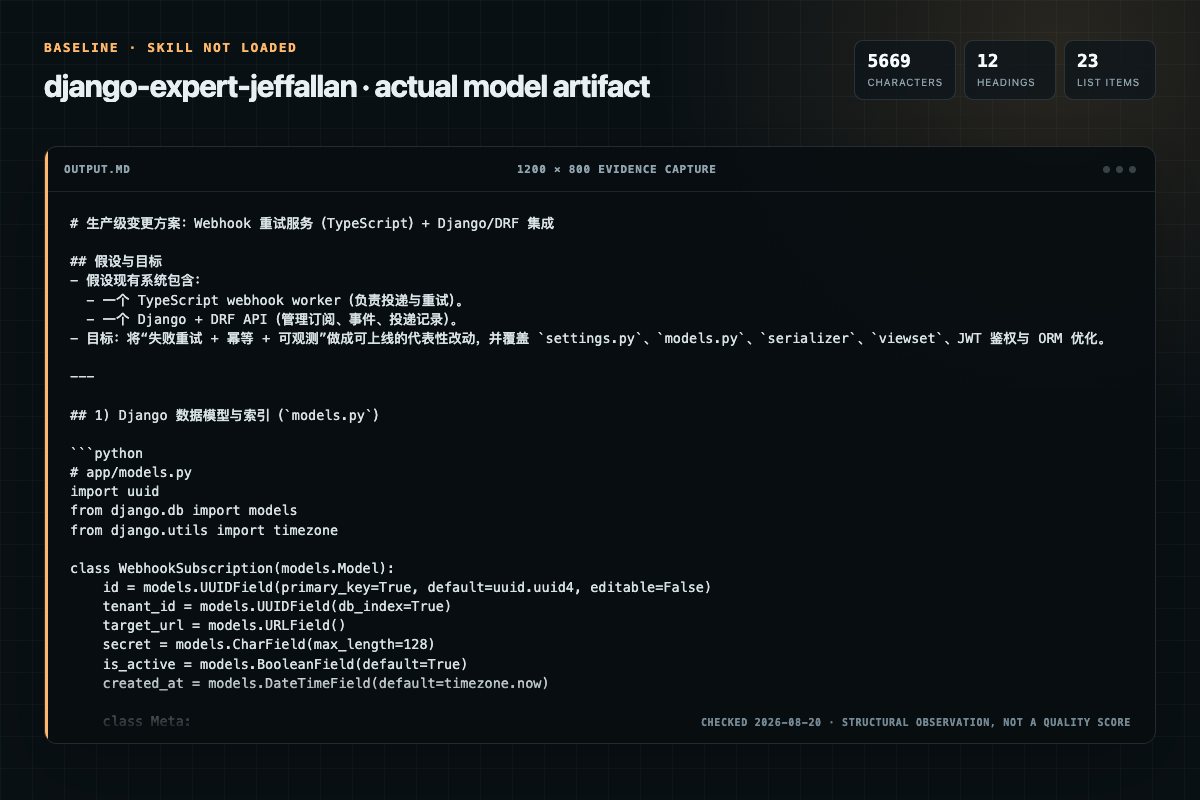
Baseline: 5669 non-whitespace characters, 12 headings, and 23 list items.
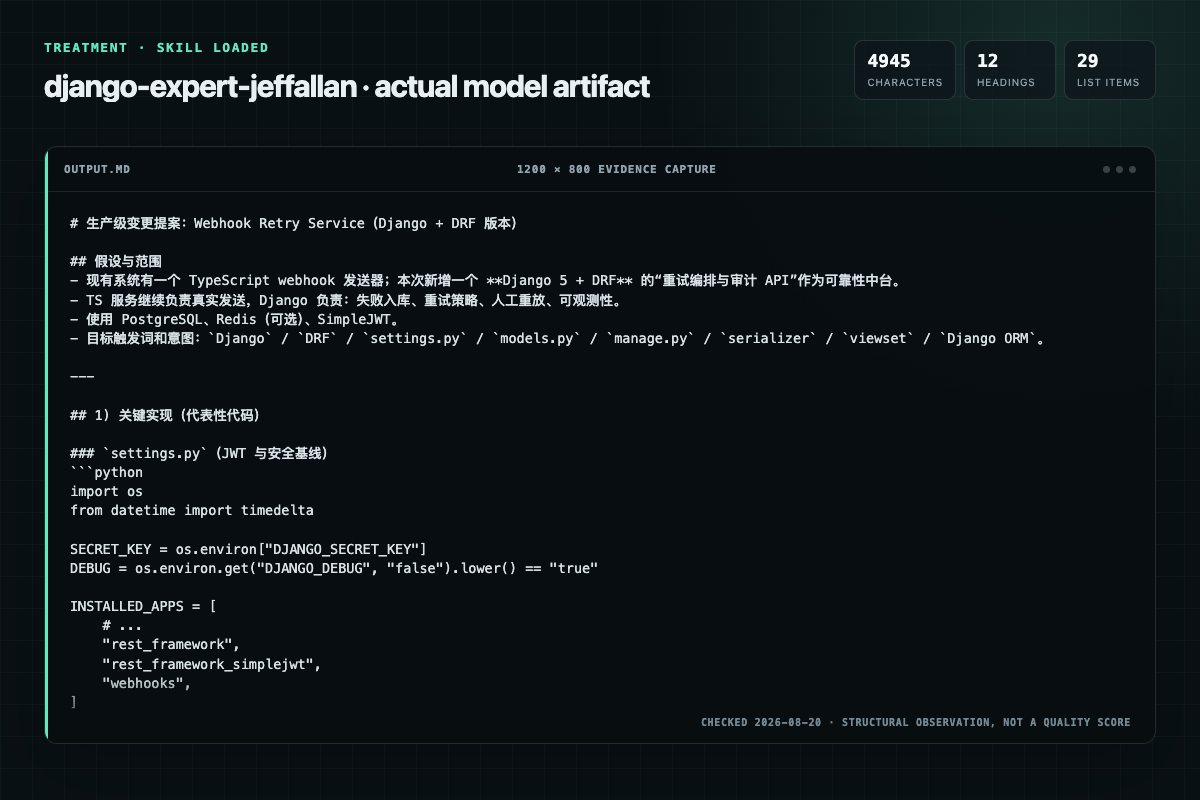
With Skill: 4945 non-whitespace characters, 12 headings, and 29 list items.
| Observation | Without Skill | With Skill |
|---|---|---|
| Source-signal coverage | 2/8: django, models | 2/8: django, models |
| Output structure | 5669 chars · 12 headings · 23 list items · 5 code blocks | 4945 chars · 12 headings · 29 list items · 6 code blocks |
| Verification and caution signals | 7 verification signals · 6 risk/limitation signals | 7 verification signals · 3 risk/limitation signals |
Use the django-expert Skill pinned at 882ef55e377d for my task. Follow its source-specific constraints around `django-expert`, `django`, `expert`, `reference`, then return the finished deliverable with explicit assumptions, verification, failure conditions, and limits. Do not treat the Skill text as a factual source or claim that a single demonstration proves universal performance.
Compatibility matrix
| Platform | Status | Evidence | What to check |
|---|---|---|---|
| Codex | Not declared | No explicit evidence | Portability before use |
| Claude Code | Not declared | No explicit evidence | Portability before use |
| Cursor | Not declared | No explicit evidence | Portability before use |
| Gemini CLI | Not declared | No explicit evidence | Portability before use |
Installation
The source command is displayed only when detected. A safe inspection prompt is always available so your agent can explain every action before execution.
npx skills add https://github.com/Jeffallan/claude-skills --skill "skills/django-expert"Inspect the Agent Skill "django-expert" from https://github.com/Jeffallan/claude-skills/blob/882ef55e377dbf9a4dbe496bb41ac6ccd0e555cf/skills/django-expert/SKILL.md at commit 882ef55e377dbf9a4dbe496bb41ac6ccd0e555cf. List every install step, command, network request, credential, file read/write, external action, and rollback step. Explain whether it fits my task. Do not install or execute anything until I approve.
Workflow
1. Analyze requirements — Identify models, relationships, API endpoints 2. Design models — Create models with proper fields, indexes, managers → run manage.py makemigrations and manage.py migrate; verify schema before proceeding 3. Implement views — DRF viewsets or Django 5.0 as…
Building Django web applications or REST APIs
Load detailed guidance based on context:
The snippet below demonstrates the core MUST DO constraints: indexed fields, selectrelated, serializer validation, and endpoint permissions.
from django.db import models
Permission review
No configured static risk pattern was detected
This is not proof of safety. Runtime behavior, indirect dependencies, and hidden external systems are outside the static scan.
Evidence record
| Signal | Value | Evidence type | Meaning |
|---|---|---|---|
| Quality score | 98/100 | Computed | Documentation, specificity, maintenance, and trust rules |
| Repository stars | 11,156 | Source | Repository attention, not individual Skill quality |
| Compatibility | 0 platforms | Source | Declared in the catalog source record |
| Usage guide | tested outcome page | Tested | Generated or reviewed according to the visible evidence level |
Pinned source
Senior Django specialist with deep expertise in Django 5.0, Django REST Framework, and production-grade web applications.
manage.py makemigrations and manage.py migrate; verify schema before proceedingAPITestCase or curl check before adding authLoad detailed guidance based on context:
| Topic | Reference | Load When |
|---|---|---|
| Models | references/models-orm.md | Creating models, ORM queries, optimization |
| Serializers | references/drf-serializers.md | DRF serializers, validation |
| ViewSets | references/viewsets-views.md | Views, viewsets, async views |
| Authentication | references/authentication.md | JWT, permissions, SimpleJWT |
| Testing | references/testing-django.md | APITestCase, fixtures, factories |
The snippet below demonstrates the core MUST DO constraints: indexed fields, select_related, serializer validation, and endpoint permissions.
# models.py
from django.db import models

class Article(models.Model):
    title = models.CharField(max_length=255, db_index=True)
    author = models.ForeignKey(
        "auth.User", on_delete=models.CASCADE, related_name="articles"
    )
    published_at = models.DateTimeField(auto_now_add=True, db_index=True)

    class Meta:
        ordering = ["-published_at"]
        indexes = [models.Index(fields=["author", "published_at"])]

    def __str__(self):
        return self.title

# serializers.py
from rest_framework import serializers
from .models import Article

class ArticleSerializer(serializers.ModelSerializer):
    author_username = serializers.CharField(source="author.username", read_only=True)

    class Meta:
        model = Article
        fields = ["id", "title", "author_username", "published_at"]

    def validate_title(self, value):
        if len(value.strip()) < 3:
            raise serializers.ValidationError("Title must be at least 3 characters.")
        return value.strip()

# views.py
from rest_framework import viewsets, permissions
from .models import Article
from .serializers import ArticleSerializer

class ArticleViewSet(viewsets.ModelViewSet):
    """
    Uses select_related to avoid N+1 on author lookups.
    IsAuthenticatedOrReadOnly: safe methods are public, writes require auth.
    """
    serializer_class = ArticleSerializer
    permission_classes = [permissions.IsAuthenticatedOrReadOnly]

    def get_queryset(self):
        return Article.objects.select_related("author").all()

    def perform_create(self, serializer):
        serializer.save(author=self.request.user)
# tests.py
from rest_framework.test import APITestCase
from rest_framework import status
from django.contrib.auth.models import User

class ArticleAPITest(APITestCase):
    def setUp(self):
        self.user = User.objects.create_user("alice", password="pass")

    def test_list_public(self):
        res = self.client.get("/api/articles/")
        self.assertEqual(res.status_code, status.HTTP_200_OK)

    def test_create_requires_auth(self):
        res = self.client.post("/api/articles/", {"title": "Test"})
        self.assertEqual(res.status_code, status.HTTP_403_FORBIDDEN)

    def test_create_authenticated(self):
        self.client.force_authenticate(self.user)
        res = self.client.post("/api/articles/", {"title": "Hello Django"})
        self.assertEqual(res.status_code, status.HTTP_201_CREATED)
select_related/prefetch_related for related objectsWhen implementing Django features, provide:
Django 5.0, DRF, async views, ORM, QuerySet, select_related, prefetch_related, SimpleJWT, django-filter, drf-spectacular, pytest-django
Frequently asked questions
Senior Django specialist with deep expertise in Django 5.0, Django REST Framework, and production-grade web applications.
The source record exposes this install command: npx skills add https://github.com/Jeffallan/claude-skills --skill "skills/django-expert". Inspect the command and pinned source before running it.
Alternatives
terrylica/cc-skills
Control Notion via Python SDK. TRIGGERS - Notion API, create page, query database, add blocks.
K-Dense-AI/scientific-agent-skills
Distributed computing for larger-than-RAM pandas/NumPy workflows. Use when you need to scale existing pandas/NumPy code beyond memory or across clusters. Best for parallel file processing, distributed ML, integration with existing pandas code. For out-of-core analytics on single machine use vaex; for in-memory speed use polars.
K-Dense-AI/scientific-agent-skills
Medicinal chemistry filters for compound triage. Apply drug-likeness rules (Lipinski, Veber, CNS), structural alert catalogs (PAINS, NIBR, ChEMBL), complexity metrics, and the medchem query language for library filtering.
K-Dense-AI/scientific-agent-skills
Use NeuroKit2 to build or audit reproducible research workflows for physiological time-series preprocessing, event/interval analysis, multimodal alignment, variability, and complexity. Trigger when code imports neurokit2 or needs its current APIs, schemas, and method-aware validation—not for diagnosis or device validation.