
Best for
- After completing a deep research thread.
- After building something new (code, pipeline, workflow).
- After a multi-source analysis that produced significant findings.
garrytan/gbrain/plugin/skills/eiirp/SKILL.md
Everything In Its Right Place. The universal post-work organizer. After any significant work session, EIIRP runs a 7-phase audit: (1) inventory every output, (2) walk taxonomy to decide where each lands, (3) check schema-pack consistency against the brain's actual shape, (4) file enriched brain pages, (5) audit the skill graph for DRY+MECE, (6) verify resolvability, (7) report. Named after the Radiohead song. Nothing produced during significant work lives only in chat — knowledge becomes permane
Decision brief
"Everything in its right place" — Radiohead, Kid A
In this controlled same-task single run, enabling eiirp changed the output from 2797 non-whitespace characters and 7 headings to 3066 characters and 16 headings. Matches among 8 signals extracted from the pinned source changed from 6 to 3. Both actual outputs are shown; this is a structural observation, not a quality score or a universal performance claim.
Review a flawed account-settings implementation for a small SaaS product. Prioritize concrete issues, explain impact, and provide corrected examples or decisions. The deliverable must specifically reflect this user intent: Everything In Its Right Place. The universal post-work organizer. After any significant work session, EIIRP runs a 7-phase audit: (1) inventory every output, (2) walk taxonomy to decide where each lands, (3) check schema-pack consistency against the brain's actual shape, (4) file enriched brain pages, (5) audit the skill graph for DRY+MECE, (6) verify resolvability, (7) report. Named after the Radiohead song. Nothing produced during significant work lives only in chat — knowledge becomes permane
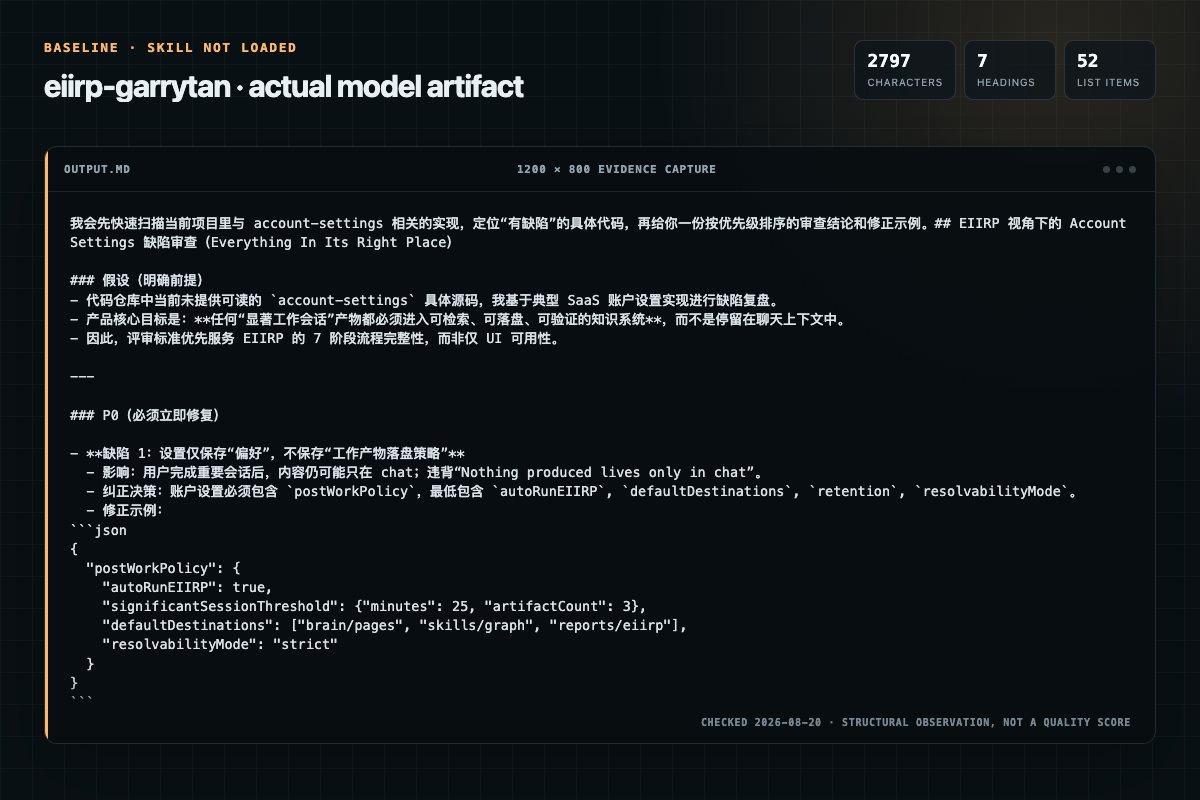
Baseline: 2797 non-whitespace characters, 7 headings, and 52 list items.
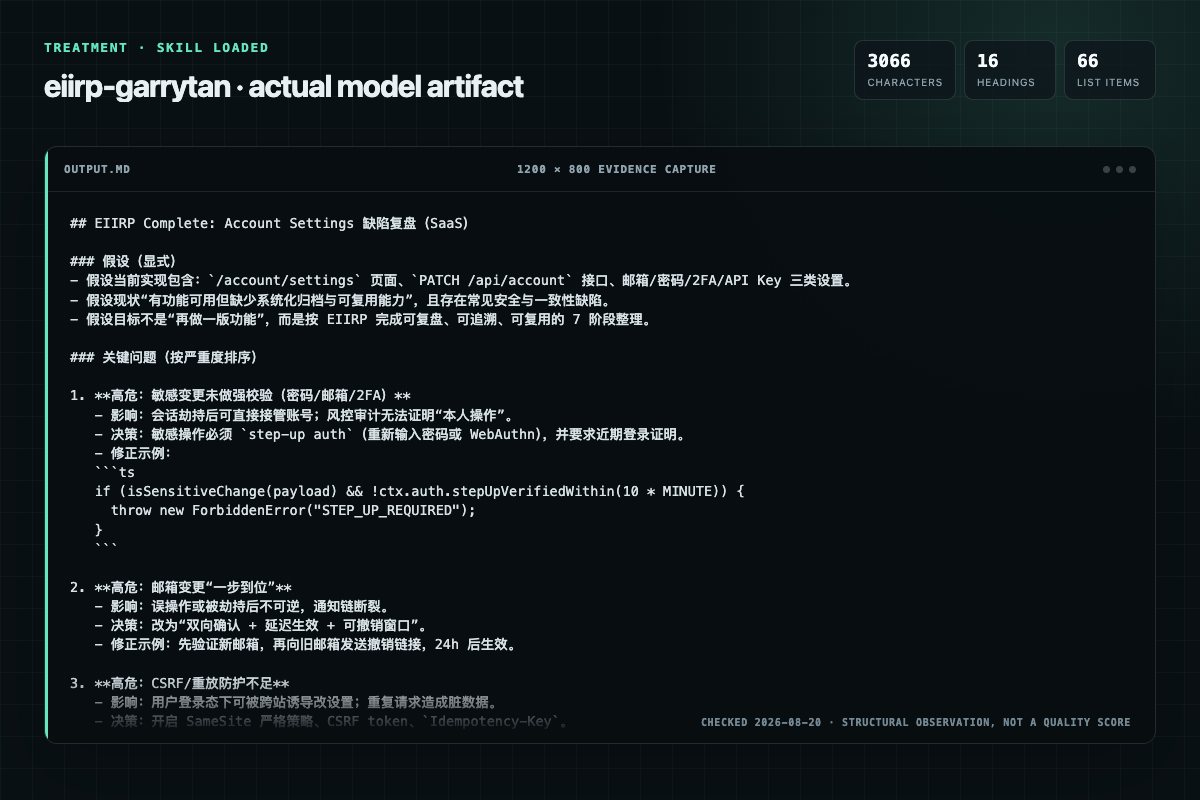
With Skill: 3066 non-whitespace characters, 16 headings, and 66 list items.
| Observation | Without Skill | With Skill |
|---|---|---|
| Source-signal coverage | 6/8: eiirp, everything, right, place, phase, inventory | 3/8: eiirp, phase, inventory |
| Output structure | 2797 chars · 7 headings · 52 list items · 4 code blocks | 3066 chars · 16 headings · 66 list items · 0 code blocks |
| Verification and caution signals | 9 verification signals · 1 risk/limitation signals | 8 verification signals · 8 risk/limitation signals |
Use the eiirp Skill pinned at 07f5d28dcfe1 for my task. Follow its source-specific constraints around `eiirp`, `everything`, `right`, `place`, then return the finished deliverable with explicit assumptions, verification, failure conditions, and limits. Do not treat the Skill text as a factual source or claim that a single demonstration proves universal performance.
Compatibility matrix
| Platform | Status | Evidence | What to check |
|---|---|---|---|
| Codex | Not declared | No explicit evidence | Portability before use |
| Claude Code | Not declared | No explicit evidence | Portability before use |
| Cursor | Not declared | No explicit evidence | Portability before use |
| Gemini CLI | Not declared | No explicit evidence | Portability before use |
Installation
The source command is displayed only when detected. A safe inspection prompt is always available so your agent can explain every action before execution.
npx skills add https://github.com/garrytan/gbrain --skill "plugin/skills/eiirp"Inspect the Agent Skill "eiirp" from https://github.com/garrytan/gbrain/blob/9dadfb97308825f246d6d0534486affad71f211b/plugin/skills/eiirp/SKILL.md at commit 9dadfb97308825f246d6d0534486affad71f211b. List every install step, command, network request, credential, file read/write, external action, and rollback step. Explain whether it fits my task. Do not install or execute anything until I approve.
Workflow
The gate is the single-deliverable fast path: one document → one page → link in the delivery reply. A full work session still deserves the complete EIIRP pass below; the gate just ensures no individual analysis waits for it.
Scan the current session/thread and identify ALL outputs across both domains.
Read the active schema pack first (the single source of truth for filing decisions in v0.39+):
This is where EIIRP closes the schema-derivation loop. If the work produced content that doesn't fit any existing pagetypes, propose adding a new type via the v0.39 cathedral:
gbrain schema review-candidates --json gbrain schema review-candidates --apply bash gbrain check-resolvable
Permission review
The documentation asks the agent to create, modify, or delete local files.
**Write** — file via capture:Evidence record
| Signal | Value | Evidence type | Meaning |
|---|---|---|---|
| Quality score | 99/100 | Computed | Documentation, specificity, maintenance, and trust rules |
| Repository stars | 29,034 | Source | Repository attention, not individual Skill quality |
| Compatibility | 0 platforms | Source | Declared in the catalog source record |
| Usage guide | tested outcome page | Tested | Generated or reviewed according to the visible evidence level |
Pinned source
"Everything in its right place" — Radiohead, Kid A
After any significant work, EIIRP organizes ALL outputs across two domains:
Knowledge domain (brain):
Capability domain (skills): 5. Every reusable pattern becomes a composable skill. 6. Existing skills are audited for DRY violations. 7. Skill graph is MECE — no gaps, no overlaps, no ambiguous routing.
The meta-guarantee: Nothing produced during significant work lives only in chat. Knowledge → brain. Patterns → skills. Everything in its right place.
Convention: see conventions/brain-first.md — this is its write side. Substantial analysis belongs in the brain, not only in chat.
Unlike the 7-phase audit above (which the user invokes after a work
session), this gate is an always-on agent-side convention, like
signal-detector: the agent applies it on every substantive reply, not
when a trigger phrase routes here. Always-on is a harness-routing
convention that a well-behaved agent follows — not a mechanical
guarantee; nothing in the gbrain runtime blocks a reply if the skill
never loads.
The moment of evaluation is delivery, not request. The gate evaluates when substantial analysis (>=500 words of structured output on a user-shared document) is ABOUT to be delivered — the analysis is done and the reply is being composed. At that moment, file the brain page FIRST, then deliver the analysis plus the page link in that same reply. The user should never have to ask "did you file this?"
=500 words of structured output (findings, recommendations, or extracted data — not restatement or formatting).
These pipelines own their brain-write logic; the gate must NOT double-file on top of them. If one of these is the right route, invoke it and let it file:
skills/meeting-ingestion/SKILL.md — transcripts + attendee propagationskills/idea-ingest/SKILL.md — articles with author/publication metadataskills/media-ingest/SKILL.md — bulk file ingestionskills/voice-note-ingest/SKILL.md — voice notesskills/book-mirror/SKILL.md — personalized book mirrorsPath — consult skills/brain-taxonomist/SKILL.md. It reads the
active schema pack (gbrain schema show --json); document analysis
usually lands under analysis/ or research/, entity-centric
findings under people/ or companies/.
Write — file via capture:
gbrain capture --file <analysis.md> --slug <taxonomist-path>
(or put_page over MCP on thin-client installs). Full frontmatter
per Phase 4a. The page must be self-contained — a reader months
later gets the full picture without the chat thread.
Link in the SAME reply — the analysis inline (conversational,
not just "see the brain page") plus a link line to the filed page,
formatted per skills/brain-link-discipline/SKILL.md (it owns the
link format and the resolve-verification step). Multiple pages →
list every link.
First-fire notice. The very first time the gate fires for a
user, append one line to the delivery reply so they learn about
auto-filing at the moment it starts, not after: Auto-filed to <path>; say "stop auto-filing" to disable. Record that the notice
was given (a per-user storage-policy note) so it never repeats.
Alternatively, ask once at setup and record the policy before the
first write.
Auto-filing is a DEFAULT, not a mandate — a per-user storage policy. If the user says to stop auto-filing document analyses (or asks for chat-only handling of a specific document), record that preference and stop firing the gate: deliver the analysis without a page. Re-enable on request.
The gate is the single-deliverable fast path: one document → one page → link in the delivery reply. A full work session still deserves the complete EIIRP pass below; the gate just ensures no individual analysis waits for it.
Scan the current session/thread and identify ALL outputs across both domains.
□ Primary findings (the synthesis)
□ Source documents (URLs, PDFs, articles, tweets)
□ Entity mentions (people, companies, organizations, places)
□ Concepts/frameworks (reusable mental models)
□ Data artifacts (structured data, timelines, statistics)
□ New skills created or modified
□ Scripts/code written (should they be in lib/ or scripts/?)
□ Methodology used (search patterns, source chains, verification steps)
□ Workflows that could be automated (cron, pipeline, webhook)
□ Patterns that will recur (→ candidate for skillification)
Produce a manifest:
## EIIRP Manifest
- Topic: [topic]
- Date: [date]
- Knowledge outputs: [count] (sources, entities, concepts)
- Capability outputs: [count] (skills, scripts, patterns)
- Reusable methodology: [yes/no — describe if yes]
Read the active schema pack first (the single source of truth for filing decisions in v0.39+):
gbrain schema show --json
The pack's page_types[] lists every directory the brain accepts plus
the primitive each maps to. Walk it for each output and pick the directory
whose path_prefixes matches the content's primary subject.
If brain-taxonomist is installed, INVOKE IT for ambiguous cases. It runs
the same decision protocol against the active pack and gives you a single
recommended filing path with reasoning.
Output: a filing plan table:
| Content | Brain path | Action |
|---------|-----------|--------|
| Primary research | reference/.../page.md | CREATE |
| Person X | people/x-slug.md | CREATE |
| Person Y | people/y-slug.md | UPDATE (already exists) |
| ... | ... | ... |
This is where EIIRP closes the schema-derivation loop. If the work
produced content that doesn't fit any existing page_types, propose
adding a new type via the v0.39 cathedral:
# What's emerging in the brain that the active pack doesn't cover?
gbrain schema detect --json

# LLM-refined suggestions (heuristic when no API key set).
gbrain schema suggest --json

# Review what's pending; promote or ignore each candidate.
gbrain schema review-candidates --json
gbrain schema review-candidates --apply <prefix-or-type-name>
Confidence floor: when gbrain schema suggest returns confidence
< 0.6 on a proposed type, DO NOT auto-apply. Surface the suggestion to
the user and let them choose. The schema-cathedral ships the
primitives; EIIRP enforces the human-in-the-loop gate.
If schema needs change:
review-candidates --apply.~/.gbrain/schema-pack-deltas/ — review and merge into the active
pack via gbrain schema edit (or hand-edit the YAML).For each item in the filing plan:
Use the brain page template. MUST include:
type, title, date, tags, sources)For each entity mentioned:
gbrain search "<name>" or gbrain get people/<slug>).After ALL pages are written, run gbrain sync (or commit + push in the
brain repo). Verify every link resolves.
This phase operates on the SKILL graph, not just the research.
Read-only plugin installs: the shipped plugin snapshot is not writable. New or updated skills and
lib/extractions target your own project skill directory or a brain-resident skillpack (gbrain skillpack init-brain-pack), never the shipped snapshot. Phases 1-4 and thegbrainCLI checks in Phase 6 work everywhere.
Ask: did this work reveal REPEATABLE patterns that will recur?
Indicators of a reusable pattern:
For each identified pattern:
lib/ (not copy-pasted into skills)gbrain check-resolvable
For ALL skills used or touched during this work, check:
lib/)The MECE question: If someone asked for this exact work again tomorrow on a different topic, which skills would they invoke? Is the path clear and unambiguous? If not, fix the routing.
## Skill Graph Changes

### New skills to create
1. **[skill-name]** — [what it does]
   - DRY check: [clean / overlaps with X]
   - Recommendation: [create / merge into X]

### Existing skills to update
1. **[skill-name]** — [what changed, why]

### Code to extract to lib/
1. **lib/[name].ts** — [what it does, which skills use it]

### Skills to merge or deprecate
1. **[skill-A] + [skill-B]** → [merged-skill] — [why]
On approval: invoke /skillify for each new/modified skill.
After all filing and skillification:
gbrain check-resolvable                         # routing-table reachability
gbrain doctor --json                            # health surface
gbrain search "<topic keywords>"                # brain pages findable
gbrain orphans                                  # any pages without inbound links?
Confirm:
skills/RESOLVER.md (where the skills tree is writable)gbrain doctor reports schema_pack_consistency: ok## EIIRP Complete: [Topic]
### Brain pages created/updated
- [path] — [description]
- ...
### Entity pages
- [path] — [created/updated]
- ...
### Schema changes
- [none / description of changes + which pack delta file]
### Skills identified
- [skill-name] — [status: created / merged / deferred]
- ...
### Resolver status
- DRY check: [clean]
- MECE audit: [clean]
- Active pack: [name] v[version]
- schema_pack_consistency: [ok / warn — pct untyped]
EIIRP produces a single Phase 7 report block. Plain markdown:
## EIIRP Complete: [topic]

### Brain pages created/updated
- [path] — [description]

### Entity pages
- [path] — [created|updated]

### Schema changes
- [none | description of changes + which pack delta file]

### Skills identified
- [skill-name] — [status: created|merged|deferred]

### Resolver status
- DRY check: [clean|N violations]
- MECE audit: [clean|N overlaps]
- Active pack: [name] v[version]
- schema_pack_consistency: [ok|warn — N% untyped]
Always machine-readable: stable section headers + bullet-per-item. The report doubles as a sync checkpoint for downstream skills (skillpack-check reads it; doctor cross-references the pack version).
gbrain schema show --json. Users on gbrain-recommended AND
custom packs MUST get the right behavior automatically.gbrain schema suggest means manual review is required. EIIRP
surfaces it; the user accepts.media/<format>/<slug>-personalized.md. See _brain-filing-rules.md
"Sanctioned exception" section.lib/.gbrain schema show --json so users who picked gbrain-recommended OR custom packs get the right behavior automatically.gbrain capture instead of the donor's git-commit mechanics; the
donor's direct GitHub-API link check was dropped in favor of the
brain-link-discipline skill's link format + verify step.detect | suggest | review-candidates) instead of a private
brain/schema.md.gbrain check-resolvable instead of
upstream scripts/skill-dry-check.mjs.gbrain doctor's schema_pack_consistency
check (T7) for the persistent surface.Frequently asked questions
"Everything in its right place" — Radiohead, Kid A
The source record exposes this install command: npx skills add https://github.com/garrytan/gbrain --skill "plugin/skills/eiirp". Inspect the command and pinned source before running it.
Static rules flagged write-files in the source; the page lists the matching lines and excerpts.
Alternatives
coreyhaines31/marketingskills
When the user wants to plan, design, or implement an A/B test or experiment, or build a growth experimentation program. Also use when the user mentions "A/B test," "split test," "experiment," "test this change," "variant copy," "multivariate test," "hypothesis," "should I test this," "which version is better," "test two versions," "statistical significance," "how long should I run this test," "growth experiments," "experiment velocity," "experiment backlog," "ICE score," "experimentation program
alirezarezvani/claude-skills
App Store Optimization (ASO) toolkit for researching keywords, analyzing competitor rankings, generating metadata suggestions, and improving app visibility on Apple App Store and Google Play Store. Use when the user asks about ASO, app store rankings, app metadata, app titles and descriptions, app store listings, app visibility, or mobile app marketing on iOS or Android. Supports keyword research and scoring, competitor keyword analysis, metadata optimization, A/B test planning, launch checklist
JasonColapietro/suede-creator-skills
Suede-owned experimentation discipline for hypotheses, sample sizing, test duration, significance, and repeatable experiment programs. Use when comparing variants, deciding whether a result is reliable, or building an experiment backlog and cadence. NOT FOR: analytics instrumentation (use suede-analytics), post-click conversion diagnosis (use suede-site-alchemy), or writing the variant copy itself (use suede-copy).
tenequm/skills
Decision validation and thinking frameworks for startup founders. Use when you need to pressure-test a decision, validate your next steps, think through strategic options, or sanity-check your approach. Triggers on phrases like "should I", "help me think through", "is this the right move", "validate my thinking", "what am I missing". Covers fundraising, customer development, runway management, prioritization, and crypto/web3 founder challenges.