
Best for
- Use when implementing authentication/authorization, securing user input, or preventing OWASP Top 10 vulnerabilities — including custom security implementations such as hashing passwords with bcrypt/argon2, sanitizing SQ…
Jeffallan/claude-skills/skills/secure-code-guardian/SKILL.md
Use when implementing authentication/authorization, securing user input, or preventing OWASP Top 10 vulnerabilities — including custom security implementations such as hashing passwords with bcrypt/argon2, sanitizing SQL queries with parameterized statements, configuring CORS/CSP headers, validating input with Zod, and setting up JWT tokens. Invoke for authentication, authorization, input validation, encryption, OWASP Top 10 prevention, secure session management, and security hardening. For pre-
Decision brief
Invoke for authentication, authorization, input validation, encryption, OWASP Top 10 prevention, secure session management, and security hardening. For pre-
In this controlled same-task single run, enabling secure-code-guardian changed the output from 2225 non-whitespace characters and 13 headings to 2262 characters and 17 headings. Matches among 8 signals extracted from the pinned source changed from 0 to 2. Both actual outputs are shown; this is a structural observation, not a quality score or a universal performance claim.
Analyze a small SaaS churn scenario and produce a concrete analysis plan with data checks, method choices, expected outputs, and validation steps. The deliverable must specifically reflect this user intent: Use when implementing authentication/authorization, securing user input, or preventing OWASP Top 10 vulnerabilities — including custom security implementations such as hashing passwords with bcrypt/argon2, sanitizing SQL queries with parameterized statements, configuring CORS/CSP headers, validating input with Zod, and setting up JWT tokens. Invoke for authentication, authorization, input validation, encryption, OWASP Top 10 prevention, secure session management, and security hardening. For pre-
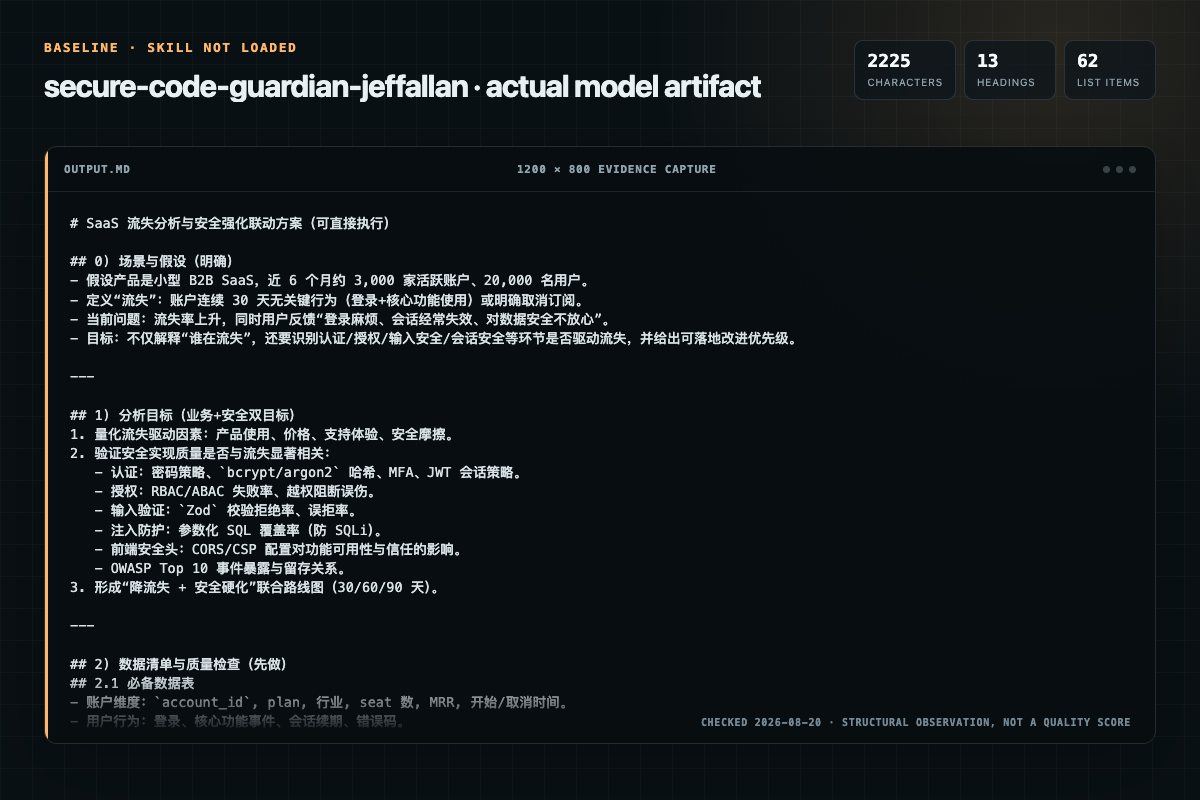
Baseline: 2225 non-whitespace characters, 13 headings, and 62 list items.
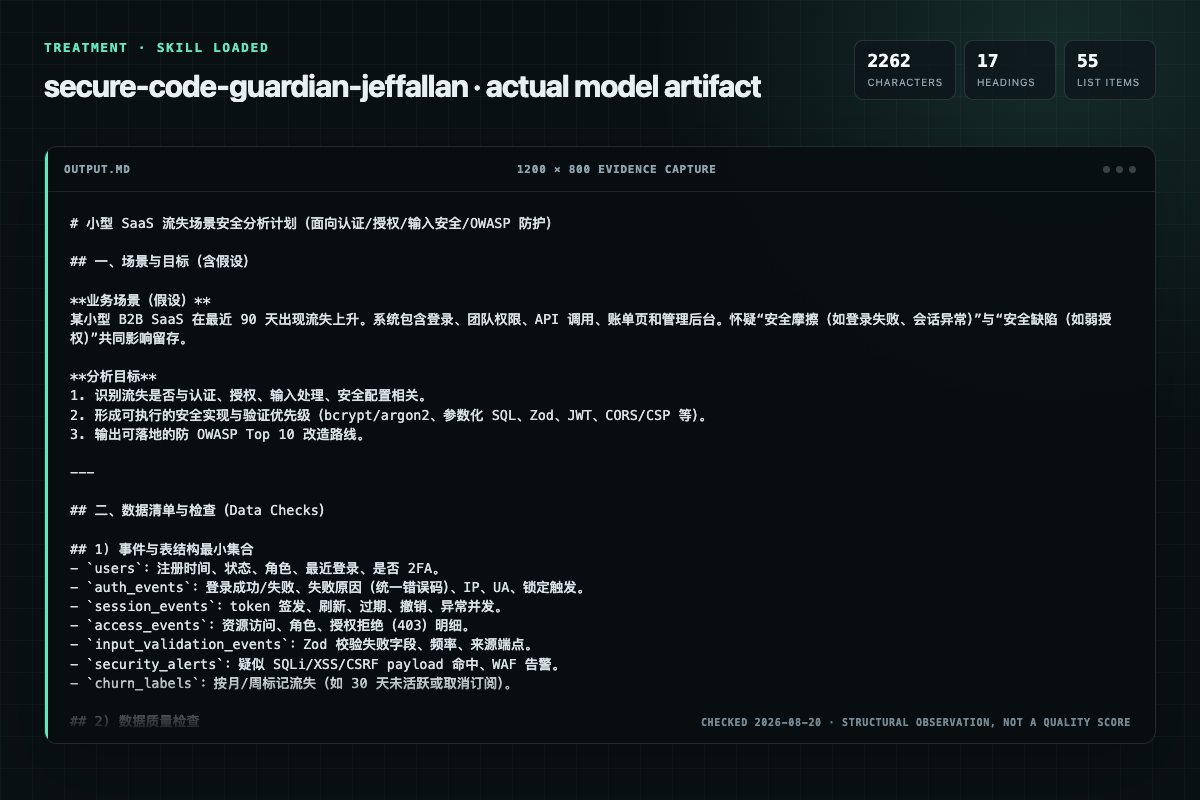
With Skill: 2262 non-whitespace characters, 17 headings, and 55 list items.
| Observation | Without Skill | With Skill |
|---|---|---|
| Source-signal coverage | 0/8: none | 2/8: secure, validation |
| Output structure | 2225 chars · 13 headings · 62 list items · 0 code blocks | 2262 chars · 17 headings · 55 list items · 0 code blocks |
| Verification and caution signals | 21 verification signals · 5 risk/limitation signals | 25 verification signals · 8 risk/limitation signals |
Use the secure-code-guardian Skill pinned at 882ef55e377d for my task. Follow its source-specific constraints around `secure-code-guardian`, `secure`, `guardian`, `validation`, then return the finished deliverable with explicit assumptions, verification, failure conditions, and limits. Do not treat the Skill text as a factual source or claim that a single demonstration proves universal performance.
Compatibility matrix
| Platform | Status | Evidence | What to check |
|---|---|---|---|
| Codex | Not declared | No explicit evidence | Portability before use |
| Claude Code | Not declared | No explicit evidence | Portability before use |
| Cursor | Not declared | No explicit evidence | Portability before use |
| Gemini CLI | Not declared | No explicit evidence | Portability before use |
Installation
The source command is displayed only when detected. A safe inspection prompt is always available so your agent can explain every action before execution.
npx skills add https://github.com/Jeffallan/claude-skills --skill "skills/secure-code-guardian"Inspect the Agent Skill "secure-code-guardian" from https://github.com/Jeffallan/claude-skills/blob/882ef55e377dbf9a4dbe496bb41ac6ccd0e555cf/skills/secure-code-guardian/SKILL.md at commit 882ef55e377dbf9a4dbe496bb41ac6ccd0e555cf. List every install step, command, network request, credential, file read/write, external action, and rollback step. Explain whether it fits my task. Do not install or execute anything until I approve.
Workflow
1. Threat model — Identify attack surface and threats 2. Design — Plan security controls 3. Implement — Write secure code with defense in depth; see code examples below 4. Validate — Test security controls with explicit checkpoints (see below) 5. Document — Record security decis…
After each implementation step, verify:
Load detailed guidance based on context:
Hash passwords with bcrypt/argon2 (never MD5/SHA-1/unsalted hashes)
Hash passwords with bcrypt/argon2 (never MD5/SHA-1/unsalted hashes)
Permission review
No configured static risk pattern was detected
This is not proof of safety. Runtime behavior, indirect dependencies, and hidden external systems are outside the static scan.
Evidence record
| Signal | Value | Evidence type | Meaning |
|---|---|---|---|
| Quality score | 91/100 | Computed | Documentation, specificity, maintenance, and trust rules |
| Repository stars | 11,171 | Source | Repository attention, not individual Skill quality |
| Compatibility | 0 platforms | Source | Declared in the catalog source record |
| Usage guide | tested outcome page | Tested | Generated or reviewed according to the visible evidence level |
Pinned source
After each implementation step, verify:
' OR 1=1--) are rejected; confirm XSS payloads (<script>alert(1)</script>) are escaped or rejected.curl -I, Mozilla Observatory) that security headers are present and CORS origin allowlist is correct.Load detailed guidance based on context:
| Topic | Reference | Load When |
|---|---|---|
| OWASP | references/owasp-prevention.md | OWASP Top 10 patterns |
| Authentication | references/authentication.md | Password hashing, JWT |
| Input Validation | references/input-validation.md | Zod, SQL injection |
| XSS/CSRF | references/xss-csrf.md | XSS prevention, CSRF |
| Headers | references/security-headers.md | Helmet, rate limiting |
import bcrypt from 'bcrypt';

const SALT_ROUNDS = 12; // minimum 10; 12 balances security and performance

export async function hashPassword(plaintext: string): Promise<string> {
  return bcrypt.hash(plaintext, SALT_ROUNDS);
}

export async function verifyPassword(plaintext: string, hash: string): Promise<boolean> {
  return bcrypt.compare(plaintext, hash);
}
// NEVER: `SELECT * FROM users WHERE email = '${email}'`
// ALWAYS: use positional parameters
import { Pool } from 'pg';
const pool = new Pool();

export async function getUserByEmail(email: string) {
  const { rows } = await pool.query(
    'SELECT id, email, role FROM users WHERE email = $1',
    [email]  // value passed separately — never interpolated
  );
  return rows[0] ?? null;
}
import { z } from 'zod';

const LoginSchema = z.object({
  email: z.string().email().max(254),
  password: z.string().min(8).max(128),
});

export function validateLoginInput(raw: unknown) {
  const result = LoginSchema.safeParse(raw);
  if (!result.success) {
    // Return generic error — never echo raw input back
    throw new Error('Invalid credentials format');
  }
  return result.data;
}
import jwt from 'jsonwebtoken';

const JWT_SECRET = process.env.JWT_SECRET!; // never hardcode

export function verifyToken(token: string): jwt.JwtPayload {
  // Throws if expired, tampered, or wrong algorithm
  const payload = jwt.verify(token, JWT_SECRET, {
    algorithms: ['HS256'],   // explicitly allowlist algorithm
    issuer: 'your-app',
    audience: 'your-app',
  });
  if (typeof payload === 'string') throw new Error('Invalid token payload');
  return payload;
}
import express from 'express';
import rateLimit from 'express-rate-limit';
import helmet from 'helmet';

const app = express();
app.use(helmet()); // sets CSP, HSTS, X-Frame-Options, etc.
app.use(express.json({ limit: '10kb' })); // limit payload size

const authLimiter = rateLimit({
  windowMs: 15 * 60 * 1000, // 15 minutes
  max: 10,                   // 10 attempts per window per IP
  standardHeaders: true,
  legacyHeaders: false,
});

app.post('/api/login', authLimiter, async (req, res) => {
  // 1. Validate input
  const { email, password } = validateLoginInput(req.body);

  // 2. Authenticate — parameterized query, constant-time compare
  const user = await getUserByEmail(email);
  if (!user || !(await verifyPassword(password, user.passwordHash))) {
    // Generic message — do not reveal whether email exists
    return res.status(401).json({ error: 'Invalid credentials' });
  }

  // 3. Authorize — issue scoped, short-lived token
  const token = jwt.sign(
    { sub: user.id, role: user.role },
    JWT_SECRET,
    { algorithm: 'HS256', expiresIn: '15m', issuer: 'your-app', audience: 'your-app' }
  );

  // 4. Secure response — token in httpOnly cookie, not body
  res.cookie('token', token, { httpOnly: true, secure: true, sameSite: 'strict' });
  return res.json({ message: 'Authenticated' });
});
When implementing security features, provide:
OWASP Top 10, bcrypt/argon2, JWT, OAuth 2.0, OIDC, CSP, CORS, rate limiting, input validation, output encoding, encryption (AES, RSA), TLS, security headers
Frequently asked questions
Invoke for authentication, authorization, input validation, encryption, OWASP Top 10 prevention, secure session management, and security hardening. For pre-
The source record exposes this install command: npx skills add https://github.com/Jeffallan/claude-skills --skill "skills/secure-code-guardian". Inspect the command and pinned source before running it.
Alternatives
K-Dense-AI/scientific-agent-skills
Distributed computing for larger-than-RAM pandas/NumPy workflows. Use when you need to scale existing pandas/NumPy code beyond memory or across clusters. Best for parallel file processing, distributed ML, integration with existing pandas code. For out-of-core analytics on single machine use vaex; for in-memory speed use polars.
getcargohq/cargo-skills
Make Cargo actually run something, or show what it would run — execute one connector action, run a multi-step workflow, trigger a batch across a whole segment or model, message an AI agent, build or edit a node graph, draw a workflow, tool or play as a diagram, and query the runtime tables (runs, batches, spans, records) with SQL. Triggers: "run this on all my contacts", "execute the action", "kick off a batch", "build a workflow", "schedule a play", "make it run every morning", "ask the agent",
NVIDIA/skills
Use this skill when the user wants to deploy, run, debug, tear down, or call the REST API of the RTVI-CV 2D detection / tracking microservice. Trigger when the user says things like 'deploy rtvi-cv', 'start warehouse 2d', 'add a stream', 'check rtvi-cv health', or 'stop the perception container'. Not for VLM, embedding, or analytics — use the matching vss-* skill.
UiPath/skills
UiPath Coded Apps — scaffold, build, run, and deploy Coded Web Apps and Coded Action Apps: React/TypeScript apps that call UiPath Cloud APIs via the `@uipath/uipath-typescript` SDK and ship to Automation Cloud (push/pull to Studio Web, pack, publish, deploy, OAuth-PKCE). Also generates live analytics & governance dashboards from a plain-language request, wired to tenant data via the Insights real-time API, with edit and deploy flows. For RPA→uipath-rpa, Python agents→uipath-agents, Maestro flows