
Tested demoQuality 99/100
HKUDS/Vibe-Trading/agent/src/skills/strategy-generate/SKILL.md
strategy-generate
Create, modify, and optimize quantitative trading strategies, then backtest and evaluate them.
- Source repository stars
- 31,651
- Declared platforms
- 0
- Static risk flags
- 0
- Last source update
- 2026-08-24
- Source checked
- 2026-08-25
Decision brief
What it does: where it fits
1. Requirements parsing: parse user intent, extract instrument codes, time range, and strategy logic, then write config.json 2. Strategy design: think through the 5 questions of data / signal / position sizing / backtest / validation 3. Strategy coding: write code/signalengine.p…
Not for
- Tasks that require unconfirmed production actions or broad system permissions.
- Environments where the pinned source and install steps cannot be inspected.
Controlled single-run demoChecked 2026-08-20
What changed when the Skill was used
In this controlled same-task single run, enabling strategy-generate changed the output from 2326 non-whitespace characters and 14 headings to 2275 characters and 11 headings. Matches among 8 signals extracted from the pinned source changed from 0 to 1. Both actual outputs are shown; this is a structural observation, not a quality score or a universal performance claim.
Same test task
Create a design direction and implementation handoff for a developer tool that compares two API responses. Prioritize the repeated user workflow and responsive behavior. The deliverable must specifically reflect this user intent: Create, modify, and optimize quantitative trading strategies, then backtest and evaluate them.
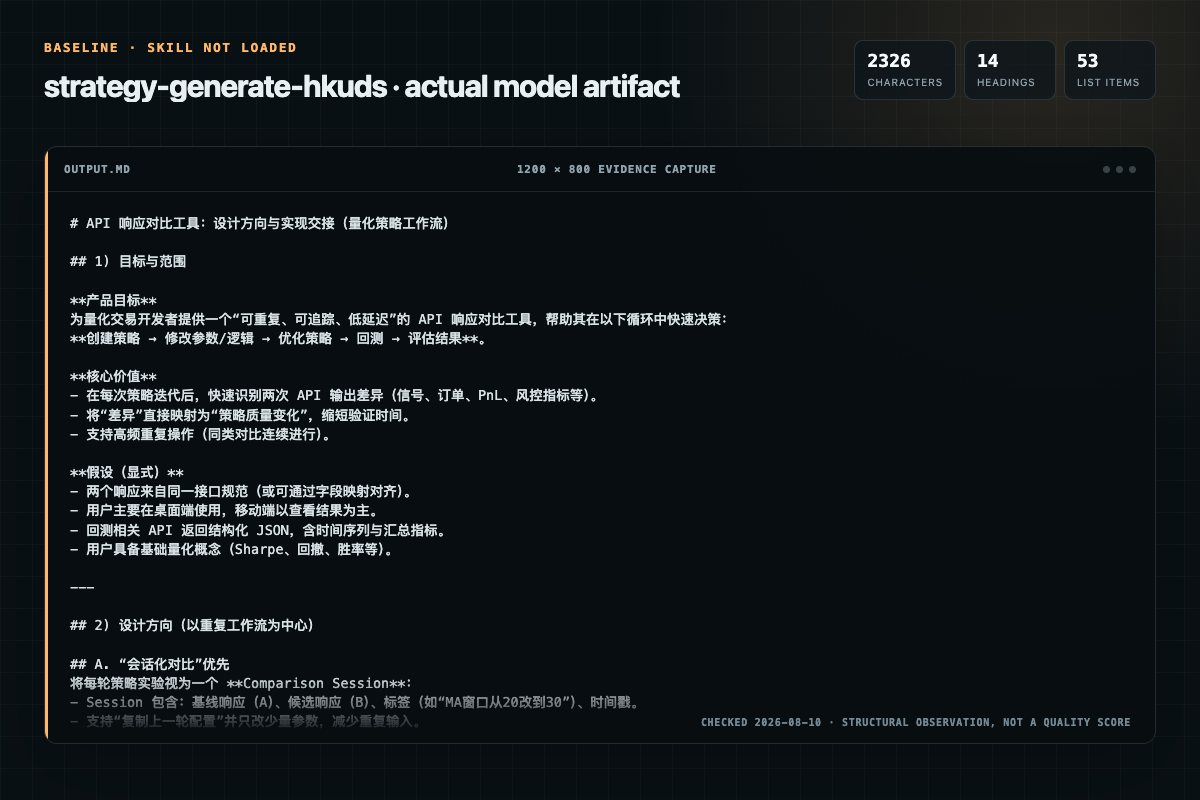
Baseline: 2326 non-whitespace characters, 14 headings, and 53 list items.
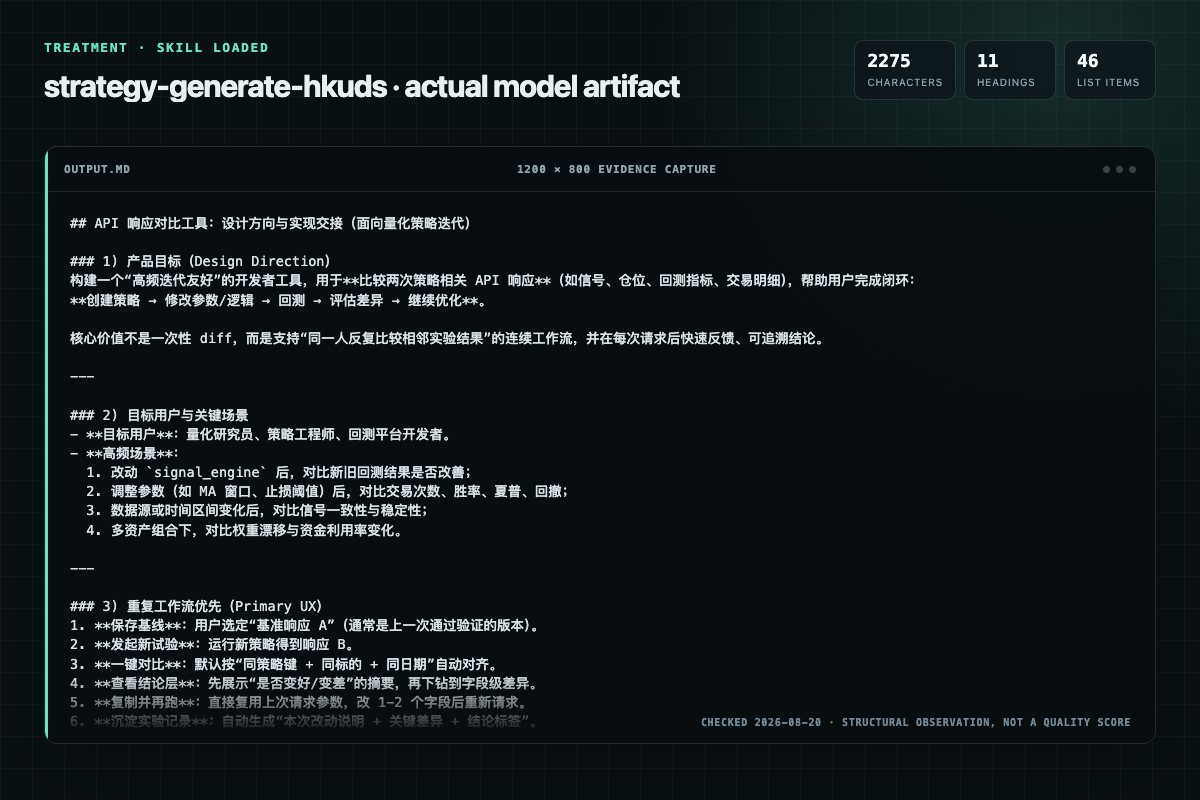
With Skill: 2275 non-whitespace characters, 11 headings, and 46 list items.
| Observation | Without Skill | With Skill |
|---|---|---|
| Source-signal coverage | 0/8: none | 1/8: design |
| Output structure | 2326 chars · 14 headings · 53 list items · 1 code blocks | 2275 chars · 11 headings · 46 list items · 0 code blocks |
| Verification and caution signals | 3 verification signals · 1 risk/limitation signals | 6 verification signals · 7 risk/limitation signals |
A prompt you can use
Use the strategy-generate Skill pinned at 7329cb096a73 for my task. Follow its source-specific constraints around `strategy-generate`, `parsing`, `strategy`, `design`, then return the finished deliverable with explicit assumptions, verification, failure conditions, and limits. Do not treat the Skill text as a factual source or claim that a single demonstration proves universal performance.
Method and limitationsExpandCollapse
Test method
- Baseline and treatment used the same task, model (gpt-5.3-codex-low), and runner; the only planned difference was whether the complete target Skill text was injected.
- The treatment used snapshot 7329cb096a7361f975f532c77fef5c93e31561c5; the current source commit 7329cb096a7361f975f532c77fef5c93e31561c5 was verified against content hash 80af9675e358. The baseline explicitly prohibited loading any Skill or external rule file.
- The same deterministic script counted characters, headings, lists, code blocks, verification terms, caution terms, and source signals in both artifacts. Source signals: `strategy-generate`, `parsing`, `strategy`, `design`, `signalengine`, `contract`, `quality`, `checklist`.
- The visuals are local screenshots of the actual Markdown artifacts in a fixed 1200 × 800 evidence canvas, not recreated product mockups. Raw JSON artifacts and request records are retained in the research directory.
Do not over-read this demo
- This is one controlled demonstration per condition, not a multi-run statistical benchmark; the model is stochastic.
- Character, structure, and keyword counts show observable differences but cannot by themselves prove correctness, originality, or business impact.
- The task is a representative test designed for repeatability, not every real-world use of the Skill; rerun after a material source change.
- Editorial review
- SkillSignal editorial
- Runner
- Cursor Agent 2026.08.11-e8db854
- Model
- gpt-5.3-codex-low
- Refresh due
- 2026-11-18
- Reviewed commit
- 7329cb096a7361f975f532c77fef5c93e31561c5
- Test snapshot
- 7329cb096a7361f975f532c77fef5c93e31561c5
Compatibility matrix
Platform support, with evidence labels
| Platform | Status | Evidence | What to check |
|---|---|---|---|
| Codex | Not declared | No explicit evidence | Portability before use |
| Claude Code | Not declared | No explicit evidence | Portability before use |
| Cursor | Not declared | No explicit evidence | Portability before use |
| Gemini CLI | Not declared | No explicit evidence | Portability before use |
Installation
Inspect first. Install second.
The source command is displayed only when detected. A safe inspection prompt is always available so your agent can explain every action before execution.
Source-detected install commandSource
npx skills add https://github.com/HKUDS/Vibe-Trading --skill "agent/src/skills/strategy-generate"Safe inspection promptEditorial
Inspect the Agent Skill "strategy-generate" from https://github.com/HKUDS/Vibe-Trading/blob/99e84abaad965f75dd15cab2fcb0f3f61d30577b/agent/src/skills/strategy-generate/SKILL.md at commit 99e84abaad965f75dd15cab2fcb0f3f61d30577b. List every install step, command, network request, credential, file read/write, external action, and rollback step. Explain whether it fits my task. Do not install or execute anything until I approve.
Workflow
What the source asks the agent to do
- 01
Workflow
1. Requirements parsing: parse user intent, extract instrument codes, time range, and strategy logic, then write config.json 2. Strategy design: think through the 5 questions of data / signal / position sizing / backtest / validation 3. Strategy coding: write code/signalengine.p…
Requirements parsing: parse user intent, extract instrument codes, time range, and strategy logic, then write config.jsonStrategy design: think through the 5 questions of data / signal / position sizing / backtest / validationStrategy coding: write code/signalengine.py (following the SignalEngine contract) - 02
Review Criteria
1. artifacts/metrics.csv exists and is non-empty 2. artifacts/equity.csv exists and is non-empty 3. exitcode == 0 (backtest exits normally) 4. The equity column in equity.csv contains no NaN values 5. tradecount 0 (zero trades = signal bug)
artifacts/metrics.csv exists and is non-emptyartifacts/equity.csv exists and is non-emptyexitcode == 0 (backtest exits normally) - 03
Requirements Parsing
Extract the following from the user's description: - Instrument codes: process them according to the normalization rules below - Time range: if the user does not specify dates, default to 10 years back from today (for example, if today is 2026-03-18, then startdate=2016-03-18, e…
Instrument codes: process them according to the normalization rules belowTime range: if the user does not specify dates, default to 10 years back from today (for example, if today is 2026-03-18, then startdate=2016-03-18, enddate=2026-03-18)Strategy logic: entry / exit conditions and indicator parameters - 04
Strategy Design
Before writing code, think through these 5 questions:
Data requirements: what fields are needed (basic OHLCV only, daily valuation fields such as pe/pb/roe, or statement fields such as incometotalrevenue / finaindicatorroe?), data frequency (daily), and market (which deter…Signal logic: what are the entry conditions? What are the exit conditions? Direction (long / short / long-short)? Are there filters (volume, trend confirmation, and so on)?Position management: equal-weight allocation or scaling in/out? Risk control (stop-loss, maximum position)? In portfolio strategies, once top N names are selected, each weight = 1/N - 05
SignalEngine Contract
Hard constraints: - The signal Series index must align exactly with the input DataFrame index - Include all required imports (numpy, pandas, and so on) - Do not hardcode dates or stock codes (read them from config.json) - Do not include an if name == "main" block - Pure pandas /…
The signal Series index must align exactly with the input DataFrame indexInclude all required imports (numpy, pandas, and so on)Do not hardcode dates or stock codes (read them from config.json)
Permission review
Static risk signals and limitations
No configured static risk pattern was detected
This is not proof of safety. Runtime behavior, indirect dependencies, and hidden external systems are outside the static scan.
Evidence record
Why each signal appears
EvidenceSourceComputedTestedEditorial
| Signal | Value | Evidence type | Meaning |
|---|---|---|---|
| Quality score | 99/100 | Computed | Documentation, specificity, maintenance, and trust rules |
| Repository stars | 31,651 | Source | Repository attention, not individual Skill quality |
| Compatibility | 0 platforms | Source | Declared in the catalog source record |
| Usage guide | tested outcome page | Tested | Generated or reviewed according to the visible evidence level |
Pinned source
Provenance and original SKILL.md
- Repository
- HKUDS/Vibe-Trading
- Skill path
- agent/src/skills/strategy-generate/SKILL.md
- Commit
- 99e84abaad965f75dd15cab2fcb0f3f61d30577b
- License
- MIT
- Collected
- 2026-08-25
- Default branch
- main
View the original SKILL.md
Workflow
- Requirements parsing: parse user intent, extract instrument codes, time range, and strategy logic, then write
config.json - Strategy design: think through the 5 questions of data / signal / position sizing / backtest / validation
- Strategy coding: write
code/signal_engine.py(following theSignalEnginecontract) - Syntax check:
bash("python -c \"import ast; ast.parse(open('code/signal_engine.py').read()); print('OK')\"") - Run backtest: call the
backtesttool (built into the engine; no need to writerun_backtest.py) - Evaluate results: read
artifacts/metrics.csvand judge by the review criteria - Iterative fixing: if results are poor, modify with
edit_file→ runbacktest→ re-evaluate
You only need to write signal_engine.py and config.json. The backtest tool automatically handles data loading and backtest execution.
Requirements Parsing
Extract the following from the user's description:
- Instrument codes: process them according to the normalization rules below
- Time range: if the user does not specify dates, default to 10 years back from today (for example, if today is
2026-03-18, thenstart_date=2016-03-18,end_date=2026-03-18) - Strategy logic: entry / exit conditions and indicator parameters
If critical information is missing, you must ask the user instead of guessing:
- Instrument not specified → ask which instrument they want to backtest (offer several popular suggestions)
- Strategy description is vague (for example, "help me build a strategy") → provide 2-3 strategy directions for the user to choose from
- Mixed markets but not clearly specified → confirm the data source
Write config.json first, then write code. config.json must be placed in the root of run_dir.
Strategy Design
Before writing code, think through these 5 questions:
- Data requirements: what fields are needed (basic OHLCV only, daily valuation fields such as
pe/pb/roe, or statement fields such asincome_total_revenue/fina_indicator_roe?), data frequency (daily), and market (which determines the data source) - Signal logic: what are the entry conditions? What are the exit conditions? Direction (long / short / long-short)? Are there filters (volume, trend confirmation, and so on)?
- Position management: equal-weight allocation or scaling in/out? Risk control (stop-loss, maximum position)? In portfolio strategies, once top N names are selected, each weight = 1/N
- Backtest parameters: time range, initial capital (default 1,000,000), commission (default 0.1%)
- Validation checklist: signal consistency (no NaN signals), position check (normalized to prevent leverage), and completeness of generated artifacts
There is no need to output a JSON design document. Express these design decisions directly in code.
SignalEngine Contract
class SignalEngine:
    def generate(self, data_map: Dict[str, pd.DataFrame]) -> Dict[str, pd.Series]:
        """
        Args:
            data_map: code -> DataFrame (columns: open, high, low, close, volume, DatetimeIndex)
                     If config.extra_fields is specified, pe, pb, roe, and similar daily_basic columns will also be present.
                     If config.fundamental_fields is specified, PIT-safe statement columns such as
                     income_total_revenue, income_n_income, and fina_indicator_roe will also be present.
        Returns:
            code -> signal Series, value range [-1.0, 1.0]
            1.0 = fully long, 0.5 = half position, 0.0 = flat, -1.0 = fully short
            Portfolio strategy: selected stocks split weights equally (for example top 10 -> each 0.1)
            Legacy integer signals {-1, 0, 1} remain compatible (treated as -100% / 0% / 100%)
        """
Hard constraints:
- The signal
Seriesindex must align exactly with the inputDataFrameindex - Include all required imports (
numpy,pandas, and so on) - Do not hardcode dates or stock codes (read them from
config.json) - Do not include an
if __name__ == "__main__"block - Pure pandas / numpy implementation, with no external signal libraries
- Output plain Python code, not Markdown fences
Quality Checklist
Self-check after writing signal_engine.py:
- All imports are included (
numpy,pandas,typing, and so on) - No undefined variables
- Signal logic is consistent with the strategy description
- Boundary handling: for empty data or insufficient history before the lookback window, use
fillna(0)or skip - Portfolio strategy: once N stocks are selected, each weight = 1/N (for example top 10 → each 0.1), unselected names = 0
- Signal values stay within
[-1.0, 1.0]
Instrument Code Normalization
- 6-digit China A-share codes → automatically append suffix: codes starting with
600/601/603→.SH, all others →.SZ - US stocks: uppercase letters +
.US, such asAAPL.US(yfinanceconverts automatically) - Hong Kong stocks: digits +
.HK, such as700.HK(yfinanceconverts automatically) - Canadian stocks: Yahoo ticker +
.TOfor TSX or.Vfor TSXV, such asTD.TOorPNG.V - Cryptocurrencies:
BTC-USDTformat (OKX spot pairs, must use the hyphen-, not slash/)- The user may write
BTC/USDT, butconfig.jsonmust use"BTC-USDT"
- The user may write
Cryptocurrency Notes
- Code format: must be
XXX-USDT(uppercase + hyphen), such asBTC-USDTandETH-USDT - source: must be set to
"okx" - extra_fields: must be
null(OKX does not support fundamentals) - Data format:
DataLoaderhas already normalized the output to match China A-shares exactly:open, high, low, close, volume+DatetimeIndex - No special handling needed in strategy code:
signal_engine.pyshould be written the same way as for China A-shares; do not add extra data conversion for OKX
Market Detection and Data Sources
| Pattern | Market | source | Extra Fields |
|---|---|---|---|
^\d{6}\.(SZ|SH|BJ)$ | China A-shares | tushare | extra_fields: pe, pb, pe_ttm, ps_ttm, dv_ttm, total_mv, circ_mv, roe; fundamental_fields: income/balancesheet/cashflow/fina_indicator |
^[A-Z]+\.US$ | US stocks | yfinance | - |
^\d{3,5}\.HK$ | Hong Kong stocks | yfinance | - |
^[A-Z0-9&.-]+\.(TO|V)$ | Canadian stocks (TSX / TSXV) | yahoo / yfinance | - |
^[A-Z]+-USDT$ | Cryptocurrency | okx | - |
extra_fields selection logic: only China A-shares (tushare) support daily valuation fields. If the strategy needs PE/PB/ROE and similar daily_basic fields, specify them in config.json.extra_fields and DataLoader will retrieve them automatically. Hong Kong, US, Canadian stocks, and crypto do not support extra_fields.
fundamental_fields selection logic: use this for China A-share financial statement pre-filters. The runner queries income, balancesheet, cashflow, and/or fina_indicator through the Tushare fundamental provider, then merges rows into daily bars only after their announcement/disclosure date. Output columns are prefixed by table name, for example income_total_revenue, income_n_income, balancesheet_total_hldr_eqy_exc_min_int, and fina_indicator_roe.
config.json Format
{
  "source": "auto",
  "codes": ["000001.SZ"],
  "start_date": "2016-03-18",
  "end_date": "2026-03-18",
  "interval": "1D",
  "initial_cash": 1000000,
  "commission": 0.001,
  "extra_fields": null,
  "fundamental_fields": null,
  "optimizer": null,
  "optimizer_params": {},
  "engine": "daily",
  "position_adjustment": "rebalance",
  "rebalance_tolerance": 0.05,
  "validation": null
}
source:"auto"(recommended, auto-select by code format) /"tushare"/"yfinance"/"okx"/"akshare"/"ccxt""auto"supports mixed instruments. For example,["000001.SZ", "BTC-USDT"]will be automatically routed totushareandokx- Futures codes (e.g.
"IF2406.CFFEX","ESZ4") and forex pairs (e.g."EUR/USD") are also auto-routed
interval: candlestick interval, default"1D". Supported values:"1m"/"5m"/"15m"/"30m"/"1H"/"4H"/"1D"- The annualization factor for minute backtests is inferred automatically from
source(252 trading days for China A-shares, 365 calendar days for crypto) - Minute backtests can be very data-heavy. Recommended limits are no more than 30 days for
1m, or 1 year for1H
- The annualization factor for minute backtests is inferred automatically from
extra_fields: China A-shares can use values such as["pe", "pb", "roe"]; other markets should usenullfundamental_fields: optional China A-share statement fields, such as{"income": ["total_revenue", "n_income"], "fina_indicator": ["roe"]}; usenullunless the strategy needs financial statement pre-filteringoptimizer: optional, one of"equal_volatility"/"risk_parity"/"mean_variance"/"max_diversification"/"turnover_aware"/null(equal-weight by default)optimizer_params: optimizer parameters, such as{"lookback": 60}.mean_varianceadditionally supports{"risk_free": 0.0};turnover_awaresupports{"risk_aversion": 1.0, "turnover_penalty": 0.5}(L1 penalty on weight changes; tune to data frequency)engine: backtest engine, default"daily". For options strategies, set"options"(requiresOptionsSignalEngine)position_adjustment: always state this explicitly — the two modes produce different books from the same signals, and neither is right for every strategy."rebalance"executes every target change with market fills and weighted-average entry accounting. It also re-sizes whenever the held weight has drifted from the target, and a strategy restates its target on every bar, so a constant target means a fill on every bar: measured on a 40-bar rising series, a constant 20% target produced 40 fills instead of 1, with the fees, slippage and transaction taxes that follow. A strategy that rebalances on its own schedule (e.g.rebalance_freq=20) will still trade daily here."hold"keeps a same-direction position until it exits or reverses, so the weight drifts with price and a requested resize is not executed. Dropped requests are counted in the report asdropped_target_adjustment_count, with the first twenty listed, so a rebalance count that does not match the trade log is explained rather than silent.- Rule of thumb:
"rebalance"when the target weight itself carries the strategy (optimizers, risk budgets, continuous scaling);"hold"when entries and exits carry it and the weight in between is incidental.
rebalance_tolerance: drift band around the target, as a fraction of it, used only under"rebalance". A resize executes once the held weight has moved further than this from its target; a changed target breaches any sane band on its own, so target changes always execute. Default0.0means no band, and then the resize test is decided by the slippage width alone — measured on a constant 20% target over 60 bars,0.0produced 60 fills,0.02produced 12, and0.05produced 5 while the weight never left 0.21. State it for any strategy with its own rebalance cadence, otherwise arebalance_freq=20strategy still trades every bar.0.05is a reasonable starting point, not a recommendation with evidence behind it — it is your modelling choice and the report records the value the run used.initial_cash: default 1,000,000commission: default 0.1%validation: optional statistical validation after backtest completes. Omit to skip. Example:"validation": { "monte_carlo": {"n_simulations": 1000}, "bootstrap": {"n_bootstrap": 1000, "confidence": 0.95}, "walk_forward": {"n_windows": 5} }monte_carlo: permutation test — shuffles trade order to compute p-value (is Sharpe significantly better than random?)bootstrap: resamples daily returns to compute Sharpe 95% confidence intervalwalk_forward: splits equity curve into N windows, checks performance consistency- Each key is optional — include only the validations you want
- Can also run standalone on past results:
python -m backtest.validation <run_dir>
Review Criteria
Hard Gates (any failure → passed=false)
artifacts/metrics.csvexists and is non-emptyartifacts/equity.csvexists and is non-emptyexit_code == 0(backtest exits normally)- The
equitycolumn inequity.csvcontains noNaNvalues trade_count > 0(zero trades = signal bug)
Scoring Rules
- Successful backtest + complete artifacts + at least 1 trade →
score ≥ 60→ passed - Poor return / low Sharpe alone should not push the score below 60; they are optimization suggestions only
score ≥ 60=passed=true
Bug Categories (reduce the score)
- Zero trades (
trade_count=0): signal-logic bug, conditions may be too strict - Late first trade (first trade > 2 years after backtest start): data-filtering bug or overly long lookback window
- Capital utilization < 50%: position-management bug, portfolio is flat most of the time
- Open position at the end (positions still open when backtest ends): exit-signal timing bug
action_items Format
If improvements are needed after evaluation, write action_items:
- Format:
"Change X from A to B"or"Add X logic in signal_engine.py" - Must be specific down to parameter values, file names, and function names
- At least 2 items
- Examples:
"Change short MA from 5 to 10 days to reduce whipsaw signals""Add stop-loss: force close when loss exceeds 5%""Add volume filter in signal_engine.py: only trigger buy on high volume"
Cross-Market Strategies
When the user requests a backtest with codes from different markets (e.g. ["000001.SZ", "BTC-USDT"]):
- Set
source: "auto"inconfig.json - The
CompositeEnginehandles calendar alignment, shared capital, and per-market rules automatically - Use volatility-adjusted weights so high-vol assets (crypto) don't dominate the risk budget
- See the cross-market-strategy skill for per-market parameters, vol-adjustment, and example code
Supporting Files
- examples.md — example call sequence
Frequently asked questions
What to verify before installation and use
What does the strategy-generate source document cover?
1. Requirements parsing: parse user intent, extract instrument codes, time range, and strategy logic, then write config.json 2. Strategy design: think through the 5 questions of data / signal / position sizing / backtest / validation 3. Strategy coding: write code/signalengine.p…
How do I install strategy-generate?
The source record exposes this install command: npx skills add https://github.com/HKUDS/Vibe-Trading --skill "agent/src/skills/strategy-generate". Inspect the command and pinned source before running it.
Alternatives
Compare before choosing
Computed 100147
oaustegard/claude-skills
featuring
Generate hierarchical _FEATURES.md files that describe what a codebase DOES from a user/consumer perspective, anchored to source symbols via tree-sitting. Supports large complex codebases through feature-driven decomposition into sub-feature files. Uses a multi-pass synthesis: orientation → detail → overview rewrite. Use when someone says "what does this do", "document features", "feature inventory", "_FEATURES.md", or needs to understand a codebase's purpose before modifying it. Complements tre
Computed 9980
vasilyu1983/AI-Agents-public
qa-testing-ios
Guides iOS testing with XCTest, XCUITest, Swift Testing, simctl, and xcresult. Use when choosing destinations, controlling flakes, or parsing test artifacts for native apps.
Computed 9965
brucesongs/kali-claw
insecure-design
Insecure Design (OWASP A06:2025) focuses on security flaws in system architecture and design phases, rather than code implementation-level bugs.
Computed 9916
NintendaDev/unikit-ai
unikit-docs
Generate and maintain the project's TECHNICAL documentation from its codebase — scans the project structure, tech stack, and module boundaries, then writes a lean README landing page plus detailed topic pages (architecture, modules, setup, build, APIs), only the docs that are relevant. Use whenever the user wants to create, update, or validate documentation of the CODE or the project itself, e.g. "generate documentation", "create docs", "write the README", "update the project docs", "document th