
Best for
- Deciding how many teammates to spawn for a task
- Choosing between preset team configurations
- Selecting the right agent type (subagenttype) for each role
wshobson/agents/plugins/agent-teams/skills/team-composition-patterns/SKILL.md
Design optimal agent team compositions with sizing heuristics, preset configurations, and agent type selection. Use this skill when deciding how many agents to spawn for a task, when choosing between a review team versus a feature team versus a debug team, when selecting the correct subagent_type for each role to ensure agents have the tools they need, when configuring display modes (tmux, iTerm2, in-process) for a CI or local environment, or when building a custom team composition for a non-sta
Decision brief
Best practices for composing multi-agent teams, selecting team sizes, choosing agent types, and configuring display modes for Claude Code's Agent Teams feature.
In this controlled same-task single run, enabling team-composition-patterns changed the output from 3239 non-whitespace characters and 13 headings to 2420 characters and 15 headings. Matches among 8 signals extracted from the pinned source changed from 3 to 1. Both actual outputs are shown; this is a structural observation, not a quality score or a universal performance claim.
Review a flawed account-settings implementation for a small SaaS product. Prioritize concrete issues, explain impact, and provide corrected examples or decisions. The deliverable must specifically reflect this user intent: Design optimal agent team compositions with sizing heuristics, preset configurations, and agent type selection. Use this skill when deciding how many agents to spawn for a task, when choosing between a review team versus a feature team versus a debug team, when selecting the correct subagent_type for each role to ensure agents have the tools they need, when configuring display modes (tmux, iTerm2, in-process) for a CI or local environment, or when building a custom team composition for a non-sta
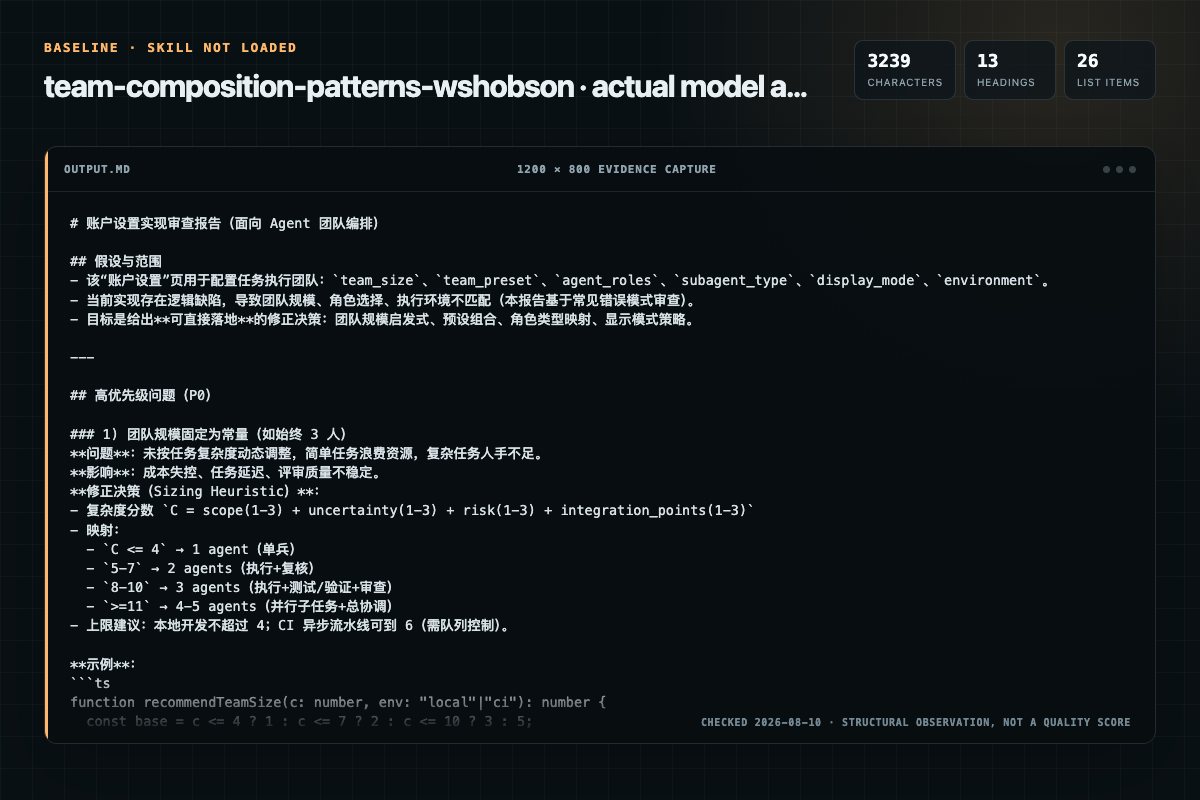
Baseline: 3239 non-whitespace characters, 13 headings, and 26 list items.
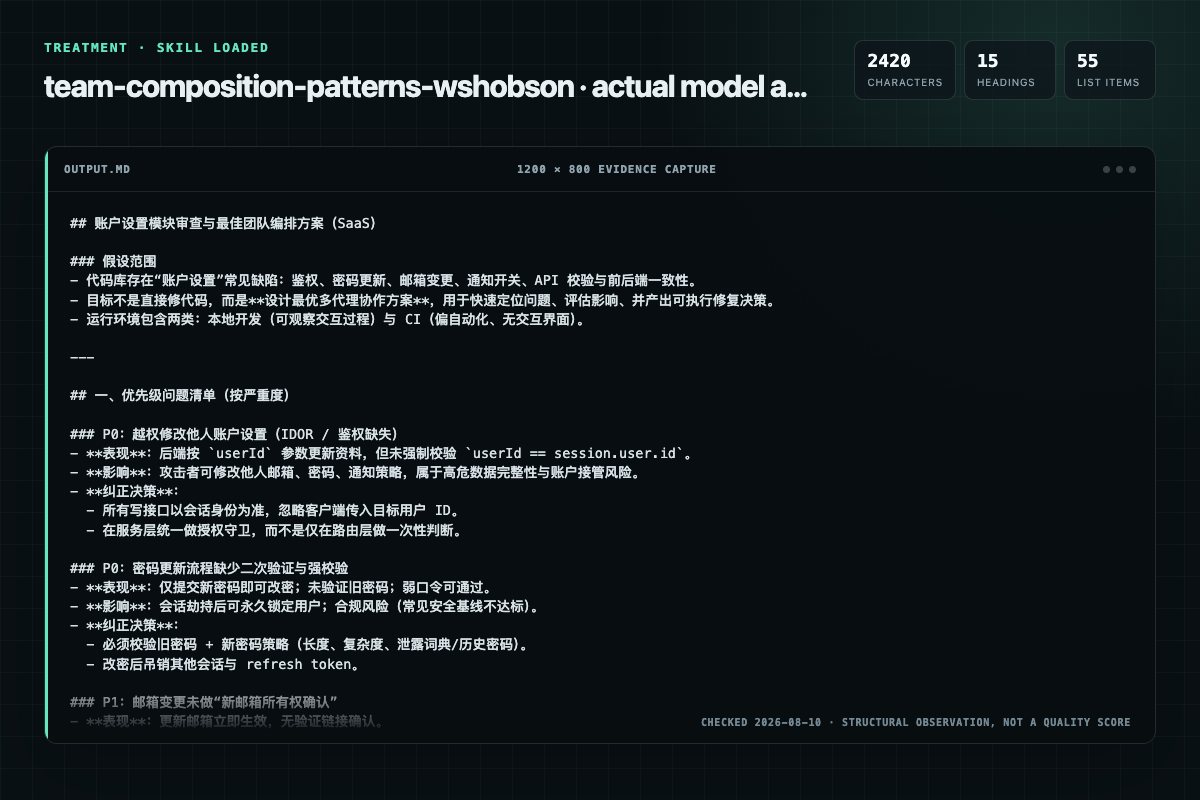
With Skill: 2420 non-whitespace characters, 15 headings, and 55 list items.
| Observation | Without Skill | With Skill |
|---|---|---|
| Source-signal coverage | 3/8: sizing, preset, debug | 1/8: debug |
| Output structure | 3239 chars · 13 headings · 26 list items · 5 code blocks | 2420 chars · 15 headings · 55 list items · 1 code blocks |
| Verification and caution signals | 9 verification signals · 3 risk/limitation signals | 12 verification signals · 8 risk/limitation signals |
Use the team-composition-patterns Skill pinned at 367cb6a4a182 for my task. Follow its source-specific constraints around `team-composition-patterns`, `composition`, `patterns`, `sizing`, then return the finished deliverable with explicit assumptions, verification, failure conditions, and limits. Do not treat the Skill text as a factual source or claim that a single demonstration proves universal performance.
Compatibility matrix
| Platform | Status | Evidence | What to check |
|---|---|---|---|
| Codex | Not declared | No explicit evidence | Portability before use |
| Claude Code | Not declared | No explicit evidence | Portability before use |
| Cursor | Not declared | No explicit evidence | Portability before use |
| Gemini CLI | Not declared | No explicit evidence | Portability before use |
Installation
The source command is displayed only when detected. A safe inspection prompt is always available so your agent can explain every action before execution.
npx skills add https://github.com/wshobson/agents --skill "plugins/agent-teams/skills/team-composition-patterns"Inspect the Agent Skill "team-composition-patterns" from https://github.com/wshobson/agents/blob/d82998e7df393c671ede2387a8435075f0b633f5/plugins/agent-teams/skills/team-composition-patterns/SKILL.md at commit d82998e7df393c671ede2387a8435075f0b633f5. List every install step, command, network request, credential, file read/write, external action, and rollback step. Explain whether it fits my task. Do not install or execute anything until I approve.
Workflow
Size: 3 reviewers
Deciding how many teammates to spawn for a task
Rule of thumb: Start with the smallest team that covers all required dimensions. Adding teammates increases coordination overhead.
Size: 3 reviewers
Size: 3 investigators
Permission review
The documentation includes network, browsing, or remote request actions.
**Capabilities**: Codebase search (Grep, Glob, Read), web search (WebSearch, WebFetch)Evidence record
| Signal | Value | Evidence type | Meaning |
|---|---|---|---|
| Quality score | 91/100 | Computed | Documentation, specificity, maintenance, and trust rules |
| Repository stars | 39,098 | Source | Repository attention, not individual Skill quality |
| Compatibility | 0 platforms | Source | Declared in the catalog source record |
| Usage guide | tested outcome page | Tested | Generated or reviewed according to the visible evidence level |
Pinned source
Best practices for composing multi-agent teams, selecting team sizes, choosing agent types, and configuring display modes for Claude Code's Agent Teams feature.
| Complexity | Team Size | When to Use |
|---|---|---|
| Simple | 1-2 | Single-dimension review, isolated bug, small feature |
| Moderate | 2-3 | Multi-file changes, 2-3 concerns, medium features |
| Complex | 3-4 | Cross-cutting concerns, large features, deep debugging |
| Very Complex | 4-5 | Full-stack features, comprehensive reviews, systemic issues |
Rule of thumb: Start with the smallest team that covers all required dimensions. Adding teammates increases coordination overhead.
team-reviewerteam-debuggerteam-lead + 2x team-implementerteam-lead + 1x frontend team-implementer + 1x backend team-implementer + 1x test team-implementergeneral-purposeteam-reviewerteam-lead + 2x team-implementer + 1x team-reviewerWhen spawning teammates with the Agent tool, choose subagent_type based on what tools the teammate needs:
| Agent Type | Tools Available | Use For |
|---|---|---|
general-purpose | All tools (Read, Write, Edit, Bash, etc.) | Implementation, debugging, any task requiring file changes |
Explore | Read-only tools (Read, Grep, Glob) | Research, code exploration, analysis |
Plan | Read-only tools | Architecture planning, task decomposition |
agent-teams:team-reviewer | Read/search/Bash plus TaskList/TaskGet/TaskUpdate/SendMessage | Code review with structured findings |
agent-teams:team-debugger | Read/search/Bash plus TaskList/TaskGet/TaskUpdate/SendMessage | Hypothesis-driven investigation |
agent-teams:team-implementer | Read/Write/Edit/search/Bash plus TaskList/TaskGet/TaskUpdate/SendMessage | Building features within file ownership boundaries |
agent-teams:team-lead | Read/search/Bash plus Agent Teams coordination tools | Team orchestration and coordination |
Key distinction: Read-only agents (Explore, Plan) cannot modify files. Never assign implementation tasks to read-only agents.
Configure in ~/.claude/settings.json:
{
  "teammateMode": "tmux"
}
| Mode | Behavior | Best For |
|---|---|---|
"tmux" | Each teammate in a tmux pane | Development workflows, monitoring multiple agents |
"iterm2" | Each teammate in an iTerm2 tab | macOS users who prefer iTerm2 |
"in-process" | All teammates in same process | Simple tasks, CI/CD environments |
When building custom teams:
team-lead or have the user coordinate directlyA teammate was spawned as Explore but needs to write files.
Explore and Plan are read-only agents. Change the subagent_type to general-purpose or an appropriate specialized agent type. Never assign implementation tasks to read-only agents.
The team is growing too large and coordination is slowing everything down. Each additional teammate adds communication overhead. Consolidate roles: can one agent cover two dimensions? A 4-person team doing 6 independent tasks is usually better served by 3 agents covering 2 tasks each.
tmux mode is not showing panes.
Ensure tmux is installed and a session is already running before spawning teammates. The in-process mode works without tmux and is suitable for CI or scripted environments.
Two reviewers are flagging the same issues. The review dimensions overlap. Redefine each reviewer's focus area: one on correctness/logic, one on security, one on performance/scalability. Overlapping coverage wastes tokens and produces duplicate findings.
A team-lead is spawning teammates but they are not receiving tasks.
Verify that the lead is using the Agent tool to spawn teammates and passing complete context in the prompt. Teammates start fresh with no prior conversation history — they need all relevant information in their initial prompt.
Frequently asked questions
Best practices for composing multi-agent teams, selecting team sizes, choosing agent types, and configuring display modes for Claude Code's Agent Teams feature.
The source record exposes this install command: npx skills add https://github.com/wshobson/agents --skill "plugins/agent-teams/skills/team-composition-patterns". Inspect the command and pinned source before running it.
Static rules flagged network in the source; the page lists the matching lines and excerpts.
Alternatives
coreyhaines31/marketingskills
When the user wants to plan, design, or implement an A/B test or experiment, or build a growth experimentation program. Also use when the user mentions "A/B test," "split test," "experiment," "test this change," "variant copy," "multivariate test," "hypothesis," "should I test this," "which version is better," "test two versions," "statistical significance," "how long should I run this test," "growth experiments," "experiment velocity," "experiment backlog," "ICE score," "experimentation program
narrative-io/narrative-skills-marketplace
Translate a fuzzy analytical question into a rigorous investigation plan. Interrogates the ask, grounds the plan in the available data dictionary, applies analytical best practices, and produces a structured brief of query specifications for a downstream query-writing skill. Plans, does not write SQL. Use when: "why did X drop", "is there a relationship between A and B", "who are our highest-value customers", "what's driving the change in Y", "investigate this trend", "design an analysis for", "
brucesongs/kali-claw
Insecure Design (OWASP A06:2025) focuses on security flaws in system architecture and design phases, rather than code implementation-level bugs.
NintendaDev/unikit-ai
Generate and maintain the project's TECHNICAL documentation from its codebase — scans the project structure, tech stack, and module boundaries, then writes a lean README landing page plus detailed topic pages (architecture, modules, setup, build, APIs), only the docs that are relevant. Use whenever the user wants to create, update, or validate documentation of the CODE or the project itself, e.g. "generate documentation", "create docs", "write the README", "update the project docs", "document th