
Best for
- Use when a Leader maintains durable TeamHarness project state for Quick Task or Project Work: create_quick_project, create_project, plan_dag, plan_loop, ready_nodes, resolve_project, accept_task_result, project completi…
agentscope-ai/AgentTeams/plugins/teamharness/skills/team/project-management/SKILL.md
Use when a Leader maintains durable TeamHarness project state for Quick Task or Project Work: create_quick_project, create_project, plan_dag, plan_loop, ready_nodes, resolve_project, accept_task_result, project completion, and requester report state. Do not use to create Matrix task rooms or send messages.
Decision brief
Use this skill when maintaining durable project state.
In this controlled same-task single run, enabling teamharness-project-management changed the output from 2338 non-whitespace characters and 16 headings to 2190 characters and 17 headings. Matches among 8 signals extracted from the pinned source changed from 1 to 1. Both actual outputs are shown; this is a structural observation, not a quality score or a universal performance claim.
Produce a decision-ready research brief for a small SaaS team evaluating retrieval-augmented generation. State assumptions, evidence needs, tradeoffs, and next actions. The deliverable must specifically reflect this user intent: Use when a Leader maintains durable TeamHarness project state for Quick Task or Project Work: create_quick_project, create_project, plan_dag, plan_loop, ready_nodes, resolve_project, accept_task_result, project completion, and requester report state. Do not use to create Matrix task rooms or send messages.
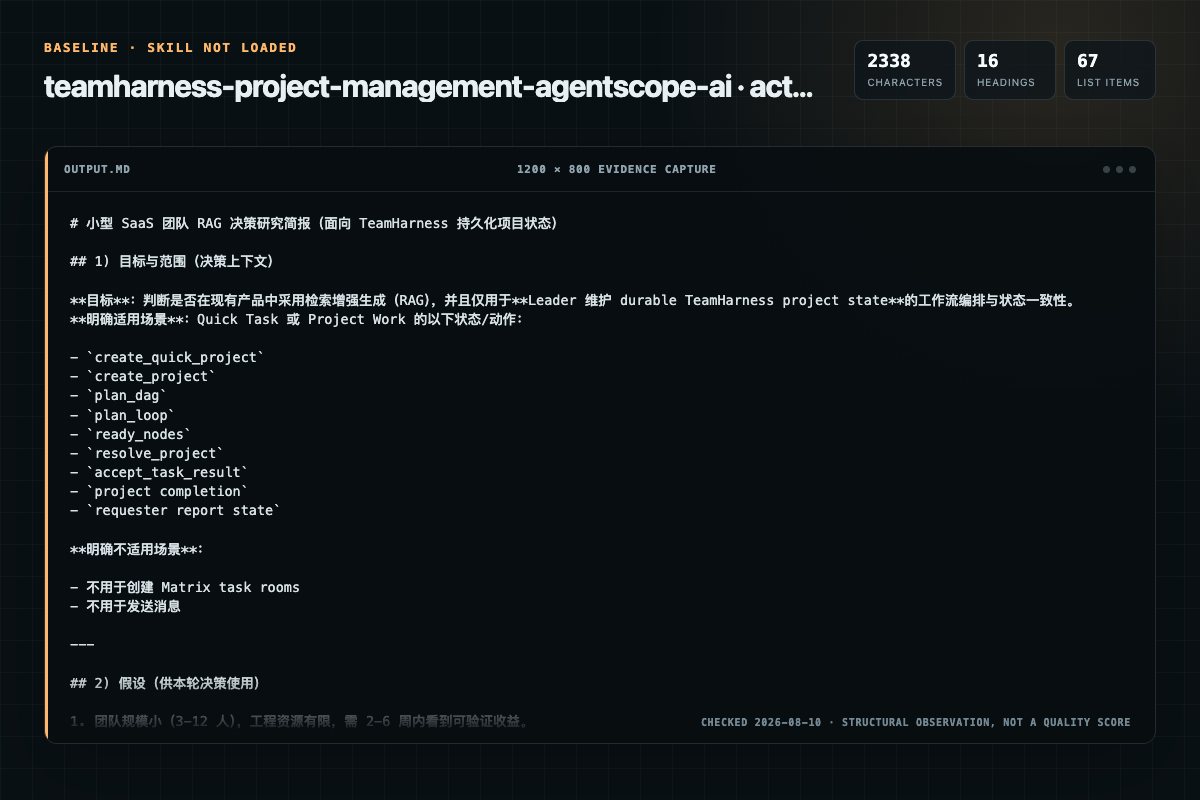
Baseline: 2338 non-whitespace characters, 16 headings, and 67 list items.
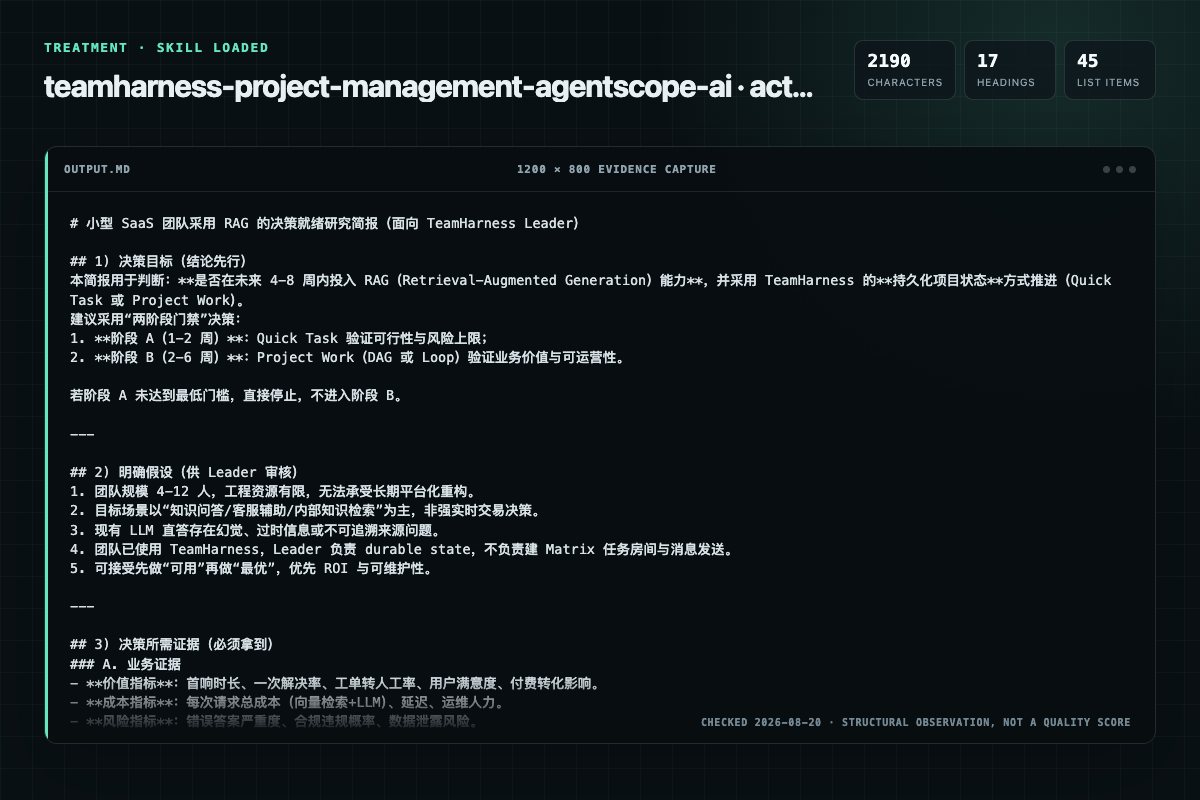
With Skill: 2190 non-whitespace characters, 17 headings, and 45 list items.
| Observation | Without Skill | With Skill |
|---|---|---|
| Source-signal coverage | 1/8: project | 1/8: project |
| Output structure | 2338 chars · 16 headings · 67 list items · 0 code blocks | 2190 chars · 17 headings · 45 list items · 0 code blocks |
| Verification and caution signals | 12 verification signals · 10 risk/limitation signals | 10 verification signals · 9 risk/limitation signals |
Use the teamharness-project-management Skill pinned at 180b8e81b649 for my task. Follow its source-specific constraints around `teamharness-project-management`, `project`, `management`, `scope`, then return the finished deliverable with explicit assumptions, verification, failure conditions, and limits. Do not treat the Skill text as a factual source or claim that a single demonstration proves universal performance.
Compatibility matrix
| Platform | Status | Evidence | What to check |
|---|---|---|---|
| Codex | Not declared | No explicit evidence | Portability before use |
| Claude Code | Not declared | No explicit evidence | Portability before use |
| Cursor | Not declared | No explicit evidence | Portability before use |
| Gemini CLI | Not declared | No explicit evidence | Portability before use |
Installation
The source command is displayed only when detected. A safe inspection prompt is always available so your agent can explain every action before execution.
npx skills add https://github.com/agentscope-ai/AgentTeams --skill "plugins/teamharness/skills/team/project-management"Inspect the Agent Skill "teamharness-project-management" from https://github.com/agentscope-ai/AgentTeams/blob/223ddc2b8073e4c8b93bcbb15e1d717f196c04d9/plugins/teamharness/skills/team/project-management/SKILL.md at commit 223ddc2b8073e4c8b93bcbb15e1d717f196c04d9. List every install step, command, network request, credential, file read/write, external action, and rollback step. Explain whether it fits my task. Do not install or execute anything until I approve.
Workflow
Use this skill when acting as Leader for:
Project files live under:
Do not use colons, slashes, spaces, or Matrix IDs as project or task IDs.
When calling projectflow, pass payload as a JSON object, not as a serialized JSON string.
Create the project before planning tasks:
Permission review
No configured static risk pattern was detected
This is not proof of safety. Runtime behavior, indirect dependencies, and hidden external systems are outside the static scan.
Evidence record
| Signal | Value | Evidence type | Meaning |
|---|---|---|---|
| Quality score | 95/100 | Computed | Documentation, specificity, maintenance, and trust rules |
| Repository stars | 5,482 | Source | Repository attention, not individual Skill quality |
| Compatibility | 0 platforms | Source | Declared in the catalog source record |
| Usage guide | tested outcome page | Tested | Generated or reviewed according to the visible evidence level |
Pinned source
Use this skill when maintaining durable project state.
A project owns the plan, context, dependencies, and accepted progress. Keep the project plan separate from individual task execution logs.
Only advance a dependency after the Leader accepts the submitted result. Do not use this skill for ordinary direct replies or lightweight one-off actions.
Use this skill when acting as Leader for:
projectflow callsFor Project Work, use teamharness-team-coordination first to decide task
boundaries. If no task room exists yet, use teamharness-roomflow and
teamharness-communication before this skill. Use
teamharness-task-delegation for individual task specs, assignment messages,
and Worker result checks.
Project files live under:
shared/projects/{project-id}/
TeamHarness writes CoPaw-compatible task runtime files:
shared/projects/{project-id}/meta.json
shared/projects/{project-id}/plan.md
Write a final project result, when needed, to:
shared/projects/{project-id}/result.md
The Leader owns this project result file. Build it from accepted project state and accepted task deliverables; do not ask Workers to write or submit it as a task deliverable.
Use projectflow to change meta.json and plan.md; do not hand-edit
project state unless a tool failure leaves no safe alternative.
Use safe IDs only:
[A-Za-z0-9][A-Za-z0-9._-]*
Do not use colons, slashes, spaces, or Matrix IDs as project or task IDs.
Suggested formats:
projectId: {short-description}-YYYYMMDD-HHMMSS
taskId: {projectId}-{seq}
If a user or test provides explicit IDs, preserve them when they are already safe.
When calling projectflow, pass payload as a JSON object, not as a serialized
JSON string.
Create the project before planning tasks:
{
  "action": "create_project",
  "payload": {
    "projectId": "demo-project-001",
    "title": "Demo Project",
    "source": "dingtalk",
    "requester": "dingtalk:sender_001:aaaaaaaa",
    "replyRoute": {
      "channel": "dingtalk",
      "targetUser": "sender_001",
      "targetSession": "aaaaaaaa"
    }
  }
}
This creates meta.json and plan.md.
team_id is stamped automatically from the runtime team configuration; pass
payload.teamId explicitly only when the project must belong to a different
team than the calling Worker's own team.
If projectId is omitted, TeamHarness derives one from title plus timestamp.
If the generated ID already exists, TeamHarness appends a numeric suffix.
Explicit projectId collisions are rejected.
Use replyRoute when the requester came from a runtime channel that may need a
cross-session final report. channel, targetUser, and targetSession must
come from the current message/session metadata or a trusted runtime query. Do
not guess them.
For Project Work that should proceed in a dedicated task room, do not call
create_project in the requester/source session. Use
teamharness-communication to send a PROJECT_REQUESTED self-trigger from the
current requester/source session to the same Leader in the target Matrix task
room first. After the task-room Leader session wakes up, call create_project
there and preserve the original requester route from the visible
PROJECT_REQUESTED request: keep the original source, requester,
sourceRoomId, and replyRoute so final reports can return to the
DingTalk group, Matrix DM, or other source room that made the request. Do not
invent missing replyRoute values from requester names or prose.
For DingTalk requester compatibility, requester may use
dingtalk:{user_id}:{session_id}; TeamHarness derives reply_route from that
value when replyRoute is not provided.
Use create_quick_project only after Quick Task mode is selected and the
Leader is in the Matrix Task room that received the task request message. It is
a shortcut for:
create_project + plan single-node DAG + assigned task spec
Do not call this in the requester/source session. If the current session is
still a DingTalk group, Matrix DM, Team room, or other source room, return to
TEAMS.md: create or reuse the task room with teamharness-roomflow, hand the
request to that room with teamharness-communication, and stop in the source
session.
Before calling this action in the Task room:
roomId.source, requester, sourceRoomId, and replyRoute
from the task request message. Do not guess route values.teamharness-task-delegation.teamharness-roomflow owns task-room creation, project-scoped reuse, source
metadata capture, and Worker invites. This skill only creates durable project
and task state after the Task room is already selected.
Example:
{
  "action": "create_quick_project",
  "payload": {
    "title": "Write readiness note",
    "source": "matrix",
    "requester": "@admin:matrix.local",
    "sourceRoomId": "!admin-dm:matrix.local",
    "assignedTo": "@worker-a:matrix.local",
    "roomId": "!task-room:matrix.local",
    "spec": "# Task\n\nWrite one concise readiness note.",
    "replyRoute": {
      "channel": "matrix",
      "targetUser": "@admin:matrix.local",
      "targetSession": "!admin-dm:matrix.local"
    }
  }
}
This writes:
shared/projects/{projectId}/meta.json
shared/projects/{projectId}/plan.md
shared/tasks/{taskId}/meta.json
shared/tasks/{taskId}/spec.md
It sets mode: quick, plan_type: dag, and the single task status to
assigned. It does not send the Matrix or external-channel assignment message;
send that message only after the tool returns ok: true.
Use DAG when the work is finite and dependencies are known enough to plan now.
Call plan_dag with the complete graph you want to keep:
{
  "action": "plan_dag",
  "payload": {
    "projectId": "demo-project-001",
    "tasks": [
      {
        "taskId": "demo-project-001-01",
        "title": "Implement the worker-owned part",
        "assignedTo": "@worker-a:matrix.local",
        "dependsOn": []
      }
    ]
  }
}
For assignedTo, use the Worker Matrix ID or the stable runtime/member name
from TEAMS.md. Do not invent a Worker name.
plan_dag returns readyNodes. Delegate only ready nodes.
Use ready_nodes when you need the next pending or assigned DAG nodes whose
dependencies are completed:
{
  "action": "ready_nodes",
  "payload": {
    "projectId": "demo-project-001"
  }
}
Only nodes with dependencies marked completed unblock downstream work.
Use Loop when teamharness-team-coordination decided the work should repeat
until a stop condition, quality gate, evidence threshold, or maximum iteration
count.
Call plan_loop with the complete current-iteration plan you want to keep:
{
  "action": "plan_loop",
  "payload": {
    "projectId": "demo-project-001",
    "goal": "Improve the result until tests pass",
    "stopCondition": "All target tests pass or maxIterations is reached",
    "iterationTemplate": "Inspect result, choose one bounded fix, run tests.",
    "maxIterations": 3,
    "currentIteration": 1,
    "tasks": [
      {
        "taskId": "demo-project-001-i001-01",
        "title": "Run iteration 1",
        "assignedTo": "@worker-a:matrix.local",
        "dependsOn": []
      }
    ]
  }
}
Required Loop inputs:
goalstopConditioniterationTemplatemaxIterationsUse ready_loop_nodes to find pending nodes in the current iteration whose
dependencies are completed:
{
  "action": "ready_loop_nodes",
  "payload": {
    "projectId": "demo-project-001"
  }
}
After evaluating an iteration, use record_loop_iteration:
{
  "action": "record_loop_iteration",
  "payload": {
    "projectId": "demo-project-001",
    "iteration": 1,
    "decision": "continue",
    "summary": "One target still fails.",
    "nextAction": "Plan the next fix pass."
  }
}
Allowed decisions are continue, replan, ask_user, stop_success, and
stop_blocked.
Do not pre-expand repeated Loop rounds into a large DAG. Plan the current iteration, evaluate it, record the iteration decision, then decide whether to continue, replan, ask the requester, stop successfully, or stop blocked.
When a Worker completion or blocker wakes the Leader in a fresh session, do not guess the project from the current room. First resolve the context from the task id:
{
  "action": "resolve_project",
  "payload": {
    "taskId": "demo-project-001-01"
  }
}
resolve_project returns the ProjectMeta, TaskMeta, replyRoute, plan type, and
ready nodes that the Leader needs to resume normal project flow.
A Worker SUCCESS or SUCCESS_WITH_NOTES result is only a candidate result.
After teamharness-task-delegation checks the task and returns effective: true, decide whether to accept the result.
To accept a result, call accept_task_result:
{
  "action": "accept_task_result",
  "payload": {
    "projectId": "demo-project-001",
    "taskId": "demo-project-001-01",
    "resultStatus": "SUCCESS",
    "summary": "Completed the assigned work."
  }
}
accept_task_result updates the DAG or Loop node and records
requester_report.pending in ProjectMeta. Keep unresolved nodes in their current
state.
Accepting a completed result does not publish the project artifact by default.
Write or update shared/projects/{project-id}/result.md as the Leader when a
project-level report file is needed. After the requester report message is sent
to a Matrix requester room, publish shared/projects/{project-id}/result.md
with artifact publish_file and set parentEventId to the report message id.
Use publishArtifacts: true only when you intentionally want an immediate
project artifact before the requester report.
Then call ready_nodes and delegate any newly ready downstream node with
teamharness-task-delegation.
After the project state changes, close the loop with requester visibility:
shared/projects/{project-id}/meta.json and plan.md.teamharness-communication
## Requester Report Delivery Protocol to deliver the report to the
requester recorded on the project.shared/projects/{project-id}/result.md exists, call artifact publish_file
for that file with parentEventId set to the report message id.shared/... artifact
paths and say they are available from the shared workspace or platform
object-storage view.mark_requester_report_sent.Task room coordination, Worker completion messages, downstream assignment messages, and tool-call summaries do not count as the requester report. You may batch several accepted task results and downstream delegations into one requester report, but do not omit the report when accepted project state changed.
Build status report content here because this skill owns project execution
state. Use teamharness-communication only for destination selection, message
tool payloads, Matrix message formatting, and same-room versus cross-room
delivery.
Before writing a requester report:
shared/projects/{project-id}/meta.json and plan.md.meta.json or plan.md.teamharness-communication to deliver it to the requester recorded on the
project.Use stable state markers and localize the visible labels:
| State | Marker |
|---|---|
| Completed | [done] |
| In Progress | [active] |
| Pending | [pending] |
| Blocked | [blocked] |
| Revision | [revision] |
Keep the report envelope consistent across DAG and Loop:
---

## <localized project status report heading>

**<localized project name label>**: <name>
**<localized project ID label>**: <project-id>
**<localized execution mode label>**: <DAG or Loop>
**<localized project status label>**: <marker + localized state label>
**<localized current focus label>**: <DAG wave/current node, or Loop iteration n / max and topic>

**<localized summary label>**: <1-3 sentences about what changed and what happens next>

**<localized task status label>**:
| <localized task ID label> | <localized task title label> | <localized owner label> | <localized status label> | <localized context label> |
|---|---|---|---|---|
| <task-id> | <title> | <worker> | <marker + localized state label> | <dependencies, iteration role, result note, or -> |

**<localized execution progress label>**:
```text
<DAG dependency flow or Loop iteration line; choose the matching shape below>
```

**<localized deliverables label>**:
- `<path>` - <what it contains>

For Matrix requester reports, this section may say the report file or artifact
was published to the requester room only after `artifact publish_file` succeeds.
For DingTalk, Feishu, WeChat, or other non-Matrix requester reports, say the
files are available from the shared workspace or platform object-storage view;
do not say "attached", "uploaded to this chat", "click the file card", or
"view the file here".

**<localized next steps label>**:
1. <next DAG transition, next Loop decision, or requester action>

**<localized notes label>**: <blocker, risk, or decision needed; omit section if none>
In requester-facing reports, owner or executor cells are descriptive text.
Use plain Worker display names or role names such as workeraa, workerbb, or
WorkerAA. Do not prefix them with @, do not use full Matrix user ids, and do
not create Matrix mention links unless the report is intentionally asking that
member to respond or take action.
Use this execution progress shape for DAG reports:
<task-id> [done] -> <task-id> [active] -> <task-id> [pending]
                                  ^
<task-id> [done] -----------------|
Use the DAG progress section to show the dependency path that changed, newly unblocked nodes, or the next ready wave. If the graph is large, show only the relevant changed path and summarize the rest in the task table.
Use this execution progress shape for Loop reports:
Iteration 1 [done] -> Iteration 2 [active] -> Iteration 3 [pending] ... Max <n>
                       Current: <current iteration topic>
                       Decision: <continue, replan, ask_user, stop_success, stop_blocked, or pending evaluation>
Use the Loop progress section to show current iteration number, maximum iterations, current iteration topic, and the latest Leader decision. Do not present future Loop rounds as if they were pre-planned DAG tasks. Show only the current iteration's task statuses in the task table unless prior iteration context is necessary.
For intermediate updates, include the Project header, summary, task status table, and next steps. Omit the deliverables section unless new deliverables are available, and omit the execution progress section only when neither DAG flow nor Loop iteration state changed.
After the requester report is sent, clear the pending flag:
{
  "action": "mark_requester_report_sent",
  "payload": {
    "projectId": "demo-project-001"
  }
}
State-mutating projectflow and taskflow operations return a
notificationNeeded field when they succeed. This field is a hint — the tool
does not send any message automatically. The Leader must act on it.
When notificationNeeded is present in the tool result:
notificationNeeded.targetRoom. If it matches the current session
room, a direct reply in the current session is sufficient — no cross-room
message is needed.targetRoom is a different room, use the message tool to send a brief
status update to that room. Use m.notice-style concise format:
[ProjectFlow] {event}: {summary}.notificationNeeded.replyRoute is present and the event is
accept_task_result or complete_project, this is the requester report
trigger — follow the Requester Report Delivery Protocol in
teamharness-communication.ok: false.The notificationNeeded field contains:
{
  "event": "create_project",
  "projectId": "demo-project-001",
  "summary": "create_project: Demo Project",
  "targetRoom": "!task-room:matrix.local",
  "replyRoute": { "channel": "matrix", "targetSession": "..." }
}
targetRoom and replyRoute may be absent when no room context is available
(for example, a bare create_project before any task room exists). In that
case, skip the notification — the assignment message or requester report will
carry the project context later.
Use these when a human asks the Leader to pause, resume, or complete a project (or when the Leader decides a project should stop dispatching new work). A Controller API also implements these as structured endpoints; this skill documents the MCP-native path a Leader uses in conversation.
Call pause_project to stop new task dispatch. In-flight tasks are NOT
cancelled — they keep running and their completion reports still arrive. Do
not delegate new ready nodes while paused.
{
  "action": "pause_project",
  "payload": {
    "projectId": "demo-project-001"
  }
}
Call resume_project to put a paused project back to active:
{
  "action": "resume_project",
  "payload": {
    "projectId": "demo-project-001"
  }
}
Call complete_project only when every task has reached a terminal status
(completed / revision / blocked / cancelled) and no work remains — a
completed project is terminal. Pass publishArtifacts: true only when you
intentionally want an immediate project artifact before the requester report
(see Accepting Worker Results):
{
  "action": "complete_project",
  "payload": {
    "projectId": "demo-project-001",
    "publishArtifacts": false
  }
}
pause_project / resume_project / complete_project change project status
only; they do not cancel in-flight tasks or delete task state. If a task must
be cancelled, use taskflow cancel_task (Leader only) with a reason.
TeamHarness v0.1 supports project creation, quick single-task project creation,
project context resolution, DAG planning, DAG ready-node resolution, Loop
planning, Loop ready-node resolution, Loop iteration recording, explicit result
acceptance, requester report clearing, pause_project, resume_project, and
complete_project. DAG and Loop task plans reject duplicate task ids, unknown
dependencies, and dependency cycles. Do not call unsupported projectflow
actions.
Frequently asked questions
Use this skill when maintaining durable project state.
The source record exposes this install command: npx skills add https://github.com/agentscope-ai/AgentTeams --skill "plugins/teamharness/skills/team/project-management". Inspect the command and pinned source before running it.
Alternatives
coreyhaines31/marketingskills
When the user wants to plan, design, or implement an A/B test or experiment, or build a growth experimentation program. Also use when the user mentions "A/B test," "split test," "experiment," "test this change," "variant copy," "multivariate test," "hypothesis," "should I test this," "which version is better," "test two versions," "statistical significance," "how long should I run this test," "growth experiments," "experiment velocity," "experiment backlog," "ICE score," "experimentation program
coreyhaines31/marketingskills
When the user wants to reduce churn, build cancellation flows, set up save offers, recover failed payments, or implement retention strategies. Also use when the user mentions 'churn,' 'cancel flow,' 'offboarding,' 'save offer,' 'dunning,' 'failed payment recovery,' 'win-back,' 'retention,' 'exit survey,' 'pause subscription,' 'involuntary churn,' 'people keep canceling,' 'churn rate is too high,' 'how do I keep users,' or 'customers are leaving.' Use this whenever someone is losing subscribers o
alirezarezvani/claude-skills
App Store Optimization (ASO) toolkit for researching keywords, analyzing competitor rankings, generating metadata suggestions, and improving app visibility on Apple App Store and Google Play Store. Use when the user asks about ASO, app store rankings, app metadata, app titles and descriptions, app store listings, app visibility, or mobile app marketing on iOS or Android. Supports keyword research and scoring, competitor keyword analysis, metadata optimization, A/B test planning, launch checklist
wanshuiyin/Auto-claude-code-research-in-sleep
Use it for operations and research tasks; the detail page covers purpose, installation, and practical steps.