
Best for
- "Write a timeline report"
- "Journey into [project]"
- "Analyze my project history"
thedotmack/claude-mem/plugin/skills/timeline-report/SKILL.md
Generate a "Journey Into [Project]" narrative report analyzing a project's entire development history from claude-mem's timeline. Use when asked for a timeline report, project history analysis, development journey, or full project report.
Decision brief
Generate a comprehensive narrative analysis of a project's entire development history using claude-mem's persistent memory timeline.
In this controlled same-task single run, enabling timeline-report changed the output from 1883 non-whitespace characters and 9 headings to 2419 characters and 13 headings. Matches among 8 signals extracted from the pinned source changed from 1 to 2. Both actual outputs are shown; this is a structural observation, not a quality score or a universal performance claim.
Produce a decision-ready research brief for a small SaaS team evaluating retrieval-augmented generation. State assumptions, evidence needs, tradeoffs, and next actions. The deliverable must specifically reflect this user intent: Generate a "Journey Into [Project]" narrative report analyzing a project's entire development history from claude-mem's timeline. Use when asked for a timeline report, project history analysis, development journey, or full project report.
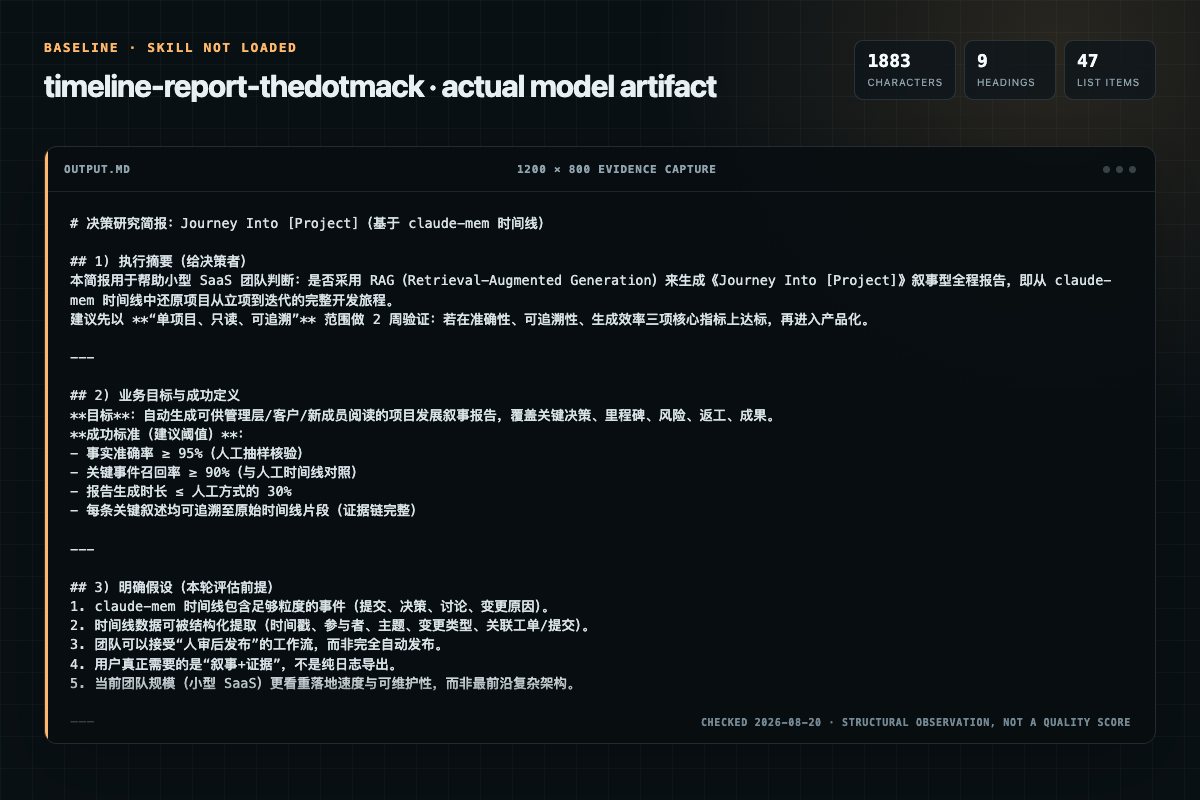
Baseline: 1883 non-whitespace characters, 9 headings, and 47 list items.
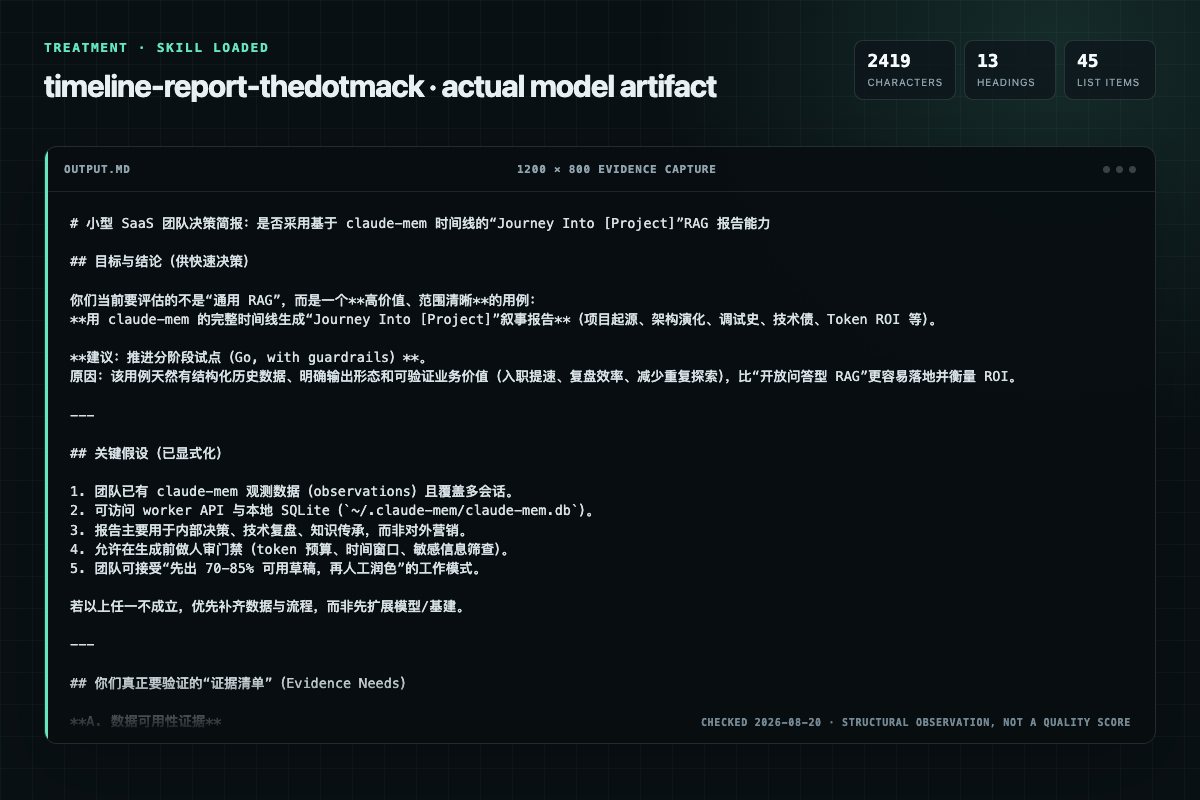
With Skill: 2419 non-whitespace characters, 13 headings, and 45 list items.
| Observation | Without Skill | With Skill |
|---|---|---|
| Source-signal coverage | 1/8: project | 2/8: timeline, project |
| Output structure | 1883 chars · 9 headings · 47 list items · 0 code blocks | 2419 chars · 13 headings · 45 list items · 0 code blocks |
| Verification and caution signals | 3 verification signals · 9 risk/limitation signals | 9 verification signals · 7 risk/limitation signals |
Use the timeline-report Skill pinned at e2d1df569a8f for my task. Follow its source-specific constraints around `timeline-report`, `timeline`, `report`, `prerequisites`, then return the finished deliverable with explicit assumptions, verification, failure conditions, and limits. Do not treat the Skill text as a factual source or claim that a single demonstration proves universal performance.
Compatibility matrix
| Platform | Status | Evidence | What to check |
|---|---|---|---|
| Codex | Not declared | No explicit evidence | Portability before use |
| Claude Code | Not declared | No explicit evidence | Portability before use |
| Cursor | Not declared | No explicit evidence | Portability before use |
| Gemini CLI | Not declared | No explicit evidence | Portability before use |
Installation
The source command is displayed only when detected. A safe inspection prompt is always available so your agent can explain every action before execution.
npx skills add https://github.com/thedotmack/claude-mem --skill "plugin/skills/timeline-report"Inspect the Agent Skill "timeline-report" from https://github.com/thedotmack/claude-mem/blob/e2d1df569a8f04075d40e92461128ece7cf04c82/plugin/skills/timeline-report/SKILL.md at commit e2d1df569a8f04075d40e92461128ece7cf04c82. List every install step, command, network request, credential, file read/write, external action, and rollback step. Explain whether it fits my task. Do not install or execute anything until I approve.
Workflow
Ask the user which project to analyze if not obvious from context. The project name is typically the directory name of the project (e.g., "tokyo", "my-app"). If the user says "this project", use the current working directory's basename.
Ask the user which project to analyze if not obvious from context. The project name is typically the directory name of the project (e.g., "tokyo", "my-app"). If the user says "this project", use the current working directory's basename.
Use Bash to fetch the complete timeline from the claude-mem worker API:
Before proceeding, estimate the token count of the fetched timeline (roughly 1 token per 4 characters). Report this to the user:
Deploy an Agent (using the Task tool) with the full timeline and the following analysis prompt. Pass the ENTIRE timeline as context to the agent. The agent should also be instructed to query the SQLite database at /.claude-mem/claude-mem.db for the Token Economics section.
Permission review
The documentation asks the agent to read local files, directories, or repositories.
WORKER_PORT="${CLAUDE_MEM_WORKER_PORT:-$(node -e "const fs=require('fs'),p=require('path'),os=require('os');const uid=(typeof process.getuid==='function'?process.getuid():77);const fallback=String(37700+(uid%100));try{const s=JSON.parse(fs.The documentation includes network, browsing, or remote request actions.
curl -s "http://localhost:${WORKER_PORT}/api/context/inject?project=PROJECT_NAME&full=true"The documentation asks the agent to create, modify, or delete local files.
Save the agent's output as a markdown file. Default location:Evidence record
| Signal | Value | Evidence type | Meaning |
|---|---|---|---|
| Quality score | 93/100 | Computed | Documentation, specificity, maintenance, and trust rules |
| Repository stars | 91,741 | Source | Repository attention, not individual Skill quality |
| Compatibility | 0 platforms | Source | Declared in the catalog source record |
| Usage guide | tested outcome page | Tested | Generated or reviewed according to the visible evidence level |
Pinned source
Generate a comprehensive narrative analysis of a project's entire development history using claude-mem's persistent memory timeline.
Use when users ask for:
The claude-mem worker must be running. The project must have claude-mem observations recorded.
Resolve the worker port (do this once at the start and reuse $WORKER_PORT in every curl call below):
WORKER_PORT="${CLAUDE_MEM_WORKER_PORT:-$(node -e "const fs=require('fs'),p=require('path'),os=require('os');const uid=(typeof process.getuid==='function'?process.getuid():77);const fallback=String(37700+(uid%100));try{const s=JSON.parse(fs.readFileSync(p.join(os.homedir(),'.claude-mem','settings.json'),'utf-8'));process.stdout.write(String(s.CLAUDE_MEM_WORKER_PORT||fallback));}catch{process.stdout.write(fallback);}" 2>/dev/null)}"
This honors CLAUDE_MEM_WORKER_PORT env, then ~/.claude-mem/settings.json, then falls back to the per-UID default 37700 + (uid % 100) — matching how the worker itself picks its port. Required for multi-account setups (#2101) and any user who has overridden the default port (#2103).
Ask the user which project to analyze if not obvious from context. The project name is typically the directory name of the project (e.g., "tokyo", "my-app"). If the user says "this project", use the current working directory's basename.
Worktree Detection: Before using the directory basename, check if the current directory is a git worktree. In a worktree, the data source is the parent project, not the worktree directory itself. Run:
git_dir=$(git rev-parse --git-dir 2>/dev/null)
git_common_dir=$(git rev-parse --git-common-dir 2>/dev/null)
if [ "$git_dir" != "$git_common_dir" ]; then
  # We're in a worktree — resolve the parent project name
  parent_project=$(basename "$(dirname "$git_common_dir")")
  echo "Worktree detected. Parent project: $parent_project"
else
  parent_project=$(basename "$PWD")
fi
echo "$parent_project"
If a worktree is detected, use $parent_project (the basename of the parent repo) as the project name for all API calls. Inform the user: "Detected git worktree. Using parent project '[name]' as the data source."
Use Bash to fetch the complete timeline from the claude-mem worker API:
curl -s "http://localhost:${WORKER_PORT}/api/context/inject?project=PROJECT_NAME&full=true"
This returns the entire compressed timeline -- every observation, session boundary, and summary across the project's full history. The response is pre-formatted markdown optimized for LLM consumption.
Token estimates: The full timeline size depends on the project's history:
If the response is empty or returns an error, the worker may not be running or the project name may be wrong. Try curl -s "http://localhost:${WORKER_PORT}/api/search?query=*&limit=1" to verify the worker is healthy.
Before proceeding, estimate the token count of the fetched timeline (roughly 1 token per 4 characters). Report this to the user:
Timeline fetched: ~X observations, estimated ~Yk tokens.
This analysis will consume approximately Yk input tokens + ~5-10k output tokens.
Proceed? (y/n)
Wait for user confirmation before continuing if the timeline exceeds 100K tokens.
Deploy an Agent (using the Task tool) with the full timeline and the following analysis prompt. Pass the ENTIRE timeline as context to the agent. The agent should also be instructed to query the SQLite database at ~/.claude-mem/claude-mem.db for the Token Economics section.
Agent prompt:
You are a technical historian analyzing a software project's complete development timeline from claude-mem's persistent memory system. The timeline below contains every observation, session boundary, and summary recorded across the project's entire history.

You also have access to the claude-mem SQLite database at ~/.claude-mem/claude-mem.db. Use it to run queries for the Token Economics & Memory ROI section. The database has an "observations" table with columns: id, memory_session_id, project, text, type, title, subtitle, facts, narrative, concepts, files_read, files_modified, prompt_number, discovery_tokens, created_at, created_at_epoch, source_tool, source_input_summary.

Write a comprehensive narrative report titled "Journey Into [PROJECT_NAME]" that covers:

## Required Sections

1. **Project Genesis** -- When and how the project started. What were the first commits, the initial vision, the founding technical decisions? What problem was being solved?

2. **Architectural Evolution** -- How did the architecture change over time? What were the major pivots? Why did they happen? Trace the evolution from initial design through each significant restructuring.

3. **Key Breakthroughs** -- Identify the "aha" moments: when a difficult problem was finally solved, when a new approach unlocked progress, when a prototype first worked. These are the observations where the tone shifts from investigation to resolution.

4. **Work Patterns** -- Analyze the rhythm of development. Identify debugging cycles (clusters of bug fixes), feature sprints (rapid observation sequences), refactoring phases (architectural changes without new features), and exploration phases (many discoveries without changes).

5. **Technical Debt** -- Track where shortcuts were taken and when they were paid back. Identify patterns of accumulation (rapid feature work) and resolution (dedicated refactoring sessions).

6. **Challenges and Debugging Sagas** -- The hardest problems encountered. Multi-session debugging efforts, architectural dead-ends that required backtracking, platform-specific issues that took days to resolve.

7. **Memory and Continuity** -- How did persistent memory (claude-mem itself, if applicable) affect the development process? Were there moments where recalled context from prior sessions saved significant time or prevented repeated mistakes?

8. **Token Economics & Memory ROI** -- Quantitative analysis of how memory recall saved work:
   - Query the database directly for these metrics using `sqlite3 ~/.claude-mem/claude-mem.db`
   - Count total discovery_tokens across all observations (the original cost of all work)
   - Count sessions that had context injection available (sessions after the first)
   - Calculate the compression ratio: average discovery_tokens vs average read_tokens per observation
   - Identify the highest-value observations (highest discovery_tokens -- these are the most expensive decisions, bugs, and discoveries that memory prevents re-doing)
   - Identify explicit recall events (observations where source_tool contains "search", "smart_search", "get_observations", "timeline", or where narrative mentions "recalled", "from memory", "previous session")
   - Estimate passive recall savings: each session with context injection receives ~50 observations. Use a 30% relevance factor (conservative estimate that 30% of injected context prevents re-work). Savings = sessions_with_context × avg_discovery_value_of_50_obs_window × 0.30
   - Estimate explicit recall savings: ~10K tokens per explicit recall query
   - Calculate net ROI: total_savings / total_read_tokens_invested
   - Present as a table with monthly breakdown
   - Highlight the top 5 most expensive observations by discovery_tokens -- these represent the highest-value memories in the system (architecture decisions, hard bugs, implementation plans that cost 100K+ tokens to produce originally)

   Use these SQL queries as a starting point:
   ```sql
   -- Total discovery tokens
   SELECT SUM(discovery_tokens) FROM observations WHERE project = 'PROJECT_NAME';

   -- Sessions with context available (not the first session)
   SELECT COUNT(DISTINCT memory_session_id) FROM observations WHERE project = 'PROJECT_NAME';

   -- Average tokens per observation
   SELECT AVG(discovery_tokens) as avg_discovery, AVG(LENGTH(title || COALESCE(subtitle,'') || COALESCE(narrative,'') || COALESCE(facts,'')) / 4) as avg_read FROM observations WHERE project = 'PROJECT_NAME' AND discovery_tokens > 0;

   -- Top 5 most expensive observations (highest-value memories)
   SELECT id, title, discovery_tokens FROM observations WHERE project = 'PROJECT_NAME' ORDER BY discovery_tokens DESC LIMIT 5;

   -- Monthly breakdown
   SELECT strftime('%Y-%m', created_at) as month, COUNT(*) as obs, SUM(discovery_tokens) as total_discovery, COUNT(DISTINCT memory_session_id) as sessions FROM observations WHERE project = 'PROJECT_NAME' GROUP BY month ORDER BY month;

   -- Explicit recall events
   SELECT COUNT(*) FROM observations WHERE project = 'PROJECT_NAME' AND (source_tool LIKE '%search%' OR source_tool LIKE '%timeline%' OR source_tool LIKE '%get_observations%' OR narrative LIKE '%recalled%' OR narrative LIKE '%from memory%' OR narrative LIKE '%previous session%');
Timeline Statistics -- Quantitative summary:
Lessons and Meta-Observations -- What patterns emerge from the full history? What would a new developer learn about this codebase from reading the timeline? What recurring themes or principles guided development?
Here is the complete project timeline:
[TIMELINE CONTENT GOES HERE]
### Step 5: Save the Report

Save the agent's output as a markdown file. Default location:
./journey-into-PROJECT_NAME.md
Or if the user specified a different output path, use that instead.

### Step 6: Report Completion

Tell the user:
- Where the report was saved
- The approximate token cost (input timeline + output report)
- The date range covered
- Number of observations analyzed

## Error Handling

- **Empty timeline:** "No observations found for project 'X'. Check the project name with: `curl -s \"http://localhost:${WORKER_PORT}/api/search?query=*&limit=1\"`"
- **Worker not running:** "The claude-mem worker is not responding on port ${WORKER_PORT}. Start it with your usual method or check `ps aux | grep worker-service`."
- **Timeline too large:** For projects with 50,000+ observations, the timeline may exceed context limits. Suggest using date range filtering: `curl -s "http://localhost:${WORKER_PORT}/api/context/inject?project=X&full=true"` -- the current endpoint returns all observations; for extremely large projects, the user may want to analyze in time-windowed segments.

## Example

User: "Write a journey report for the tokyo project"

1. Fetch: `curl -s "http://localhost:${WORKER_PORT}/api/context/inject?project=tokyo&full=true"`
2. Estimate: "Timeline fetched: ~34,722 observations, estimated ~718K tokens. Proceed?"
3. User confirms
4. Deploy analysis agent with full timeline
5. Save to `./journey-into-tokyo.md`
6. Report: "Report saved. Analyzed 34,722 observations spanning Oct 2025 - Mar 2026 (~718K input tokens, ~8K output tokens)."
Frequently asked questions
Generate a comprehensive narrative analysis of a project's entire development history using claude-mem's persistent memory timeline.
The source record exposes this install command: npx skills add https://github.com/thedotmack/claude-mem --skill "plugin/skills/timeline-report". Inspect the command and pinned source before running it.
Static rules flagged read-files, network, write-files in the source; the page lists the matching lines and excerpts.
Alternatives
alirezarezvani/claude-skills
App Store Optimization (ASO) toolkit for researching keywords, analyzing competitor rankings, generating metadata suggestions, and improving app visibility on Apple App Store and Google Play Store. Use when the user asks about ASO, app store rankings, app metadata, app titles and descriptions, app store listings, app visibility, or mobile app marketing on iOS or Android. Supports keyword research and scoring, competitor keyword analysis, metadata optimization, A/B test planning, launch checklist
wanshuiyin/Auto-claude-code-research-in-sleep
Use it for operations and research tasks; the detail page covers purpose, installation, and practical steps.
prowler-cloud/prowler
PostgreSQL indexing best practices for Prowler: index design, partial indexes, partitioned table indexing, EXPLAIN ANALYZE validation, concurrent operations, monitoring, and maintenance. Trigger: When creating or modifying PostgreSQL indexes, analyzing query performance with EXPLAIN, debugging slow queries, reviewing index usage statistics, reindexing, dropping indexes, or working with partitioned table indexes. Also trigger when discussing index strategies, partial indexes, or index maintenance
brucesongs/kali-claw
Insecure Design (OWASP A06:2025) focuses on security flaws in system architecture and design phases, rather than code implementation-level bugs.