
Best for
- Also use when converting feature documentation, API references, or skill knowledge into step-by-step learning content.
vercel/next.js/.agents/skills/write-guide/SKILL.md
Generates technical guides that teach real-world use cases through progressive examples. **Auto-activation:** User asks to write, create, or draft a guide or tutorial. Also use when converting feature documentation, API references, or skill knowledge into step-by-step learning content. **Input sources:** Feature skills, API documentation, existing code examples, or user-provided specifications. **Output type:** A markdown guide with YAML frontmatter, introduction, 2-4 progressive steps, and next
Decision brief
Generates technical guides that teach real-world use cases through progressive examples. **Auto-activation:** User asks to write, create, or draft a guide or tutorial.
In this controlled same-task single run, enabling write-guide changed the output from 2870 non-whitespace characters and 13 headings to 3743 characters and 5 headings. Matches among 8 signals extracted from the pinned source changed from 1 to 3. Both actual outputs are shown; this is a structural observation, not a quality score or a universal performance claim.
Create an implementation guide for adding a webhook retry queue to a TypeScript service. Include prerequisites, steps, verification, and common mistakes. The deliverable must specifically reflect this user intent: Generates technical guides that teach real-world use cases through progressive examples. **Auto-activation:** User asks to write, create, or draft a guide or tutorial. Also use when converting feature documentation, API references, or skill knowledge into step-by-step learning content. **Input sources:** Feature skills, API documentation, existing code examples, or user-provided specifications. **Output type:** A markdown guide with YAML frontmatter, introduction, 2-4 progressive steps, and next
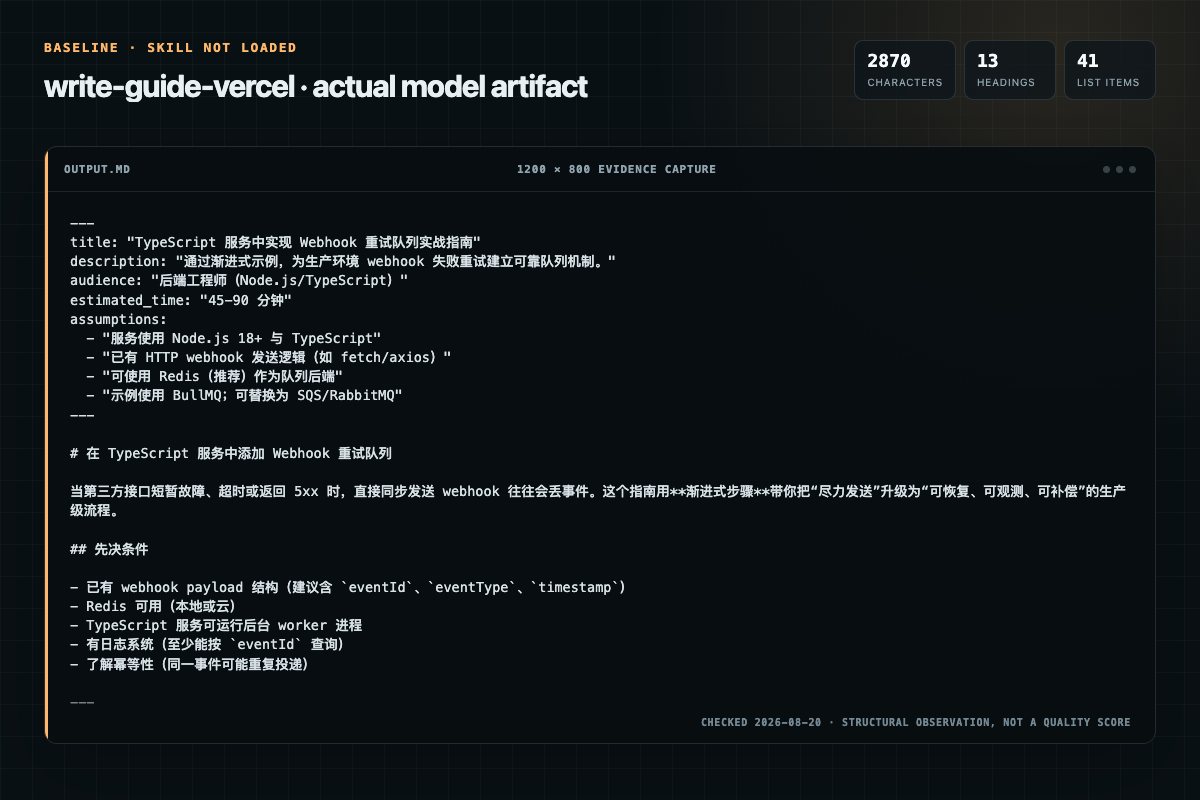
Baseline: 2870 non-whitespace characters, 13 headings, and 41 list items.
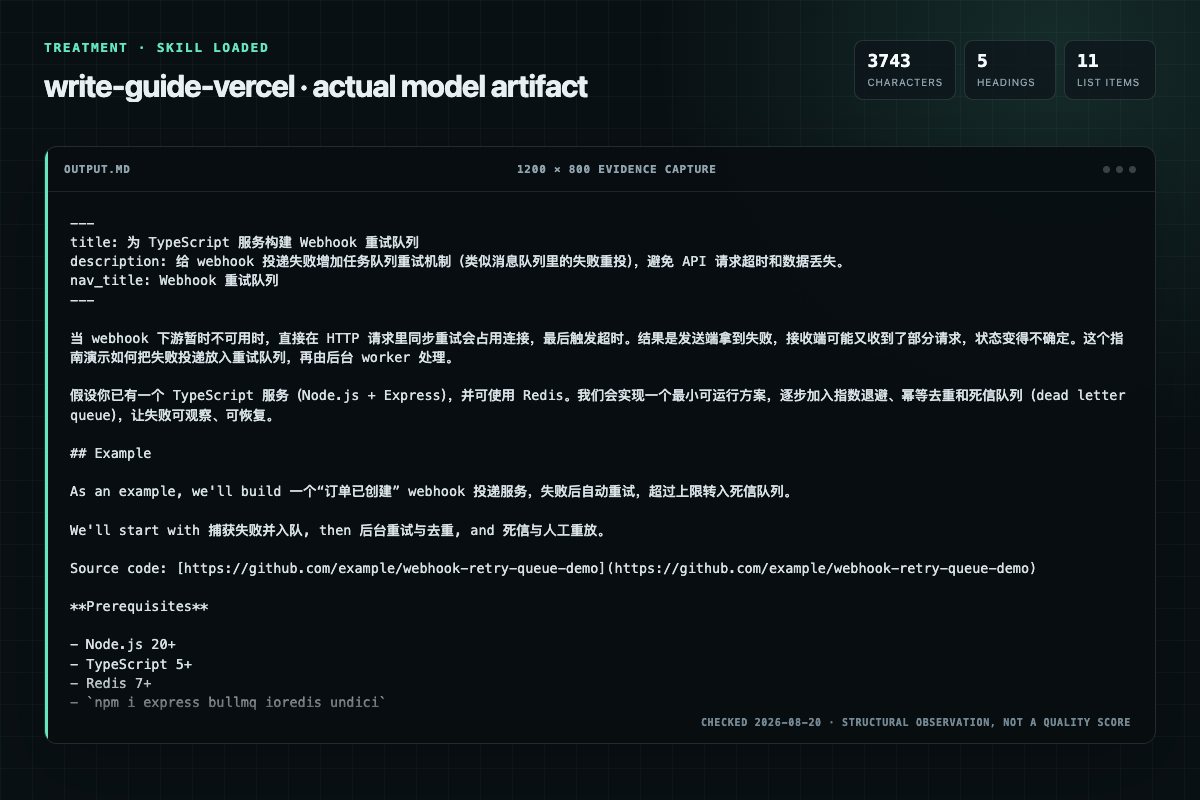
With Skill: 3743 non-whitespace characters, 5 headings, and 11 list items.
| Observation | Without Skill | With Skill |
|---|---|---|
| Source-signal coverage | 1/8: title | 3/8: guides, example, title |
| Output structure | 2870 chars · 13 headings · 41 list items · 3 code blocks | 3743 chars · 5 headings · 11 list items · 6 code blocks |
| Verification and caution signals | 18 verification signals · 4 risk/limitation signals | 19 verification signals · 3 risk/limitation signals |
Use the write-guide Skill pinned at e2fb664ceb12 for my task. Follow its source-specific constraints around `write-guide`, `writing`, `guides`, `structure`, then return the finished deliverable with explicit assumptions, verification, failure conditions, and limits. Do not treat the Skill text as a factual source or claim that a single demonstration proves universal performance.
Compatibility matrix
| Platform | Status | Evidence | What to check |
|---|---|---|---|
| Codex | Not declared | No explicit evidence | Portability before use |
| Claude Code | Not declared | No explicit evidence | Portability before use |
| Cursor | Not declared | No explicit evidence | Portability before use |
| Gemini CLI | Not declared | No explicit evidence | Portability before use |
Installation
The source command is displayed only when detected. A safe inspection prompt is always available so your agent can explain every action before execution.
npx skills add https://github.com/vercel/next.js --skill ".agents/skills/write-guide"Inspect the Agent Skill "write-guide" from https://github.com/vercel/next.js/blob/1780fa03750fe96816e90f85ad51f68cd5974f70/.agents/skills/write-guide/SKILL.md at commit 1780fa03750fe96816e90f85ad51f68cd5974f70. List every install step, command, network request, credential, file read/write, external action, and rollback step. Explain whether it fits my task. Do not install or execute anything until I approve.
Workflow
{Brief context, 1-2 sentences.}
{Same pattern: context → code → explain → friction → resolution → proof.}
Review the “Step 3: {Action-oriented title}” section in the pinned source before continuing.
1. Research: Check available skills for relevant features. Read existing docs for context and linking opportunities. 2. Plan: Outline sections. Verify scope (one problem, 2-4 steps). Each step needs a friction point and resolution. 3. Write: Follow the template above. Apply the…
Produce a technical guide that teaches a real-world use case through progressive examples. Concepts are introduced only when the reader needs them.
Permission review
No configured static risk pattern was detected
This is not proof of safety. Runtime behavior, indirect dependencies, and hidden external systems are outside the static scan.
Evidence record
| Signal | Value | Evidence type | Meaning |
|---|---|---|---|
| Quality score | 91/100 | Computed | Documentation, specificity, maintenance, and trust rules |
| Repository stars | 141,923 | Source | Repository attention, not individual Skill quality |
| Compatibility | 0 platforms | Source | Declared in the catalog source record |
| Usage guide | tested outcome page | Tested | Generated or reviewed according to the visible evidence level |
Pinned source
Produce a technical guide that teaches a real-world use case through progressive examples. Concepts are introduced only when the reader needs them.
Each guide solves one specific problem. Not a category of problems. If the outline has 5+ steps or covers multiple approaches, split it.
Every guide follows this arc: introduction, example setup, 2-5 progressive steps, next steps.
Each step follows this loop: working code → new requirement → friction → explanation → resolution → observable proof.
Sections: introduction (no heading, 2 paragraphs max), ## Example (what we're building + source link), ### Step N (action-oriented titles, 2-4 steps), ## Next steps (summary + related links).
Headings should tell a story on their own. If readers only saw the headings, they'd understand the guide's takeaway.
---
title: {Action-oriented, e.g., "Building X" or "How to Y"}
description: {One sentence}
nav_title: {Short title for navigation}
---

{What the reader will accomplish and why it matters. The friction and how this approach resolves it. 2 paragraphs max.}

## Example

As an example, we'll build {what we're building}.

We'll start with {step 1}, then {step 2}, and {step 3}.

{Source code link.}

### Step 1: {Action-oriented title}

{Brief context, 1-2 sentences.}

```tsx filename="path/to/file.tsx"
// Minimal working code
```

{Explain what happens.}

{Introduce friction: warning, limitation, or constraint.}

{Resolution: explain the choice, apply the fix.}

{Verify the fix with observable proof.}

### Step 2: {Action-oriented title}

{Same pattern: context → code → explain → friction → resolution → proof.}

### Step 3: {Action-oriented title}

{Same pattern.}

## Next steps

You now know how to {summary}.

Next, learn how to:

- [Related guide 1]()
- [Related guide 2]()
function Header() {}.| Don't | Do |
|---|---|
| "creates friction in the pipeline" | "blocks the response" |
| "needs dynamic information" | "depends on request-time data" |
| "requires dynamic processing" | "output can't be known ahead of time" |
| "The component blocks the response — causing delays" | "The component blocks the response. This causes delays." |
description and intro. Guides win or lose SERPs on the colloquial query (e.g. "next js form submission", "next js api endpoint", "next js error page"), not on the framework's preferred noun. When the guide covers a renamed or differentiated concept, include one synonym (Pages-era term, REST/web term, or industry-standard label) in the frontmatter description and once in the introduction. Fold into prose. No separate "Synonyms" or "Also known as" section.| Don't | Do |
|---|---|
| "Learn how to use Route Handlers" | "Build API endpoints (formerly API Routes) with Route Handlers" |
| "Learn how to mutate data with Server Functions" | "Submit forms and update data with Server Functions, the App Router approach to form posts and API mutations" |
Read these guides in docs/01-app/02-guides/ before writing. They demonstrate the patterns above.
public-static-pages.mdx — intro → example → 3 progressive steps → next steps. Concepts named at point of resolution. Problems shown with build output.forms.mdx — progressive feature building without explicit "Step" labels. Each section adds one capability.Frequently asked questions
Generates technical guides that teach real-world use cases through progressive examples. **Auto-activation:** User asks to write, create, or draft a guide or tutorial.
The source record exposes this install command: npx skills add https://github.com/vercel/next.js --skill ".agents/skills/write-guide". Inspect the command and pinned source before running it.
Alternatives
oaustegard/claude-skills
Generate hierarchical _FEATURES.md files that describe what a codebase DOES from a user/consumer perspective, anchored to source symbols via tree-sitting. Supports large complex codebases through feature-driven decomposition into sub-feature files. Uses a multi-pass synthesis: orientation → detail → overview rewrite. Use when someone says "what does this do", "document features", "feature inventory", "_FEATURES.md", or needs to understand a codebase's purpose before modifying it. Complements tre
PaulRBerg/agent-skills
Create/scaffold/init a project-local agent skill under `.agents/skills` in an ordinary repository; defer to repository instructions that define a source catalog and lifecycle.
NintendaDev/unikit-ai
Generate and maintain the project's TECHNICAL documentation from its codebase — scans the project structure, tech stack, and module boundaries, then writes a lean README landing page plus detailed topic pages (architecture, modules, setup, build, APIs), only the docs that are relevant. Use whenever the user wants to create, update, or validate documentation of the CODE or the project itself, e.g. "generate documentation", "create docs", "write the README", "update the project docs", "document th
Jeffallan/claude-skills
Use when building high-performance async Python APIs with FastAPI and Pydantic V2. Invoke to create REST endpoints, define Pydantic models, implement authentication flows, set up async SQLAlchemy database operations, add JWT authentication, build WebSocket endpoints, or generate OpenAPI documentation. Trigger terms: FastAPI, Pydantic, async Python, Python API, REST API Python, SQLAlchemy async, JWT authentication, OpenAPI, Swagger Python.