
Tested demoQuality 89/100
Donchitos/Claude-Code-Game-Studios/.claude/skills/asset-spec/SKILL.md
asset-spec
Generate per-asset visual specifications and AI generation prompts from GDDs, level docs, or character profiles. Produces structured spec files and updates the master asset manifest. Run after art bible and GDD/level design are approved, before production begins.
- Source repository stars
- 24,540
- Declared platforms
- 0
- Static risk flags
- 1
- Last source update
- 2026-05-21
- Source checked
- 2026-08-26
Decision brief
What it does: where it fits
This flow produces design/assets/entity-inventory.md — the master list of everything the game needs visually. Run once before asset spec work begins.
Not for
- Tasks that require unconfirmed production actions or broad system permissions.
- Environments where the pinned source and install steps cannot be inspected.
Controlled single-run demoChecked 2026-08-20
What changed when the Skill was used
In this controlled same-task single run, enabling asset-spec changed the output from 2332 non-whitespace characters and 16 headings to 2941 characters and 14 headings. Matches among 8 signals extracted from the pinned source changed from 0 to 0. Both actual outputs are shown; this is a structural observation, not a quality score or a universal performance claim.
Same test task
Create an implementation guide for adding a webhook retry queue to a TypeScript service. Include prerequisites, steps, verification, and common mistakes. The deliverable must specifically reflect this user intent: Generate per-asset visual specifications and AI generation prompts from GDDs, level docs, or character profiles. Produces structured spec files and updates the master asset manifest. Run after art bible and GDD/level design are approved, before production begins.
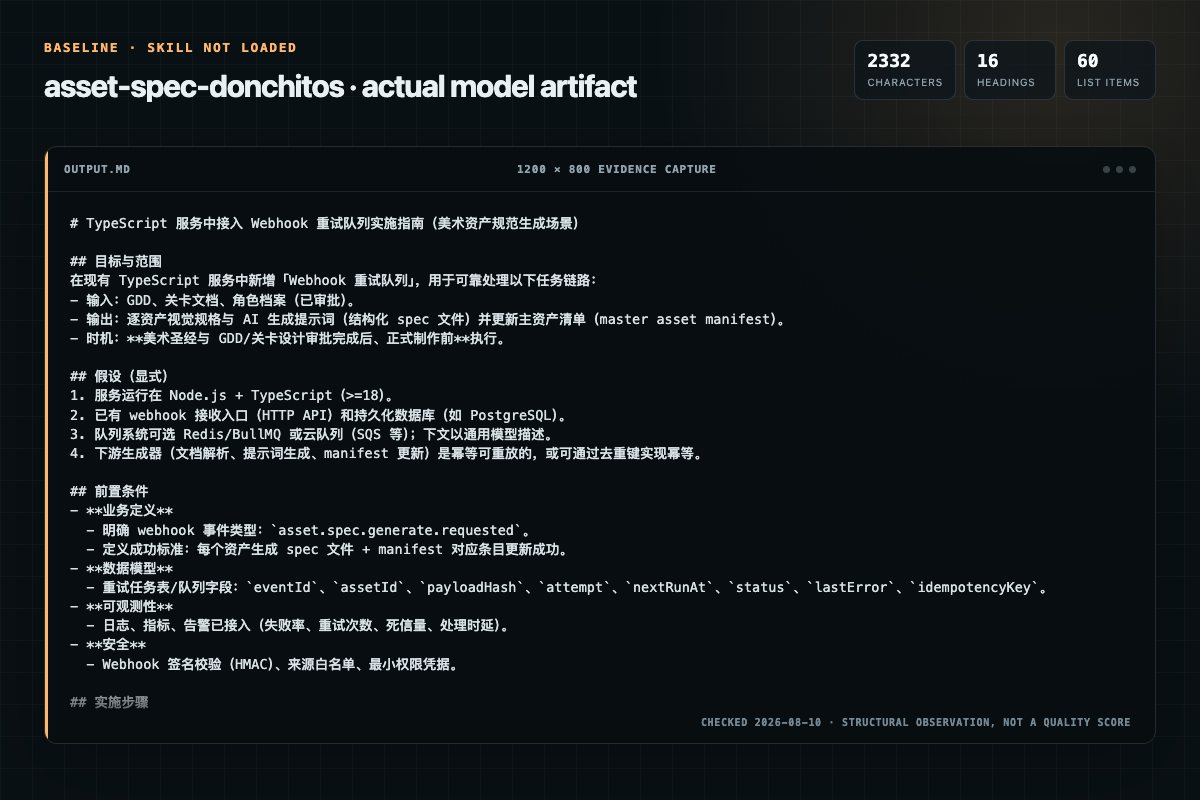
Baseline: 2332 non-whitespace characters, 16 headings, and 60 list items.
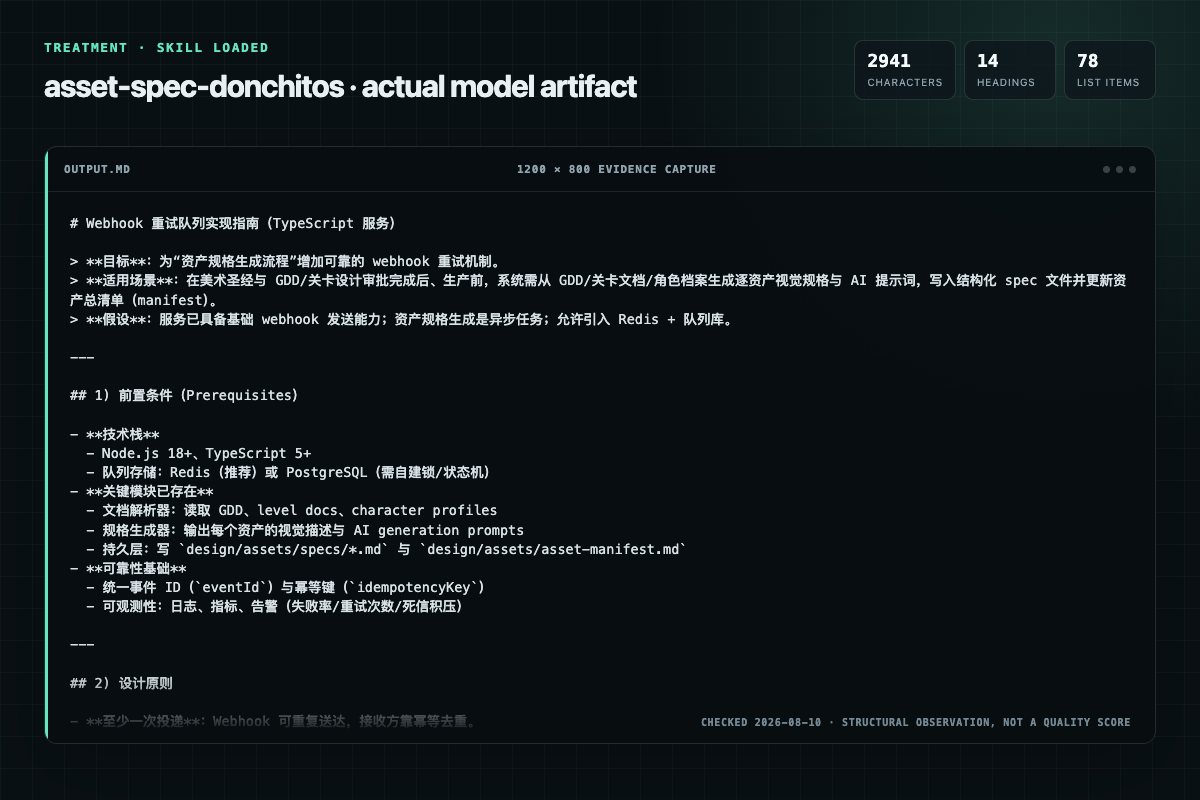
With Skill: 2941 non-whitespace characters, 14 headings, and 78 list items.
| Observation | Without Skill | With Skill |
|---|---|---|
| Source-signal coverage | 0/8: none | 0/8: none |
| Output structure | 2332 chars · 16 headings · 60 list items · 0 code blocks | 2941 chars · 14 headings · 78 list items · 0 code blocks |
| Verification and caution signals | 19 verification signals · 5 risk/limitation signals | 11 verification signals · 2 risk/limitation signals |
A prompt you can use
Use the asset-spec Skill pinned at 984023ddac0d for my task. Follow its source-specific constraints around `asset-spec`, `phase`, `entity`, `screen`, then return the finished deliverable with explicit assumptions, verification, failure conditions, and limits. Do not treat the Skill text as a factual source or claim that a single demonstration proves universal performance.
Method and limitationsExpandCollapse
Test method
- Baseline and treatment used the same task, model (gpt-5.3-codex-low), and runner; the only planned difference was whether the complete target Skill text was injected.
- The treatment used snapshot 984023ddac0d5e27624f2baacde6105e45de375f; the current source commit 984023ddac0d5e27624f2baacde6105e45de375f was verified against content hash 44d9aac03948. The baseline explicitly prohibited loading any Skill or external rule file.
- The same deterministic script counted characters, headings, lists, code blocks, verification terms, caution terms, and source signals in both artifacts. Source signals: `asset-spec`, `phase`, `entity`, `screen`, `inventory`, `arguments`, `existing`, `gather`.
- The visuals are local screenshots of the actual Markdown artifacts in a fixed 1200 × 800 evidence canvas, not recreated product mockups. Raw JSON artifacts and request records are retained in the research directory.
Do not over-read this demo
- This is one controlled demonstration per condition, not a multi-run statistical benchmark; the model is stochastic.
- Character, structure, and keyword counts show observable differences but cannot by themselves prove correctness, originality, or business impact.
- The task is a representative test designed for repeatability, not every real-world use of the Skill; rerun after a material source change.
- Editorial review
- SkillSignal editorial
- Runner
- Cursor Agent 2026.07.09-a3815c0
- Model
- gpt-5.3-codex-low
- Refresh due
- 2026-11-18
- Reviewed commit
- 984023ddac0d5e27624f2baacde6105e45de375f
- Test snapshot
- 984023ddac0d5e27624f2baacde6105e45de375f
Compatibility matrix
Platform support, with evidence labels
| Platform | Status | Evidence | What to check |
|---|---|---|---|
| Codex | Not declared | No explicit evidence | Portability before use |
| Claude Code | Not declared | No explicit evidence | Portability before use |
| Cursor | Not declared | No explicit evidence | Portability before use |
| Gemini CLI | Not declared | No explicit evidence | Portability before use |
Installation
Inspect first. Install second.
The source command is displayed only when detected. A safe inspection prompt is always available so your agent can explain every action before execution.
Source-detected install commandSource
npx skills add https://github.com/Donchitos/Claude-Code-Game-Studios --skill ".claude/skills/asset-spec"Safe inspection promptEditorial
Inspect the Agent Skill "asset-spec" from https://github.com/Donchitos/Claude-Code-Game-Studios/blob/984023ddac0d5e27624f2baacde6105e45de375f/.claude/skills/asset-spec/SKILL.md at commit 984023ddac0d5e27624f2baacde6105e45de375f. List every install step, command, network request, credential, file read/write, external action, and rollback step. Explain whether it fits my task. Do not install or execute anything until I approve.
Workflow
What the source asks the agent to do
- 01
Phase 0b: Entity & Screen Inventory (runs when no arguments and no existing inventory)
This flow produces design/assets/entity-inventory.md — the master list of everything the game needs visually. Run once before asset spec work begins.
design/gdd/systems-index.md — extract every system listedAll GDDs in design/gdd/ — extract: Visual/Audio Requirements sections, UI elements mentioned, VFX events, any named entities (characters, enemies, buildings, items)design/art/art-bible.md — extract: any named visual categories, asset type expectations - 02
Step 1 — Gather from docs
Read all available source material in parallel: - design/gdd/systems-index.md — extract every system listed - All GDDs in design/gdd/ — extract: Visual/Audio Requirements sections, UI elements mentioned, VFX events, any named entities (characters, enemies, buildings, items) - de…
design/gdd/systems-index.md — extract every system listedAll GDDs in design/gdd/ — extract: Visual/Audio Requirements sections, UI elements mentioned, VFX events, any named entities (characters, enemies, buildings, items)design/art/art-bible.md — extract: any named visual categories, asset type expectations - 03
Step 2 — Build proposed inventory
Organize everything found into categories:
Organize everything found into categories:For each item, note the source doc it was found in. - 04
Step 3 — Present and collaborate
Present the full proposed inventory to the user in conversation. Then use AskUserQuestion: - Prompt: "I found [N] visual entities and [N] UI screens across your GDDs and art bible. Review the list — what's missing, what's not needed?" - Options: - [A] Looks good — save this inve…
Prompt: "I found [N] visual entities and [N] UI screens across your GDDs and art bible. Review the list — what's missing, what's not needed?"Options:[A] Looks good — save this inventory - 05
Step 4 — Write inventory
After user approval, ask: "May I write the entity inventory to design/assets/entity-inventory.md?"
After user approval, ask: "May I write the entity inventory to design/assets/entity-inventory.md?"
Permission review
Static risk signals and limitations
Writes files
The documentation asks the agent to create, modify, or delete local files.
Write the file:Writes files
The documentation asks the agent to create, modify, or delete local files.
Options: `[A] Approve all — write to file` / `[B] Revise a specific asset` / `[C] Regenerate with different direction`Evidence record
Why each signal appears
EvidenceSourceComputedTestedEditorial
| Signal | Value | Evidence type | Meaning |
|---|---|---|---|
| Quality score | 89/100 | Computed | Documentation, specificity, maintenance, and trust rules |
| Repository stars | 24,540 | Source | Repository attention, not individual Skill quality |
| Compatibility | 0 platforms | Source | Declared in the catalog source record |
| Usage guide | tested outcome page | Tested | Generated or reviewed according to the visible evidence level |
Pinned source
Provenance and original SKILL.md
- Repository
- Donchitos/Claude-Code-Game-Studios
- Skill path
- .claude/skills/asset-spec/SKILL.md
- Commit
- 984023ddac0d5e27624f2baacde6105e45de375f
- License
- MIT
- Collected
- 2026-08-26
- Default branch
- main
View the original SKILL.md
If no argument is provided, check whether design/assets/entity-inventory.md exists:
- If it exists: read it, find the first entity or screen with status "Needed" but no spec file yet, and use
AskUserQuestion:- Prompt: "The next unspecced item is [name]. Generate specs for it?"
- Options:
[A] Yes — spec [name]/[B] Pick a different item/[C] Stop here
- If no entity inventory: check
design/assets/asset-manifest.md. If manifest exists, same flow above but reading from manifest. - If neither exists: start the Entity & Screen Inventory flow (Phase 0b below) rather than failing.
Phase 0b: Entity & Screen Inventory (runs when no arguments and no existing inventory)
This flow produces design/assets/entity-inventory.md — the master list of everything
the game needs visually. Run once before asset spec work begins.
Step 1 — Gather from docs
Read all available source material in parallel:
design/gdd/systems-index.md— extract every system listed- All GDDs in
design/gdd/— extract: Visual/Audio Requirements sections, UI elements mentioned, VFX events, any named entities (characters, enemies, buildings, items) design/art/art-bible.md— extract: any named visual categories, asset type expectationsdesign/narrative/— scan for any character or world entity documents if they exist (optional — not required)
Step 2 — Build proposed inventory
Organize everything found into categories:
Characters / Protagonists
Enemies / Creatures
Buildings / Structures
Environment / Terrain
Items / Props
VFX / Particles
UI Screens (list each screen by name)
HUD Elements
Audio (SFX, music — descriptions only, no generation prompts)
Other
For each item, note the source doc it was found in.
Step 3 — Present and collaborate
Present the full proposed inventory to the user in conversation. Then use AskUserQuestion:
- Prompt: "I found [N] visual entities and [N] UI screens across your GDDs and art bible. Review the list — what's missing, what's not needed?"
- Options:
[A] Looks good — save this inventory[B] Add items I'll describe[C] Remove items that don't apply[D] Both add and remove — let me edit
If [B] or [D]: ask the user to describe additional items. Accept brief descriptions ("a medieval keep, used as a level background") or detailed ones — either works. Work through them collaboratively until the user is satisfied.
If [C] or [D]: ask which items to remove and why. Remove them from the list.
Step 4 — Write inventory
After user approval, ask: "May I write the entity inventory to design/assets/entity-inventory.md?"
Write the file:
# Visual Entity & Screen Inventory

> Generated: [date]
> Sources: [list of source docs read]

## Entities

| # | Name | Type | Description | Source | Status |
|---|------|------|-------------|--------|--------|
| 1 | [name] | Character / Enemy / Building / Environment / Item / Other | [brief description] | [source doc] | Needed |

## UI Screens

| # | Screen Name | Description | Source | Status |
|---|-------------|-------------|--------|--------|
| 1 | Main Menu | [description] | [source] | Needed |

## HUD Elements

| # | Element | Description | Source | Status |
|---|---------|-------------|--------|--------|

## Audio

| # | Name | Type (SFX / Music / Ambient) | Description | Source | Status |
|---|------|------------------------------|-------------|--------|--------|
After writing, tell the user:
"Entity inventory saved. Next steps:
- Run
/ux-design [screen name]for each UI screen in the inventory- Run
/asset-spec entity:[name]to spec each visual entity- Or run
/asset-specagain to work through the inventory one item at a time"
Phase 0: Parse Arguments
Extract:
- Target type:
system,level, orcharacter - Target name: the name after the colon (normalize to kebab-case)
- Review mode:
--review [full|lean|solo]if present
Mode behavior:
full(default): spawn bothart-directorandtechnical-artistin parallellean: spawnart-directoronly — faster, skips technical constraint passsolo: no agent spawning — main session writes specs from art bible rules alone. Use for simple asset categories or when speed matters more than depth.
Phase 1: Gather Context
Read all source material before asking the user anything.
Required reads:
-
Art bible: Read
design/art/art-bible.md— fail if missing:"No art bible found. Run
/art-biblefirst — asset specs are anchored to the art bible's visual rules and asset standards." Extract: Visual Identity Statement, Color System (semantic colors), Shape Language, Asset Standards (Section 8 — dimensions, formats, polycount budgets, texture resolution tiers). -
Technical preferences: Read
.claude/docs/technical-preferences.md— extract performance budgets and naming conventions.
Source doc reads (by target type):
- system: Read
design/gdd/[target-name].md. Extract the Visual/Audio Requirements section. If it doesn't exist or reads[To be designed]:"The Visual/Audio section of
design/gdd/[target-name].mdis empty. Either run/design-system [target-name]to complete the GDD, or describe the visual needs manually." UseAskUserQuestion:[A] Describe needs manually/[B] Stop — complete the GDD first - level: Read
design/levels/[target-name].md. Extract art requirements, asset list, VFX needs, and the art-director's production concept specs from Step 4. - character or entity: Read
design/narrative/characters/[target-name].mdor searchdesign/narrative/anddesign/assets/entity-inventory.mdfor a matching entry. Extract visual description, role, and any specified distinguishing features.- If no source doc exists: do not fail. Instead, use
AskUserQuestion:- Prompt: "No profile found for [name]. Describe it briefly — a sentence or two is enough."
- Options:
[A] Describe it now/[B] Skip this entity/[C] Stop here - If [A]: the user's description becomes the source. Brief answers produce concise specs; detailed answers produce detailed specs. Accept whatever level of detail the user provides and work from it.
- If no source doc exists: do not fail. Instead, use
Optional reads:
- Existing manifest: Read
design/assets/asset-manifest.mdif it exists — extract already-specced assets for this target to avoid duplicates. - Related specs: Glob
design/assets/specs/*.md— scan for assets that could be shared (e.g., a common UI element specced for one system might apply here too).
Present context summary:
Asset Spec: [Target Type] — [Target Name]
- Source doc: [path] — [N] asset types identified
- Art bible: found — Asset Standards at Section 8
- Existing specs for this target: [N already specced / none]
- Shared assets found in other specs: [list or "none"]
Phase 2: Asset Identification
From the source doc, extract every asset type mentioned — explicit and implied.
For systems: look for VFX events, sprite references, UI elements, audio triggers, particle effects, icon needs, and any "visual feedback" language.
For levels: look for unique environment props, atmospheric VFX, lighting setups, ambient audio, skybox/background, and any area-specific materials.
For characters: look for sprite sheets (idle, walk, attack, death), portrait/avatar, VFX attached to abilities, UI representation (icon, health bar skin).
Group assets into categories:
- Sprite / 2D Art — character sprites, UI icons, tile sheets
- VFX / Particles — hit effects, ambient particles, screen effects
- Environment — props, tiles, backgrounds, skyboxes
- UI — HUD elements, menu art, fonts (if custom)
- Audio — SFX, music tracks, ambient loops (note: audio specs are descriptions only — no generation prompts)
- 3D Assets — meshes, materials (if applicable per engine)
Present the full identified list to the user. Use AskUserQuestion:
- Prompt: "I identified [N] assets across [N] categories for [target]. Review before speccing:"
- Show the grouped list in conversation text first
- Options:
[A] Proceed — spec all of these/[B] Remove some assets/[C] Add assets I didn't catch/[D] Adjust categories
Do NOT proceed to Phase 3 without user confirmation of the asset list.
Phase 3: Spec Generation
Spawn specialist agents based on review mode. Issue all Task calls simultaneously — do not wait for one before starting the next.
Full mode — spawn in parallel:
art-director via Task:
- Provide: full asset list from Phase 2, art bible Visual Identity Statement, Color System, Shape Language, the source doc's visual requirements, and any reference games/art mentioned in the art bible Section 9
- Ask: "For each asset in this list, produce: (1) a 2–3 sentence visual description anchored to the art bible's shape language and color system — be specific enough that two different artists would produce consistent results; (2) a generation prompt ready for use with AI image tools (Midjourney/Stable Diffusion style — include style keywords, composition, color palette anchors, negative prompts); (3) which art bible rules directly govern this asset (cite by section). For audio assets, describe the sonic character instead of a generation prompt."
technical-artist via Task:
- Provide: full asset list, art bible Asset Standards (Section 8), technical-preferences.md performance budgets, engine name and version
- Ask: "For each asset in this list, specify: (1) exact dimensions or polycount (match the art bible Asset Standards tiers — do not invent new sizes); (2) file format and export settings; (3) naming convention (from technical-preferences.md); (4) any engine-specific constraints this asset type must respect; (5) LOD requirements if applicable. Flag any asset type where the art bible's preferred standard conflicts with the engine's constraints."
Lean mode — spawn art-director only (skip technical-artist).
Solo mode — skip both. Derive specs from art bible rules alone, noting that technical constraints were not validated.
Collect both responses before Phase 4. If any conflict exists between art-director and technical-artist (e.g., art-director specifies 4K textures but technical-artist flags the engine budget requires 512px), surface it explicitly — do NOT silently resolve.
Phase 4: Compile and Review
Combine the agent outputs into a draft spec per asset. Present all specs in conversation text using this format:
## ASSET-[NNN] — [Asset Name]

| Field | Value |
|-------|-------|
| Category | [Sprite / VFX / Environment / UI / Audio / 3D] |
| Dimensions | [e.g. 256×256px, 4-frame sprite sheet] |
| Format | [PNG / SVG / WAV / etc.] |
| Naming | [e.g. vfx_frost_hit_01.png] |
| Polycount | [if 3D — e.g. <800 tris] |
| Texture Res | [e.g. 512px — matches Art Bible §8 Tier 2] |

**Visual Description:**
[2–3 sentences. Specific enough for two artists to produce consistent results.]

**Art Bible Anchors:**
- §3 Shape Language: [relevant rule applied]
- §4 Color System: [color role — e.g. "uses Threat Blue per semantic color rules"]

**Generation Prompt:**
[Ready-to-use prompt. Include: style keywords, composition notes, color palette anchors, lighting direction, negative prompts.]

**Status:** Needed
After presenting all specs, use AskUserQuestion:
- Prompt: "Asset specs for [target] — [N] assets. Review complete?"
- Options:
[A] Approve all — write to file/[B] Revise a specific asset/[C] Regenerate with different direction
If [B]: ask which asset and what to change. Revise inline and re-present. Do NOT re-spawn agents for minor text revisions — only re-spawn if the visual direction itself needs to change.
If [C]: ask what direction to change. Re-spawn the relevant agent with the updated brief.
Phase 5: Write Spec File
After approval, ask: "May I write the spec to design/assets/specs/[target-name]-assets.md?"
Write the file with:
# Asset Specs — [Target Type]: [Target Name]

> **Source**: [path to source GDD/level/character doc]
> **Art Bible**: design/art/art-bible.md
> **Generated**: [date]
> **Status**: [N] assets specced / [N] approved / [N] in production / [N] done

[all asset specs in ASSET-NNN format]
Then update design/assets/asset-manifest.md. If it doesn't exist, create it:
# Asset Manifest

> Last updated: [date]

## Progress Summary

| Total | Needed | In Progress | Done | Approved |
|-------|--------|-------------|------|----------|
| [N] | [N] | [N] | [N] | [N] |

## Assets by Context

### [Target Type]: [Target Name]
| Asset ID | Name | Category | Status | Spec File |
|----------|------|----------|--------|-----------|
| ASSET-001 | [name] | [category] | Needed | design/assets/specs/[target]-assets.md |
If the manifest already exists, append the new context block and update the Progress Summary counts.
Ask: "May I update design/assets/asset-manifest.md?"
Phase 6: Close
Use AskUserQuestion:
- Prompt: "Asset specs complete for [target]. What's next?"
- Options:
[A] Spec another system — /asset-spec system:[next-system][B] Spec a level — /asset-spec level:[level-name][C] Spec a character — /asset-spec character:[character-name][D] Run /asset-audit — validate delivered assets against specs[E] Stop here
Asset ID Assignment
Asset IDs are assigned sequentially across the entire project — not per-context. Read the manifest before assigning IDs to find the current highest number:
Grep pattern="ASSET-" path="design/assets/asset-manifest.md"
Start new assets from ASSET-[highest + 1]. This ensures IDs are stable and unique across the whole project.
If no manifest exists yet, start from ASSET-001.
Shared Asset Protocol
Before speccing an asset, check if an equivalent already exists in another context's spec:
- Common UI elements (health bars, score displays) are often shared across systems
- Generic environment props may appear in multiple levels
- Character VFX (hit sparks, death effects) may reuse a base spec with color variants
If a match is found: reference the existing ASSET-ID rather than creating a duplicate. Note the shared usage in the manifest's referenced-by column.
"ASSET-012 (Generic Hit Spark) already specced for Combat system. Reusing for Tower Defense — adding tower-defense to referenced-by."
Error Recovery Protocol
If any spawned agent returns BLOCKED or cannot complete:
- Surface immediately: "[AgentName]: BLOCKED — [reason]"
- In
leanmode or iftechnical-artistblocks: proceed with art-director output only — note that technical constraints were not validated - In
solomode or ifart-directorblocks: derive descriptions from art bible rules — flag as "Art director not consulted — verify against art bible before production" - Always produce a partial spec — never discard work because one agent blocked
Collaborative Protocol
Every phase follows: Identify → Confirm → Generate → Review → Approve → Write
- Never spec assets without first confirming the asset list with the user
- Always anchor specs to the art bible — a spec that contradicts the art bible is wrong
- Surface all agent disagreements — do not silently pick one
- Write the spec file only after explicit approval
- Update the manifest immediately after writing the spec
Recommended Next Steps
- Run
/asset-spec [next-context]to continue speccing remaining systems, levels, or characters - Run
/asset-auditto validate delivered assets against the written specs and identify gaps or mismatches
Frequently asked questions
What to verify before installation and use
What does the asset-spec source document cover?
This flow produces design/assets/entity-inventory.md — the master list of everything the game needs visually. Run once before asset spec work begins.
How do I install asset-spec?
The source record exposes this install command: npx skills add https://github.com/Donchitos/Claude-Code-Game-Studios --skill ".claude/skills/asset-spec". Inspect the command and pinned source before running it.
Which permission-related actions were detected?
Static rules flagged write-files in the source; the page lists the matching lines and excerpts.
Alternatives
Compare before choosing
Computed 100146
oaustegard/claude-skills
featuring
Generate hierarchical _FEATURES.md files that describe what a codebase DOES from a user/consumer perspective, anchored to source symbols via tree-sitting. Supports large complex codebases through feature-driven decomposition into sub-feature files. Uses a multi-pass synthesis: orientation → detail → overview rewrite. Use when someone says "what does this do", "document features", "feature inventory", "_FEATURES.md", or needs to understand a codebase's purpose before modifying it. Complements tre
Computed 9916
NintendaDev/unikit-ai
unikit-docs
Generate and maintain the project's TECHNICAL documentation from its codebase — scans the project structure, tech stack, and module boundaries, then writes a lean README landing page plus detailed topic pages (architecture, modules, setup, build, APIs), only the docs that are relevant. Use whenever the user wants to create, update, or validate documentation of the CODE or the project itself, e.g. "generate documentation", "create docs", "write the README", "update the project docs", "document th
Computed 9824,975
alirezarezvani/claude-skills
quality-manager-qms-iso13485
ISO 13485 Quality Management System implementation and maintenance for medical device organizations. Provides QMS design, documentation control, internal auditing, CAPA management, and certification support. Use when working with medical device quality systems, preparing for ISO 13485 audits, managing regulatory compliance documentation, setting up corrective actions, or building audit preparation programs. Useful for quality management, audit preparation, regulatory compliance, medical device d
Computed 982,682
compozy/compozy
bubbletea
Build terminal user interfaces with Go and Bubbletea framework. Use when creating TUI apps with the Elm architecture, dual-pane layouts, accordion modes, mouse/keyboard handling, Lipgloss styling, and reusable components. Includes production-ready templates, effects library, and battle-tested layout patterns from real projects. Don't use for plain-text CLI scripts without an interactive UI, web/desktop GUIs, or non-Go terminal frameworks (Ink, Textual, Ratatui).